Kamala Harris vs Donald Trump Campaign: The Battle of Donations


Kamala Harris vs Donald Trump Campaign Donations For US Election 2024
In today's world, large technology companies play a significant role in shaping politics, not just through their platforms but also through the financial support they provide to political candidates. Recent revelations about political donations have sparked discussions about the influence of tech giants like Google and Microsoft on U.S. elections.
On September 24, Elon Musk on US Election 2024, shared a tweet highlighting how these two tech behemoths disproportionately donate to the Democratic Party. Musk pointed out that together, Google and Microsoft control 100% of web browsers and search engines. This control, even with the best intentions, inevitably leads to concerns about bias and the impact on information people consume online.
While Musk's statement emphasizes the role of these companies in political contributions, he also subtly calls attention to the broader issue of how the monopoly over information channels, such as browsers and search engines, can shape narratives and influence voters. Whether intentional or not, the control over what information gets seen, how it's ranked, and what news gets the most visibility has serious implications for democracy.
Kamala Harris vs Donald Trump Campaign Funding: A Deeper Dive into Donations For US Election 2024
In conjunction with Musk's tweet, presents a visual breakdown of the top donor contributions to the principal campaign committees of Donald Trump and Kamala Harris (representing the Biden-Harris ticket) for the 2024 election cycle.
The chart provides an eye-opening comparison of where large corporate donations are flowing. Notably, companies like Google and Microsoft are shown to be significant contributors to Harris.
This aligns with the narrative that tech giants lean towards supporting Democratic candidates, further reinforcing Musk's claim. On the other hand, companies like Oracle and Las Vegas Sands, which have contributed heavily to Trump, suggest that certain industries remain aligned with the Republican Party, often in areas such as business, energy, and gambling sectors.
The chart further illustrates how starkly different industries support different candidates, a reflection of how business interests and political ideologies often intersect.
Here’s a table of the donations organized as Kamala Harris vs Donald Trump for the 2024 campaign cycle:
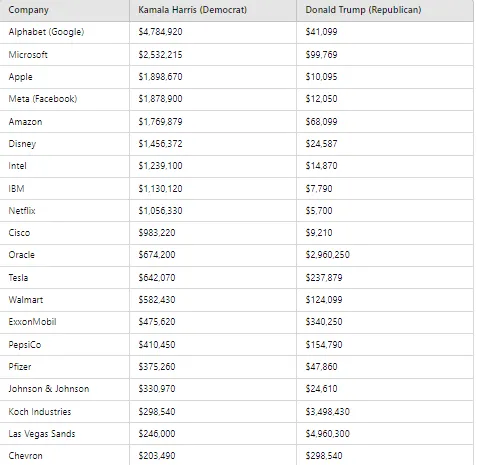
This table provides a comparative breakdown of the donations to Kamala Harris (Biden-Harris) and Donald Trump from the respective companies.
The Influence of Big Tech in Political Donations: The Broader Impact of Corporate Donations
Corporate donations in politics have long been a topic of debate, particularly in the United States where political campaigns are heavily funded by large sums of private money. This practice has drawn criticism from those who argue that it allows corporations to have an outsized influence on policy decisions and national governance.
For companies like Google and Microsoft, their support for Democratic candidates could reflect their broader business interests, such as more progressive stances on issues like climate change, net neutrality, and immigration policies.
On the other hand, contributions to Republican candidates, particularly from companies like Oracle, may represent a desire for business-friendly policies, tax breaks, or deregulation.
These contributions raise concerns about whether elected officials will prioritize the interests of the public or those of their wealthy donors. Additionally, Musk’s concern about the influence of tech companies, especially those that dominate how we access information online, underscores the potential risks when the companies that control vast amounts of data and communications favor one side of the political spectrum.
Conclusion
The role of tech giants in political donations is undeniably significant. As companies like Google and Microsoft continue to influence politics through their financial support, it’s crucial to consider the broader implications of their dominance in the tech industry. Elon Musk’s comments have once again ignited the conversation about the intersection of technology, information control, and political bias.
As we move closer to the 2024 elections, these issues will likely remain at the forefront of political discourse. Voters and policymakers alike will need to weigh the consequences of corporate donations and their impact on democratic processes. The control of information, paired with financial power, is a potent combination that requires careful scrutiny.
Read More: Trump Crypto Move: WLFI Token Launch A Boon Or Bane?