Bitget Adopts Chainlink Proof of Reserve for BGBTC Transparency


Bitget Adopts Chainlink Proof of Reserve to Boost BGBTC Transparency
Bitget, a top cryptocurrency exchange that has over 120 million users and has over $8 billion in aggregate assets. It has integrated Chainlink Proof of Reserve on Ethereum in a major step towards greater transparency and user confidence. The project will allow verifying the collateral of the wrapped Bitcoin token (BGBTC) in real-time. This article explains how Bitget empowers transparency and how Chainlink PoR works.
Bitget Empowering Crypto Transparency Through Chainlink PoR
Centralized exchanges have come under greater scrutiny after the high-profile failures of FTX exchange in 2022 revealed concealed reserve deficits and put users and investors in danger. To avert such cases, Bitget uses Chainlink PoR to make sure that collateral backing BGBTC is cryptographically verifiable and continuously tracked.
A Bitget spokesperson said, This adoption is a significant step towards restoring trust in crypto markets. Now users and platforms can confirm in near real-time that BGBTC has a full backing of Bitcoin, decreasing counterparty risk and increasing confidence in our ecosystem.
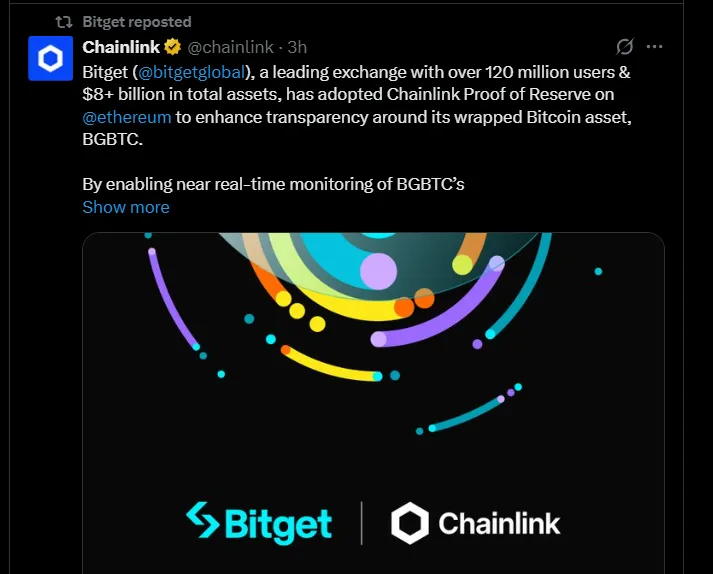
Source: Chainlink X
Chainlink Proof of Reserve explained: How it Works
Chainlink PoR is a blockchain-based system that applies cryptographic proofs to confirm the assets held in reserve. This makes sure that the wrapped tokens, such as BGBTC, are 1:1 backed by assets.
A 2023 study by the National Bureau of Economic Research found that approximately 70% of stablecoins did not have adequate reserves. These transparent and auditable reserves are essential. With the introduction of PoR, the exchange solves the issue that is prevalent in the industry and raises a new level of responsibility in centralized finance.
Impact on DeFi Platforms
The PoR adoption is significant not only to Bitget. BitVault Finance is a DeFi platform that implements BGBTC in its yield strategies. As collateral for lending vaults, it can now work more safely. Users and investors are able to track the collateralization status of BGBTC. Thus, their assets are secured.
This combination is one way of moving towards the reconciliation of centralized and decentralized finance. As noted in a 2024 Chainlink Labs whitepaper on hybrid financial systems, these models are picking up steam, as they take advantage of the liquidity and scalability of CeFi and the transparency and decentralization of DeFi.
Establishing a Standard in the Crypto Field
The decision may have an impact on other exchanges to implement such transparency. Exchanges can reduce risks, regain user confidence, and avoid fraudulent practices that have dogged the industry in the past by offering verifiable evidence of reserves.
According to crypto experts, such a tendency may open the path to a more secure and responsible financial landscape, where users feel safe using the centralized platforms and decentralized applications.
Conclusion
This adoption is an indication of an increasingly strong trend toward transparency, security, and accountability in the crypto industry. With the crypto market still developing, such an initiative is bound to become a key to creating a more secure and reliable financial environment where retail and institutional investors can feel safe. Recently, Chainlink partnered with ICE for better and advanced on-chain finance to bring reliable Forex data.