Crypto Hacks November Sees Major Exploits and Rising Web3 Losses


Crypto Hacks November Data Highlights Web3 Exploits and Security Risks
Why did Crypto Hacks November turn into one of the worst periods for digital assets this year? Investors expected a quiet end to 2025, but instead saw attackers strike exchanges, DeFi platforms and individual users in multiple ways.
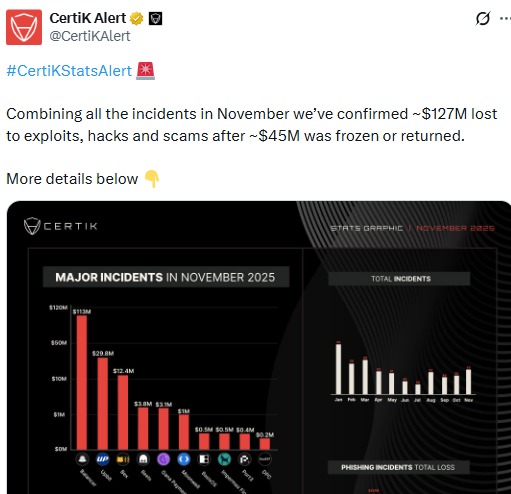
Data from CertiK and global cybersecurity groups show that criminals are becoming faster, smarter and more coordinated. With total November losses reaching $172,479,108 even after $45 million was recovered the crypto industry is facing its most complex security challenge yet.
Source: X (formerly Twitter)
Major Losses Highlight the Scale of November Attacks
According to the CertiK stats, Balancer suffered the largest exploit of the month, losing $113 million. This single event made up more than half of all exploit-based losses in Crypto Hacks November. Other major incidents included:
Upbit – $29.8 million
Bex – $12.4 million
Beets – $3.8 million
Gana Payment – $3.1 million
Code vulnerability remained the biggest threat, causing more than $130 million in losses. Wallet compromises accounted for another $33 million, while phishing attacks added over $5.8 million.
CertiK also reported that DeFi platforms were the most targeted category with $134,991,114 drained. Exchanges followed with nearly $30m lost.
Upbit Solana Hack Shakes Investor Confidence
One of the most talked-about incidents in Crypto Hacks November was the abnormal withdrawal from Upbit on November 27. Between $30m and $38 million in Solana-based tokens were sent to an unknown wallet. Upbit reacted quickly by halting activity, shifting assets to cold storage, and freezing $8.5 million worth of LAYER tokens.
Authorities are still checking whether the attack came from a private-key leak, a system flaw or an external exploit. Some analysts also suspect North Korea’s Lazarus Group, which has been linked to major breaches this year.
Yearn Finance yETH Vault Loses $9M to Price Manipulation
DeFi was hit again when Yearn Finance reported a loss of $9 million in its yETH vault. The attacker manipulated token prices and vault accounting, tricking the system into letting them withdraw more ETH than they deposited. Over 1,000 ETH was later mixed through Tornado Cash.
This incident proves that a platform can be drained even without breaking its code. Poor pricing logic and liquidity design can be just as dangerous.
Phishing Surges as North Korean Hackers Shift Tactics
A second major trend in Crypto Hacks November is the rise in spear-phishing attacks. AhnLab’s 2026 Security Outlook shows that Lazarus Group now relies heavily on targeted messages disguised as job offers, interviews or academic invitations. These scams use deep research to fool victims into sharing credentials or installing malware.
AI tools are making this problem worse. Attackers can now build emails, fake websites and deepfake videos that look real to an untrained eye. As more investors trust digital communication, phishing becomes harder to detect and far more successful.
New Malware Steals SOL Through Tiny Transfers
Another threat emerged when researchers discovered a malicious Chrome extension called Crypto Copilot. It injected a hidden second instruction into Raydium swaps, stealing small amounts of SOL usually around 0.0013 per transaction. Because the theft was tiny and hidden inside normal activity, many users did not notice. The extension remained live on the Chrome Web Store even after reports surfaced.
Conclusion
Crypto Hacks November shows that crypto risks are expanding across every corner of the ecosystem. Large exploits, silent DeFi attacks, phishing campaigns and AI-driven scams all played a part in this month’s massive losses. As attackers evolve, the industry must invest in stronger audits, safer exchange systems and better user education to avoid even bigger incidents in 2026.