Lykke crypto hack: $22.8M theft tied to Lazarus Group attack


North Korea link emerges in Lykke crypto hack, UK victims demand justi
Lykke crypto hack Linked to Lazarus Group
North Korean hackers have been accused of planning a $22.8M (£17 million) decentralised theft that led to the downfall of the platform, which is a UK registered trading platform.
The information was recently shared by the Wu Blockchain on their X handle that the theft includes Bitcoin, Ethereum and other assets. The company closed in March after going bankrupt and now Switzerland authorities are investigating its founder Richard Oslen.
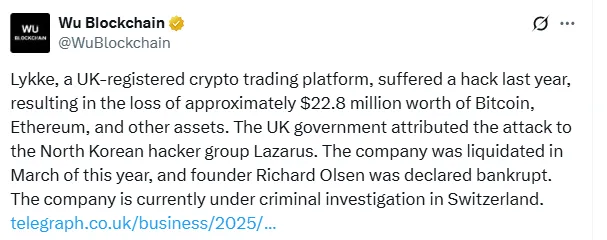
Source: X
The UK government attributed the attack to the Lazarus group, which is already infamous for funding Pyongyang's military and nuclear ambitions through cyberattacks.
According to Britain’s Office of Financial Sanctions Implementation (OFSI) the attackers targeted both Bitcoin and Ethereum networks, draining millions before routing the assets through platforms known for weak anti-money laundering controls.
Collapse of promising platform
The company was founded in 2015 that was a descendent of Swiss banking legend Julius Baer, Lykke quickly gained attention for offering zero-fee digital currency trading from Switzerland’s cryptovalley.
Despite its promising start, the firm froze operations in 2022 following the cyberattack and leaving customers unable to access their funds. The regulators had already warned that the platform lacked proper authorisation in the UK and raised questions about oversight before its collapse of the Lykke crypto hack.
Investors fight for compensation after Lykke crypto hack
According to The Telegraph, the huge loss bought more than 70 affected customers, launched a legal battle in British courts and claimed a combined loss of $7.66 million (£5.7M).
This year in March, a judge ordered Lykke to be liquidated with the Interpath Advisory appointed to distribute remaining assets. Its Swiss parent company also entered liquidation and Olsen was declared bankrupt in January.
Legal filings further reveal that he is under criminal investigation in Switzerland though he is not publicly commented.
Ongoing dispute over Liquidation
While OFSI and independent researchers such as Israeli firm Whitestream attribute the Lykke crypto hack to North Korea and some analysts caution that definitive proof remains elusive.
The laundering of stolen funds through opaque exchanges has further complicated tracing efforts. Although if it is confirmed then the incident would mark the largest North Korean linked digital currency theft from a UK company to date.
Other digital currency thefts That Shocked the World
It is not the first time that investors and the crypto world is facing cyberattacks like this, there are many more as follows:
2018 Coincheck fraud Drains $534M in NEM (XEM)
FTX Hit by $477M virtual asset theft After 2022 Collapse
2014 Mt. Gox fraud Wipes Out $460M in Bitcoin
2024 DMM Bitcoin Hack Drains $308M in BTC
WazirX in 2024 suffered a loss of around $234.9 million by Lazarus group.
To stay safe from crypto hacks and scams, always stay updated with the latest news and tricks used by scammers. Use trusted platforms, enable security features, and never share your private keys.
Conclusion
Some experts blame North Korea for the Lykke crypto hack but solid proof is still missing. If it is true then it would be the biggest crypto theft from a UK firm linked to them.