UK To Fully Regulate Crypto Firms By 2027, FCA Licensing Opens In 2026


UK New Crypto Laws Explained: FCA Licensing Gateway, Deadline, Penalty
Highlights
The UK will fully regulate cryptocurrencies firms under a new legal framework starting in October 2027.
The companies must apply for FCA Licensing approval from September 2026 to keep operating.
Existing AML or payment registrations won’t transfer automatically and must be re-approved.
The UK Is Launching a New Crypto Regulation System
The UK government is making a huge stride in increasing regulation of the industry. There is also a new regulatory framework that is being offered to place cryptoasset businesses under the same financial regulatory framework as traditional financial firms. This latest system will become operational in October 2027 and will be regulated by the Financial Conduct Authority (FCA).
The purpose is straightforward: to make the market safer, more transparent, and more reputable both to the companies and to the customers.
A Crypto Licensing “Gateway” Opens in September 2026
To help firms prepare, the FCA will open a crypto licensing application window, often called a “gateway,” in September 2026. During this period, crypto firms can apply for approval to continue operating once the new UK crypto rules kick in.
This early window gives businesses over a year to sort out their paperwork before the full regime becomes law.
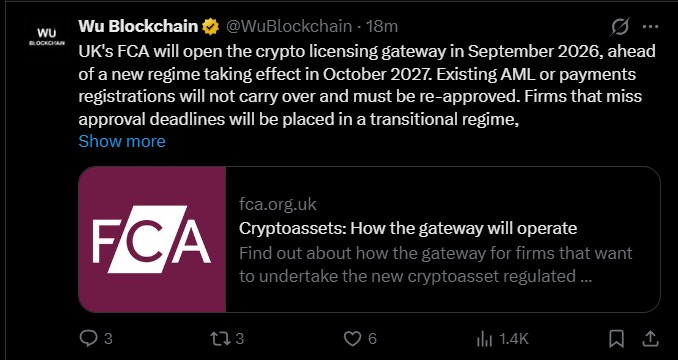
Source: Wu Blockchain
Old Registrations Will NOT Automatically Carry Over
One key detail companies need to understand is that existing registrations won’t be enough. If a company is already registered under anti-money laundering (AML) rules or payment regulations, that approval will not automatically convert into a cryptocurrency licence.
In simple terms, most firms will need to reapply or amend their permissions, even if they’re already FCA-registered.
FSMA Authorisation Becomes Mandatory
Under the new system, cryptocurrency firm must be authorised under the Financial Services and Markets Act (FSMA). Without this approval, firms won’t be legally allowed to offer crypto services to UK customers after October 2027.
Even companies that currently rely on third-party firms to approve their cryptocurrency ads will need their own FCA authorisation.
What Happens If a Firm Applies on Time?
Firms that submit applications during the official window can expect the FCA to review them before the new regime starts. If the decision takes longer, those firms may still be allowed to operate temporarily until an outcome is reached. This approach is designed to avoid sudden business shutdowns.
What Happens If a Firm Misses the Deadline?
The companies that do not attain the authorization within the deadline will be put under a transitional regime. They are only able to serve the existing customers and carry on with the existing services during this period. They are, however, unable to introduce new products, recruit new customers, and grow in the UK market.
Late Applicants Do Not Get Fast Tracked
Late applicants should not be given special treatment by companies. FCA has ensured that the delayed submissions will not be given priority reviews, and thus, the delays may affect the growth of the business.
FCA Support for Crypto Firms
The FCA will conduct information sessions and provide free pre-application meetings to assist companies in preparing. Although these meetings do not ensure approval, they assist companies in knowing what to expect and prevent expensive errors.
Why the UK Is Doing This?
The UK is interested in consumer protection, lessening financial crime, and establishing a rulebook on crypto. Simultaneously, regulators are optimistic about creating a stable, regulated cryptocurrency market that would promote responsible innovation.
Conclusion
The latest regulations in the UK are expected to purify the market, safeguard consumers, and compel companies to adhere to standards that will be a significant step towards complete regulation by 2027.
Disclaimer: This is not financial advice. Please DYOR before investing. CoinGabbar is not responsible for any financial losses. Crypto assets are highly volatile, and you can lose your entire investment.







