Can HODL Survive 2025’s Market Volatility and Tariff Fears?

Why Smart Investors Are Moving From HODLing to Short-Term Strategies
Is the HODL approach slowly losing its charm against some of the wild market swings aroused by geopolitical uncertainties? That, indeed, is the question on every investor's mind, now that tariff tensions between the US and the EU are destabilizing long-term investing. As July 9, a crucial deadline for trade negotiations, draws near, investors are faced with a tough question: to stay patient or trade the volatility?
With equity futures getting whipsawed, volatility indices shooting upward, and AI-powered trading gaining traction, the once-iron HODLing mindset is undergoing unprecedented stress. Let's explore the markets' reactions and what it might do to price action in the coming days.
EU-US Tariff Tensions Spark Shift from HODLing to Short-Term Trading
The tariff standoffs between the European Union and the United States have once again revived the very dark prospect of a trade war worldwide. Investors who had once held their assets through all the racket before are now abandoning ship and fast for more nimble, short-term strategies. The underlying cause: volatility, and a lot of it.
From Euro Stoxx 50 Futures to the S&P 500 Volatility Index (VIX), one thing has become clear from the charts: erratic price movement has taken over in the markets. Long-term positions are standing in line to be liquidated while the headlines flip and flop by the hour. Once symbolic of endurance, the HODL is equated now with taking a gamble.
Short-Term Trading Steals the Spotlight as Volatility Dethrones HODL Culture
"In today's trading environment, agility outweighs patience," Arrash Yasavolian says, CEO of the AI-powered trading platform Taoshi. "Traders refuse to take any overnight exposure. HODL strategies are suffering when policymaking headlines can nullify entire days' worth of gains within a matter of minutes."
With tariffs being imposed or removed in real time, sentiment reversal happens almost instantaneously, causing traders to focus on liquidity and flexibility and sell off HODL-style positions in favor of quick-entry-and-exit trades. Platforms like Taoshi are thus spearheading the behavioral evolution, deploying AI algorithms that monitor headlines dynamically and adjust trading strategies automatically.
EU-US Tariff Tensions Fuel Market Instability and Diminish HODL Confidence
The sticking point? Rescued tariff wars between the US and European blocks now. Without further comforting assurances from European Commission President von der Leyen, however, who found her recent conversation with President Trump ``productive,'' any resolution is now delayed until July 9.

That threw even long-term HODLers into risk-off mode. Equity benchmarks like the S&P 500 and the Euro Stoxx 50 saw growing intraday volatility. The EUR/USD incurred wild swings, and commodity prices for industrial metals subsided, as traders and long-term investors alike began reconsidering being taken into risk.
Chart Analysis: The Inverse Dance of Risk and Reward
Euro Stoxx 50 Index Futures: A Volatile Descent
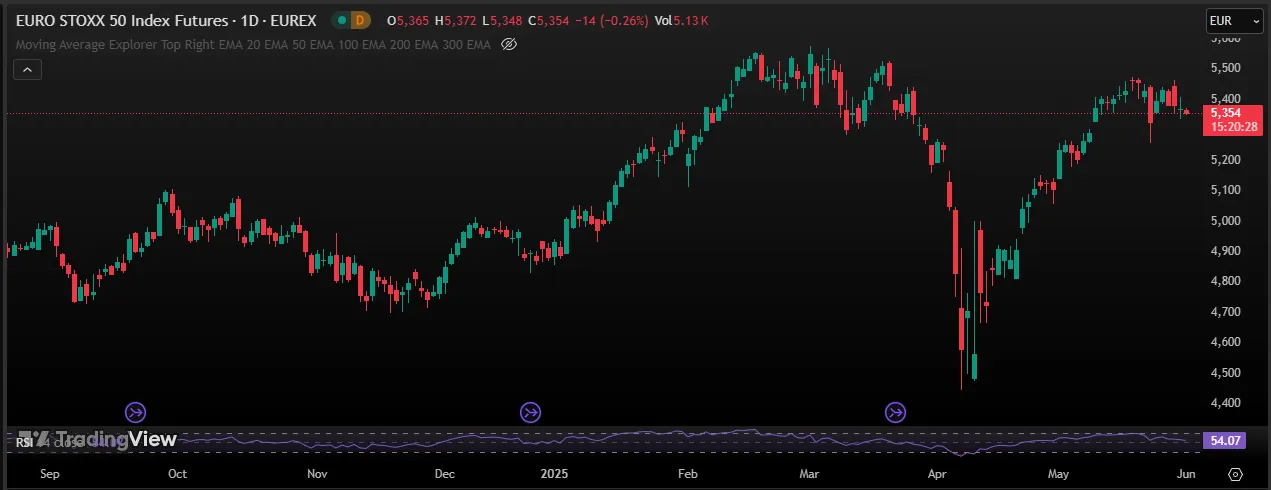
The Euro Stoxx 50 Futures chart reveals a strong inverse correlation between volatility and price. In April 2025, the index fell from above 5,500 to below 4,500 as tariff rhetoric went to full tilt. Even with a series of temporary rebounds, the chart remains highly susceptible to political developments-anathema to the passive HODL investors.
Strong resistance near 5,400 is formed.
With RSI near 54, the market is neutral but the sentiment can sway bearish on any new tariff talk.
Volatility-fed pullbacks one after the other practically walked hand in hand with tariff news and trade delay.
Source: TradingView
S&P 500 Volatility Index (VIX): Volatility Surge Mirrors Fear
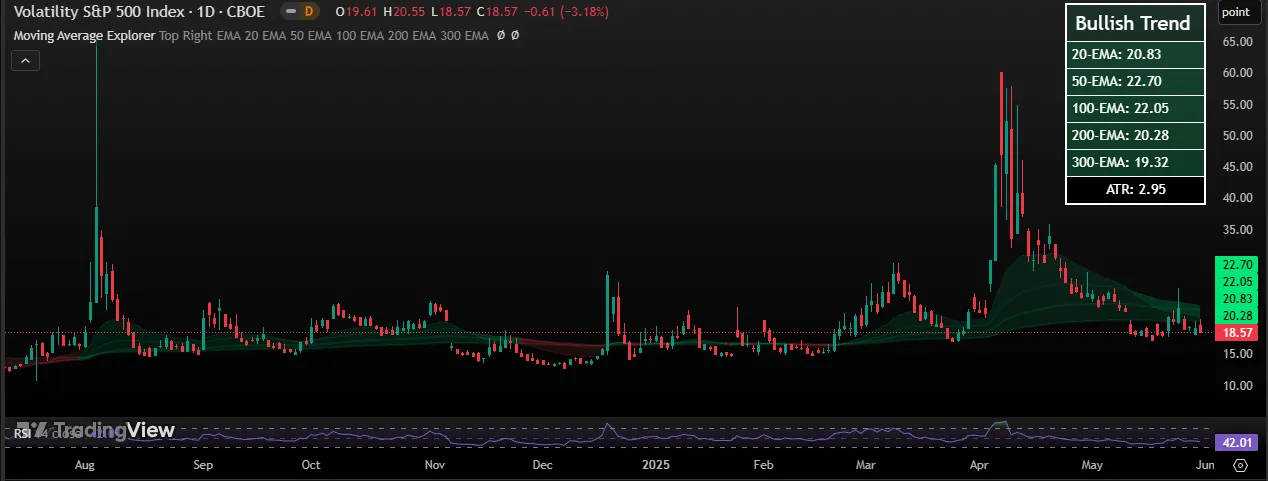
The VIX climbed above 60 in April, signaling rising fear in the markets just before the Euro Stoxx downfall-a classic case of inverse co-movement. Since then, the VIX has eased to around 18.57 but levels are still significantly higher than the levels considered safe by HODLers.
RSI at 42.01 indicates decreasing momentum-but not stability.
Every spike is accompanied by political chatter, and negotiation delays, again unfair to HODL behavior.
Source: TradingView
AI-Powered Platforms Lead the Charge in Adaptive Trading
While HODLers have kept away from trading, AI-powered trading platforms such as Taoshi are doing fine. This is one of those kinds of methods that demand no kind of clarity-a situation presented in real time, scanning the news, witnessing shifts in sentiment, and responding to that information faster than any human could.
"Agility now beats patience," continues Arrash Yasavolian. "When tariffs can wipe out a week’s worth of gains in a matter of minutes, traditional strategies are simply not working." The algorithmic power of the Taoshi software optimizes its entries and exits to changing risk parameters, giving short-term trading outperformance.
By that time, this paradigm shift toward assisting intraday trading on the machine shows how technology is altering investor behavior in 2025 and maybe forever.
Eyes on July 9: A Crucial Deadline for Market Direction
All eyes on July 9: the next milestone in EU-US negotiations. A successful resolution may bring market stability back, and perhaps along with it, faith in the HODL strategy. However, delays, if any, or a breakdown may force even diamond-hand investors to rethink their position.
Unfortunately are the days when the long-term investors keep on assessing portfolios and mostly trimming out high-risk assets. With such a backdrop, HODLers nervously look on while short-term traders rule the cast, riding waves of market news.