Why Herculis chose Telegram's network for gold tokenization

How Herculis Gold Coin Brings Swiss Gold to Telegram Users
How Herculis Gold Coin (XAUH) brings Swiss gold to Telegram's billion users through TON blockchain
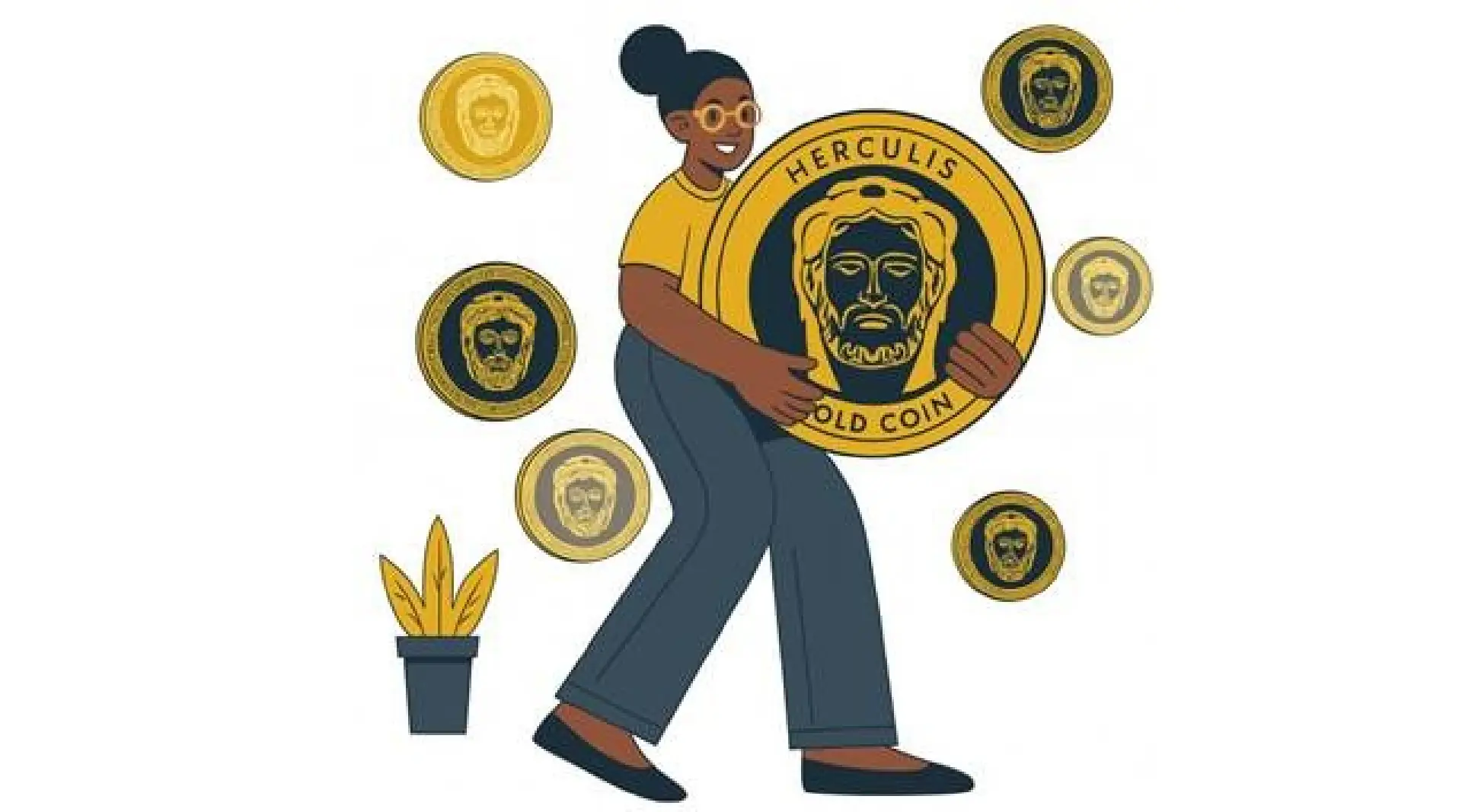
Real-world asset (RWA) tokenization has entered a new phase with the launch of Herculis Gold Coin (XAUH) on the TON blockchain, marking the first major gold-backed token designed for Telegram’s ecosystem. Each Herculis Gold Coin represents one gram of LBMA 999.9 fine gold, stored in insured vaults in Switzerland.
The choice of TON over established platforms like Ethereum represents a strategic bet on accessibility over incumbency. With Telegram's more than 1 billion monthly active users, XAUH gains instant potential distribution that no other blockchain can match.
The JAMTON advantage: Layer 2 architecture for TON and Polkadot
XAUH operates on JAMTON, a Layer 2 protocol that bridges TON and Polkadot. This architecture delivers several key advantages for a gold-backed payment token.
Transaction costs on JAMTON are minimal—just 0.02% per transfer. Traditional gold trading involves dealer commissions, storage fees, and insurance costs that can exceed 2-3% annually. Major gold ETFs charge between 19 and 40 basis points per year in custody fees alone.
Speed matters for a payment token. JAMTON processes transactions instantly, compared to the T+2 settlement standard for physical gold bars and most gold ETFs. Gold futures contracts settle at expiration dates, not on demand.
The Layer 2 design allows XAUH to leverage both TON's user base and Polkadot's security infrastructure. TON provides the distribution channel through Telegram. Polkadot provides the security guarantees through its shared validator network.
Polkadot's shared security: Economic deterrence at scale
Unlike standalone blockchains that maintain independent validator sets, JAMTON inherits security directly from Polkadot's Relay Chain. This shared security model creates economic barriers to attack that individual chains cannot replicate.
Polkadot operates under a Nominated Proof-of-Stake consensus mechanism. Validators stake DOT tokens and are subject to slashing penalties in cases of malicious activity. The aggregate value of staked DOT currently makes network compromise economically unfeasible, requiring capital commitments measured in billions of dollars.
Validator rotation prevents concentration of power. Validator assignments rotate across parachains rather than being fixed to specific chains. This rotation ensures that compromising JAMTON would require compromising the entire Polkadot network.
The security guarantees include censorship resistance, protection against double-spending, and transaction finality. For a gold-backed token where each transaction represents real value transfer, these guarantees are foundational.
Why TON over Ethereum for gold tokenization
Ethereum dominates the tokenized gold market. Tether Gold (XAUT) and PAX Gold (PAXG) both operate on Ethereum and are well-established. So why build on TON instead?
The answer lies in distribution strategy and target market. Ethereum-based gold tokens primarily serve crypto-native users who already operate within DeFi ecosystems. XAUH targets a different audience: Telegram users who may have limited crypto experience but want gold exposure.
Telegram integration removes several user-experience barriers. Users can interact with XAUH directly through Telegram wallets without downloading separate applications or navigating complex DeFi interfaces. This integration allows users to own and transfer gold with the same ease as sending a Telegram message.
Transaction costs favor TON for small-value transfers. Ethereum gas fees fluctuate based on network congestion, sometimes exceeding $50 during peak periods. For a token representing one gram of gold (approximately $80-90 at current prices), high gas fees destroy the economics of fractional ownership.
TON's transaction throughput surpasses Ethereum's base layer. While Ethereum processes roughly 15-30 transactions per second, TON's architecture enables significantly higher throughput through its multi-blockchain design. For a payment token intended for daily transactions, speed matters.
Technical infrastructure: Smart contracts and multi-signature security
The XAUH smart contracts have undergone independent third-party audits to verify integrity and security. These audits examine the contractual logic to ensure it operates as intended and resists known vulnerabilities.
Multi-signature wallets protect both customer-held and reserve assets. Transactions require approval from multiple authorized parties before execution. This structure eliminates single-point access risks that have plagued other crypto projects.
All transactions are recorded on the blockchain, ensuring immutability and full traceability. This transparency allows anyone to verify that the number of XAUH tokens in circulation matches the gold reserves held in Swiss vaults.
The gold reserves undergo quarterly audits by independent Swiss firms. These audits verify the physical gold quantities and confirm that each token is fully collateralized. Audit results are made publicly available through the Chainlink decentralized oracle network protocol.
The tokenization mechanics: From gold bar to digital token
Herculis Tokens SA operates as the customer-facing entity for primary market transactions. Customers who complete KYC verification can tokenize their LBMA 999.9 fine gold bullion from PX Precinox SA, a Swiss refinery in Neuchâtel.
The conversion ratio is straightforward: one gram equals one XAUH token. A tokenization fee of 0.3% applies to minted tokens. Customers purchasing gold directly through Herculis pay 2% for one kilogram or more, or 3% for smaller amounts. These fees cover acquisition, refining, transportation to Swiss vaults, and insurance.
Once tokenized, XAUH can be freely traded on decentralized and centralized exchanges without Herculis involvement.
Redemption for physical gold requires a minimum of 500 XAUH (500 grams), with fees of 1% for one kilogram or more and 3% for the minimum amount, excluding shipping costs.
Trading infrastructure: DEX and CEX integration
XAUH has been listed on major TON-based decentralized exchanges including STON.fi and Capital DEX. These listings provide immediate liquidity within the TON ecosystem, allowing users to trade XAUH against other TON-native tokens.
The token will also be available on centralized exchanges, expanding accessibility for users who prefer traditional exchange interfaces. Trading across multiple venues ensures that XAUH maintains liquidity across varying user preferences and regulatory jurisdictions.
Partnership with WERT.IO enables fiat onramps. Users can purchase XAUH directly with fiat currency or stablecoins like USDT and USDC. This integration removes the need to first acquire TON or other cryptocurrencies before buying gold-backed tokens.
Trading fees are determined by exchange spreads relative to the gold spot price. Unlike traditional gold markets with fixed dealer premiums, DEX trading allows for price discovery through automated market makers and liquidity pools.
Market context: Gold's 6,200% gains since 1973
Gold has appreciated from approximately $2 per gram in 1973 to over $140 per gram in 2025, representing gains exceeding 6,200% over five decades. Recent geopolitical instability and banking crises like the 2023 U.S. regional bank failures and Credit Suisse collapse have accelerated demand, with central banks in Russia, China, India, and Turkey becoming net buyers.
Traditional gold ownership presents significant barriers. Physical gold requires secure storage and insurance, while gold futures demand large capital commitments ($320,000 per 100-ounce contract). Major gold ETFs charge annual custody fees of 19-40 basis points, meaning a $100,000 position incurs $190-400 yearly.
XAUH eliminates recurring custody fees entirely. After the initial tokenization or purchase fee, holders pay nothing for storage or insurance. The gold remains in Swiss vaults, fully insured and audited, at no ongoing cost to token holders.
Regulatory framework: Panama compliance and global reach
Herculis Tokens SA operates in compliance with AML and CFT regulations as established by the Financial Analysis Unit (UAF) of the Republic of Panama.
KYC verification is mandatory for primary market participants who tokenize gold or redeem XAUH for physical gold, aligning with international standards for preventing money laundering and terrorist financing.
Secondary market trading on exchanges falls under each platform's terms and conditions. Decentralized exchanges allow peer-to-peer transactions without KYC requirements in many jurisdictions, while centralized exchanges implement their own compliance procedures.
Panama's payment token classification allows XAUH to operate as a means of payment and value transfer without securities regulation constraints that apply in some jurisdictions.
Implications for the TON ecosystem
The launch of XAUH is the first big real-world asset token on TON. It shows that the TON blockchain can handle advanced financial products that need strong security, clear tracking, and reliable payments.
For the TON ecosystem, XAUH also opens new opportunities. People may use it as collateral in DeFi apps to borrow or lend money backed by gold. Liquidity pools with XAUH, stablecoins, or TON could also help users earn rewards. In the future, Telegram payments may allow users to send gold-backed payments as easily as sending a message.
XAUH will also compete with gold tokens already running on Ethereum. Ethereum has more users and bigger liquidity, while TON offers lower fees and easier access. But TON still needs to prove it can stay secure and reliable as more users join.
What Could Happen Next for Gold Tokens on TON
Herculis plans to make XAUH more useful by adding it to more DEXs, listing it on major exchanges, and partnering with DeFi platforms for lending and borrowing. If XAUH succeeds, it could lead to more real-world assets coming to TON, including real estate, commodities, and even art.
In the end, adoption will matter most. Can XAUH attract people who never owned gold before? Can it convince gold investors to move away from ETFs or physical gold? The answers to these questions will decide whether TON becomes an important platform for real-world asset tokenization or stays a small experiment.
Also read: