BDAG Tokenomics Explained: Supply, Vesting and Unlock Rules

BDAG Tokenomics Breakdown: 150B Supply, Vesting Schedule and Unlocks
Understanding BDAG tokenomics starts with one simple question: how will BDAG coins enter the market over time? A project can promote a big supply cap and still face pressure later if too many coins unlock too fast.
That is why readers need more than a headline number. They need to understand allocation, vesting, lockups, and scarcity tools.
In BlockDAG’s case, the top-line figure is easy to follow.
The project says BDAG has a maximum supply of 150 billion coins. From there, the real story moves to distribution. The token model includes a large miner allocation, a major presale bucket, a smaller team share, and a phased vesting plan.
Source: BlockDag Network
This makes BDAG tokenomics an important topic for anyone trying to assess future supply pressure, market stability, and long-term design.
What Does BDAG Tokenomics Cover?
At its core, tokenomics is the economic structure of a crypto asset. It explains how many coins exist, who gets them, when they unlock, and what systems are in place to control supply.
For BDAG, that means looking at five main areas: total supply, presale allocation, miner rewards, team lockups, and vesting.
Together, these shape how coins move from paper allocation into real circulation. That is where BDAG tokenomics becomes more useful than simple marketing language. It helps readers separate total supply from circulating supply, which is often the number that matters most after launch.
A fixed maximum supply can support scarcity. Still, if large amounts of coins unlock early, price pressure can rise. So in this case, BlockDAG tokenomics is really about both supply and release timing.
How the 150 Billion BDAG Supply Is Split?
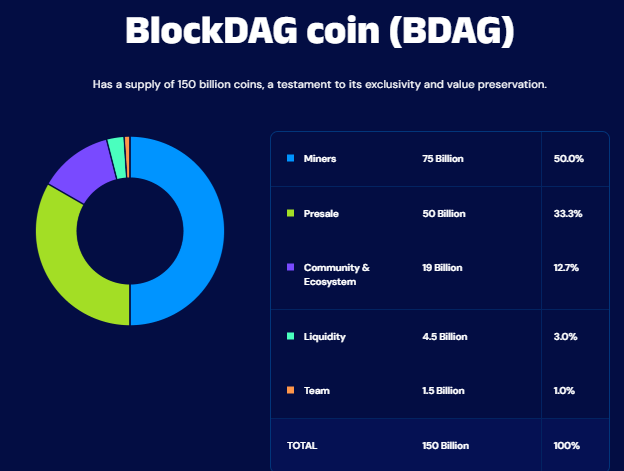
BlockDAG says its total supply is capped at 150,000,000,000 coins. That supply is divided into five major buckets.
Miners: 75 billion coins — 50%
Presale: 50 billion coins — 33.3%
Community and Ecosystem: 19 billion coins — 12.7%
Liquidity: 4.5 billion coins — 3.0%
Team: 1.5 billion coins — 1.0%
This split gives a quick view of BDAG tokenomics. The biggest share goes to miners, showing that mining rewards are meant to support network growth over time. The next largest share goes to presale buyers, which makes the token release schedule especially important.
BlockDAG also groups miners, community and ecosystem, and liquidity into a wider 98.5 billion coin community allocation.
So while BlockDag presale holds a large share, most of the supply is still tied to network support and ecosystem growth.
The 50 billion BDAG presale allocation, or 33.3% of total supply, deserves close attention because it can affect early market pressure.
In BDAG tokenomics, the key issue is not just how much is allocated, but how those tokens unlock.
A phased release can help reduce sudden sell pressure, which is why vesting is such an important part of the model.
BDAG Vesting Schedule Explained
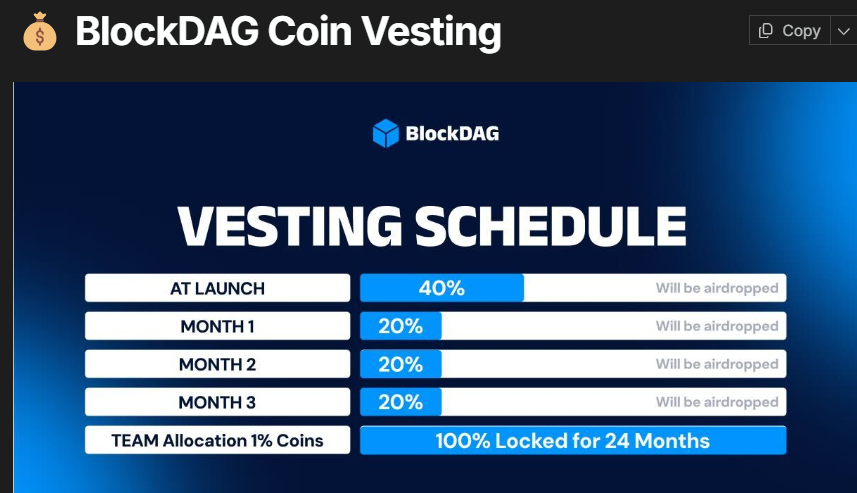
The official material lays out a clear vesting plan for presale coins purchased during the presale. The release schedule is:
At launch: 40%
Month 1: 20%
Month 2: 20%
Month 3: 20%
This means presale buyers do not receive all of their purchased tokens at launch. Instead, the release is staggered over four stages. That kind of structure is common in crypto because it aims to reduce sudden post-launch oversupply.
Source: BlockDAG Wiki
In practical terms, BDAG tokenomics uses vesting as a stability tool. A phased release can reduce the shock of a full day-one unlock. It also gives demand more time to develop while supply enters the market gradually.
The effect, of course, depends on real conditions after BDAG launch. Even a phased vesting plan cannot fully prevent volatility. Still, it is more controlled than an immediate full release.
Presale Coins and Bonus Coins Follow Different Rules
One useful detail in BDAG tokenomics is that not all presale-related coins follow the same release model. The project draws a line between presale coins bought directly and bonus-related coins.
Presale coins bought directly have:
no lockup before vesting starts
40% released at launch
20% released per month for three months
Presale bonus coins, including bonuses, giveaways, rewards, prizes, or similar extra allocations, have:
a 12-month lockup
linear vesting over 12 months after that
That difference matters. It means direct buyers receive part of their allocation relatively early, while bonus-linked supply is delayed much longer. From a market view, that could reduce early oversupply from promotional or reward-based token distribution.
This is one of the stronger points in the BDAG tokenomics structure because it separates core purchased supply from extra reward supply.
Team Allocation and 24-Month Lock
BlockDAG has set aside 1.5 billion BDAG tokens, or 1% of total supply, for its team.
These coins are locked for 24 months, which means they cannot be sold or moved during that period.
In BDAG tokenomics, this helps reduce fears of early insider selling and shows a stronger focus on long-term project growth.
Community, Liquidity, and Market Support
BlockDAG Network also allocates 19 billion BDAG for community and ecosystem growth and 4.5 billion BDAG for liquidity.
The community share is meant to support education, events, and platform development, while the liquidity pool is designed to improve trading conditions.
In BDAG tokenomics, these allocations matter because market stability depends not only on unlocks, but also on liquidity and ecosystem support.
Is There a Real Burn Mechanism?
This article covers supply, vesting, and burn mechanics, but the material provided does not clearly describe an active BDAG burn model. What it does clearly describe is:
a fixed max supply of 150 billion
annual halving events
staggered vesting
long lockups for bonus and team allocations
So based on the available material, BDAG tokenomics appears to rely more on capped supply, halving, and controlled unlocks than on a fully documented burn system. That is an important distinction for accuracy.
A burn mechanism permanently removes tokens from circulation. A supply cap limits how many can ever exist. Vesting controls when they unlock. Halving slows the pace of future issuance. These are related ideas, but they are not the same.
Final Take
Overall, BDAG tokenomics looks structured around supply control rather than fast token release. The model combines a fixed 150 billion supply, a large miner allocation, a one-third presale share, phased unlocks, delayed bonus vesting, and a two-year team lock.
The strongest confirmed scarcity tools here are the capped supply, annual halving, and staged release schedule. The burn side is less clear from the material provided.
That means the best way to read BDAG tokenomics is with balance: the framework looks designed to reduce immediate sell pressure, but real outcomes will still depend on execution, circulating supply, and how the unlock schedule plays out in the live market.
YMYL Disclaimer: This article is for informational purposes only and does not constitute financial or investment advice. Always verify official BlockDAG tokenomics details and assess the risks before making any crypto decision.









.webp)




