Crypto Press Release Distribution for Institutional Era (2026)


How Crypto Press Release Distribution Is Reshaping 2026
This article is for educational purposes only. Crypto markets, regulations, and media standards change frequently. Information mentioned here is approximate and should not be interpreted as financial, legal, or investment advice. Each project should consult appropriate professionals for its own situation. Nothing here should be interpreted as a recommendation to pursue any particular strategy.
Introduction: The Communication Shift in Crypto’s Institutional Phase
In the evolving crypto ecosystem of 2026, technology is no longer the only factor shaping whether a project is taken seriously. Increasingly, how information is communicated, discovered, and verified plays a decisive role in how projects are perceived by partners, platforms, and institutional participants.
Over the past two years, the structure of the market has changed. Spot ETFs, corporate treasury adoption, and a rise in mergers and acquisitions have pushed crypto deeper into traditional financial and corporate environments.
According to multiple industry reports published during 2025, crypto-related M&A activity reached its highest levels to date, while ETF products became a primary gateway for institutional exposure.
This is where crypto press release distribution has gradually changed its role. It is no longer just a promotional channel. For many teams, it now functions more like part of the information and credibility infrastructure around a project.
This guide explains what that means in practice, how this process works, when it is typically used, where it fails, and what its realistic limitations are, using observations and patterns from the 2025–2026 market environment.
What Is Crypto Press Release Distribution
At a basic level, crypto press release distribution refers to the process of publishing and syndicating official project announcements through established crypto and financial news networks rather than only on a project’s own channels.
In practice, this usually involves:
Structuring announcements in a standardized, media-readable format
Distributing them through crypto and financial news ecosystems
Ensuring they are indexed, archived, and searchable over time
This is different from simply posting updates on a blog, Medium, or social channels. Owned channels are useful, but they do not create the same third-party reference layer that external stakeholders rely on when doing research.
Related terms often used in this context include:
Blockchain PR
Crypto announcements
Crypto news distribution
Press release SEO impact
Blockchain project publicity
All of these point to the same underlying goal: making important information discoverable, verifiable, and persistent outside a project’s own ecosystem.
How This Evolved: From 2021 to 2026
What communication looked like in 2021
During the 2020–2021 cycle, most projects relied on:
Twitter, Telegram, Discord
Influencer amplification
Community-driven narrative momentum
This worked because the market was dominated by retail speculation and fast-moving attention cycles.
What changed by 2025–2026
By 2025–2026:
Institutions entered via ETFs and structured products
Corporate teams began evaluating crypto like any other vendor, partner, or acquisition target
According to ETF flow trackers and market coverage in early 2026, some days saw several hundred million dollars in net inflows into crypto ETFs, showing how different the capital base now is
Key difference vs last cycle:
In 2021, attention created credibility.
In 2026, credibility must exist before attention.
Why Institutional Adoption Changes the Rules
Why do institutions ignore social channels?
Institutional evaluation rarely starts in Discord or Telegram. It usually starts with search and third-party references.
From an institutional perspective, if a project cannot be independently researched, it is difficult to justify spending time on it.
A simplified comparison looks like this:
Retail-Focused Signals | Institutional-Focused Signals |
Social engagement | Search visibility |
Influencer mentions | Reputable media references |
Community sentiment | Archived announcements |
Short-term narratives | Consistent historical record |
This is one reason crypto PR for institutional visibility has become a distinct and more formalized activity rather than just an extension of marketing.
How Crypto Press Release Distribution Works in Practice
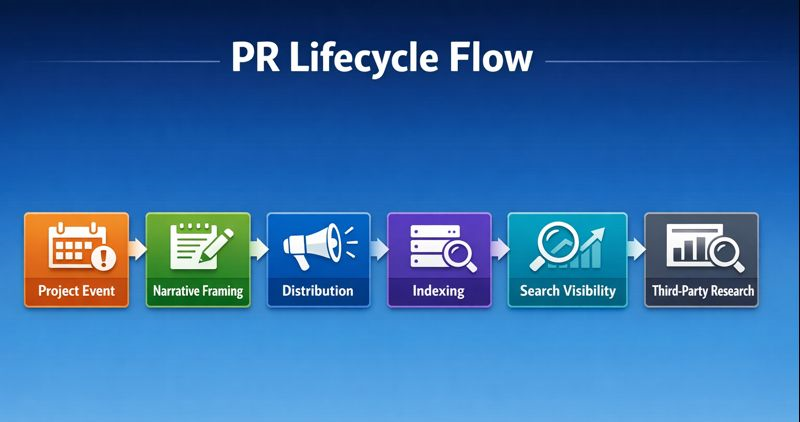
A typical institutional-grade workflow often looks like this:
Event selection: The team decides whether something is materially relevant: product launch, partnership, governance change, treasury update, or structural milestone.
Narrative framing: The information is written in neutral, verifiable language rather than promotional language.
Drafting: The announcement is structured in a standard press release format that third parties can easily understand.
Review and risk checks: Many teams now review language for regulatory sensitivity and misinterpretation risk.
Distribution strategy: Decisions are made about which regions, platforms, and categories are relevant.
Syndication and pickup: The release enters news ecosystems and becomes available to be referenced.
Long-term indexing: The announcement becomes part of the project’s persistent public information footprint.
When Projects Commonly Use Professional Distribution
In practice, teams most often use professional crypto press release distribution for:
Presale or token launch announcements
Mainnet or major product launches
Strategic partnerships
Exchange listings
Fundraising or treasury-related updates
Governance or structural changes
If You Are a Presale Team vs a Growth-Stage Team
If you are a presale or early-stage team
The main use is establishing a third-party narrative footprint
You are often unknown outside your own community
The goal is not hype, but legibility
If you are a growth-stage or scaling team
The main use is maintaining narrative consistency
You are already known, but information is often fragmented
The goal is documentation and credibility maintenance
Benefits and Limitations: A Balanced View
Potential Benefits | Realistic Limitations |
Improves discoverability | No guaranteed pickup or editorial coverage |
Creates third-party reference footprint | Weak substance often leads to minimal or zero impact |
Supports credibility signaling | Many 2025 campaigns saw no meaningful coverage despite syndication |
Helps narrative consistency | Poorly framed announcements can be ignored or rejected |
Contributes to long-term search presence | Adds cost, time, and coordination overhead |
Even with distribution, weak or uninteresting announcements often produce little or no result. Syndication does not make something newsworthy.
Common Reasons Professional Distribution Underperforms (2025–2026 Patterns)
The announcement lacks real newsworthiness
Overly promotional language triggers editorial rejection
Targeting is too broad or unfocused
No supporting assets (audits, vesting charts, documentation)
Teams focus on short-term buzz instead of long-term indexing
These are not theoretical issues. They are practical workflow, perception, and documentation problems.
Two Realistic Mini Case Studies
Case 1: The Invisible Presale
A presale team in 2025 had strong community traction and a working product demo. However, during partnership discussions, the counterparty could not find any third-party references about the project.
The team had announcements only on Medium and social channels. They paused outreach, rebuilt their narrative trail through proper distribution, and only then resumed discussions.
Case 2: The Inconsistent Growth Story
A growth-stage protocol has been active since 2022. By 2026, its public story was fragmented across blog posts, old interviews, and outdated docs. During due diligence for a strategic partnership, the other side flagged narrative inconsistencies. The team spent months standardizing and documenting key milestones through structured announcements.
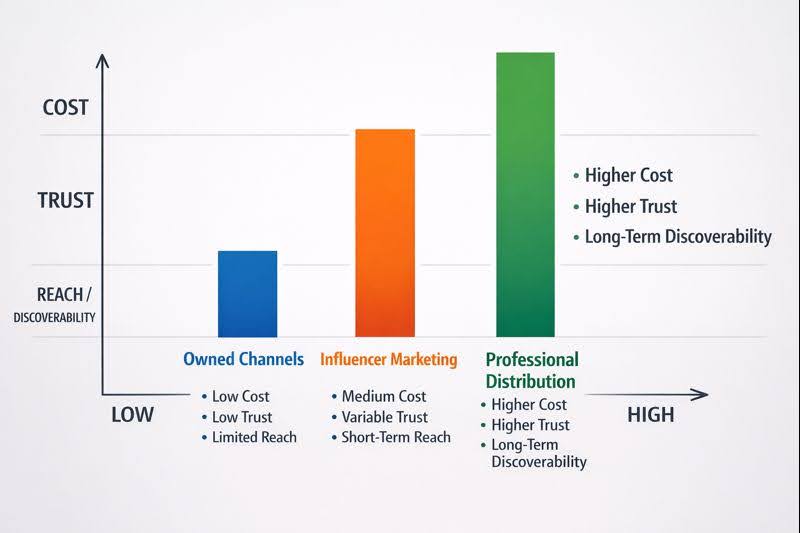
Comparing Communication Channels
Market, Regulatory, and Execution Realities
It is important to be explicit:
Communication does not replace product execution
Distribution does not create demand by itself
Regulations and enforcement priorities change
Poor communication can increase risk
This is one reason blockchain PR is increasingly treated as something closer to compliance than pure promotion.
Conclusion: A Tool, Not a Guarantee
The 2025–2026 period has made one thing clearer: crypto is no longer only an experimental technology sector. It is part of the broader financial and corporate information environment.
In that environment, crypto press release distribution functions mainly as a way to make projects legible to external researchers, partners, and institutions.
Understanding this layer can help teams make better decisions about timing and communication. However, outcomes will always depend on much more than distribution alone. Professional distribution is only one tool among many, and its effectiveness varies by project quality, market conditions, and regulatory shifts.
Also read: