DeepSnitch AI Crypto Fraud Detection for Wallet and DeFi Risk

How DeepSnitch AI Uses Machine Learning for Crypto Fraud Detection?
Crypto fraud rarely appears through one obvious warning. It usually builds through smaller signals. A wallet starts moving funds. Liquidity weakens. A contract carries risky permissions. Social channels begin repeating the same narrative.
DeepSnitch AI presents itself as a platform built to connect those signals. In its official whitepaper, the project describes itself as an AI-powered blockchain tracking platform that aims to reduce “information asymmetry” by giving retail users faster access to actionable intelligence. It says the platform uses five AI agents to monitor on-chain activity, social behaviour, contract security, and predictive market signals.
That is the core idea behind Deepsnitch ai crypto fraud detection. Instead of reviewing one token metric at a time, the platform is designed to combine machine learning, graph analytics, and multi-source monitoring into one system.
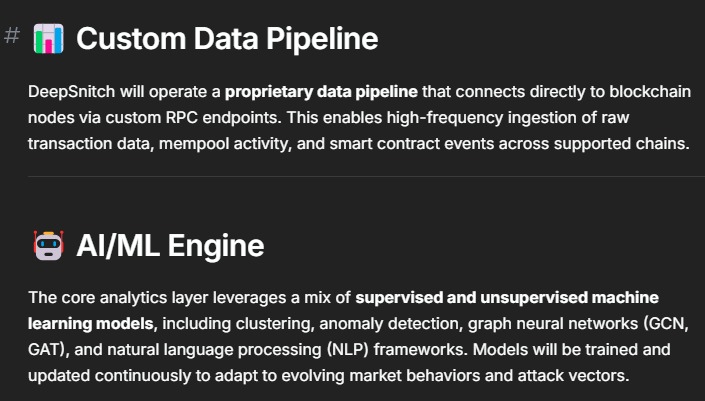
Its technology overview says the stack uses custom data pipelines, AI and ML models, and off-chain integrations to process blockchain and social data together.
Source: DeepSnitch AI Docs
Why Machine Learning Matters?
Manual crypto research still has limits. A user may check token holders, study liquidity, scan social posts, and read a contract. That process can help, but fraud campaigns often move faster than manual review.
DeepSnitch AI says its analytics layer uses:
supervised and unsupervised machine learning
clustering models
anomaly detection
graph neural networks such as GCN and GAT
natural language processing frameworks
In practice, those tools can support fraud detection in several ways:
Anomaly detection can flag wallet or transaction behaviour that does not match normal activity.
Clustering can group related wallets or transactions that may be acting together.
Graph analysis can map relationships between wallets, contracts, and fund movement.
NLP can track social hype, repeated messaging, and abrupt sentiment swings.
This makes deepsnitch ai crypto fraud detection a pattern-recognition framework, not just a token scanner.
The Five-Agent Structure
DeepSnitch AI’s documentation says the platform is organised around five specialised agents. Each covers a different part of the security and intelligence workflow.
SnitchFeed
SnitchFeed focuses on social and sentiment monitoring. The official summary says it tracks on-chain transactions and social media activity in real time. That matters because manipulative tokens often show narrative changes early, before the wider market reacts.
SnitchScan
SnitchScan is the token-risk layer. The project says it screens new tokens using on-chain data, developer activity, contract age, LP lock ratio, and rug-risk flags. This is one of the clearest parts of Deepsnitch ai crypto fraud detection because it targets the structural signals many DeFi users look for before entering a position.
SnitchGPT
SnitchGPT is presented as a research assistant that helps users understand blockchain data in simpler language. It is less directly tied to fraud detection than SnitchScan or AuditSnitch, but it supports due diligence by making technical data easier to interpret.
SnitchCast
SnitchCast is listed in the whitepaper as part of the platform’s information flow layer. In security terms, this matters because suspicious token activity often spreads through transaction data and community channels at the same time.
AuditSnitch
AuditSnitch is the contract-risk component. The official page says users can enter a contract address and receive an automated safety analysis with a simplified trust score or verdict. This is especially relevant in DeFi, where many losses come from harmful contract design rather than from large exchange hacks.
How Fraud Pattern Detection Works
The main strength of Deepsnitch ai crypto fraud detection is its attempt to combine several weak signals into one clearer risk picture.
A risky token may show:
unusual wallet clustering
weak or unlocked liquidity
suspicious developer activity
repeated social promotion
contract settings linked to rug-pull or honeypot risk
One signal alone may not confirm fraud. Several signals together can change the assessment.
DeepSnitch AI describes a system built to correlate on-chain behaviour with off-chain narrative shifts. That approach fits the structure of many crypto scams, which are rarely purely technical or purely social.
Wallet Monitoring and DeFi Security
Wallet monitoring is one of the clearest practical use cases. The project says it is designed to monitor on-chain transactions in real time and give retail users intelligence that was previously harder to access.
From a security angle, wallet monitoring can help identify:
early accumulation by connected addresses
suspicious movement into or out of liquidity pools
insider selling before broader awareness
repeated wallet patterns across multiple risky tokens
This matters even more in DeFi. Users there interact directly with smart contracts and liquidity pools. A token can look active while still carrying serious risks.
Common DeFi danger areas include:
hidden sell restrictions
dangerous owner permissions
weak liquidity protection
copied contracts with small malicious edits
hype-driven launches with poor safeguards
DeepSnitch AI’s product descriptions suggest it wants to address that gap through token screening, contract analysis, trust scoring, and early warnings.
Infrastructure and Current Rollout
The official technology overview says DeepSnitch AI uses a proprietary data pipeline connected to blockchain nodes through custom RPC endpoints. It also says the platform ingests mempool activity and smart contract events, combines that with social-media intelligence, and uses privacy-focused architecture such as AES-256 encryption.
That is an ambitious framework on paper.
At the same time, the whitepaper also warns that the project relies on complex AI development and that features may differ from those described or may not be fully realised.
Its recent rollout has also faced operational friction. CoinGabbar reported that after the March 31, 2026 Uniswap launch of $DSNT, some users reported failed claims, token visibility issues, low liquidity, and “No routes available” swap errors. A later update said the team opened a vesting portal and told users to use their presale wallet and official links when claiming.
Final Assessment
DeepSnitch AI’s official materials describe an early-stage crypto intelligence platform built around machine learning, graph analytics, token screening, wallet monitoring, and contract-risk analysis. Those are all relevant functions for fraud detection in modern DeFi markets.
The remaining question is execution. A detailed whitepaper can explain the design well, but long-term value depends on platform reliability, usable alerts, and consistent real-world performance after launch.
Disclaimer: This article is for educational and informational purposes only. It is not financial, legal, or investment advice. Crypto assets and early-stage token projects carry high risk, including liquidity risk, technical uncertainty, and possible loss of capital. Readers should verify official links, review contract details independently, and conduct their own research before making any financial decision.
Also read: