New Stablecoin Rules and Impact on Crypto Projects 2026


How New Stablecoin Rules Are Changing Crypto Projects
New Stablecoin Rules have become a major policy issue for crypto projects in 2026. Stablecoins are no longer being treated only as trading tools. Regulators now view them as payment products that may need reserve standards, licensing, redemption rights, and compliance controls. This shift is affecting issuers, exchanges, wallets, payment apps, and other crypto businesses.
Why New Stablecoin Rules Matter in 2026
The global approach to stablecoins is becoming more defined. The United States is moving ahead with a federal framework for payment stablecoins under the GENIUS Act. Treasury said the law applies Bank Secrecy Act treatment to permitted payment stablecoin issuers and requires anti-money laundering and sanctions controls. The OCC has also opened rulemaking tied to licensing, registration, and supervision.
At the same time, the broader CLARITY Act debate adds more context. The bill is part of the wider U.S. effort to define digital asset regulation, but recent reporting shows that disagreements over stablecoin rewards and yield-linked products remain a key sticking point. That issue matters because stablecoins are increasingly used beyond payments, including in apps, exchanges, and incentive systems.
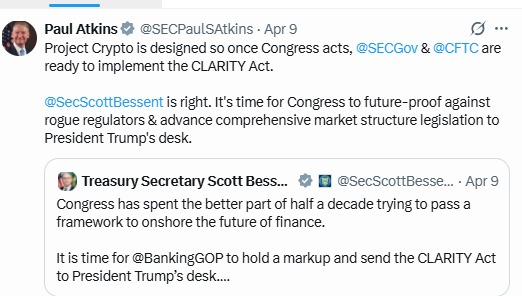
Source: Paul Atkins X Account
Main Areas Covered by New Stablecoin Rules
Current New Stablecoin Rules focus on a few core areas:
Reserve backing: what assets support the stablecoin
Redemption rights: whether holders can redeem 1:1 into fiat
Licensing: whether the issuer is authorized in a specific market
Compliance: AML, sanctions, and disclosure obligations
Rewards and incentives: whether yield-like features are allowed
These issues now shape how crypto projects design products and enter new markets.
United States: GENIUS Act and CLARITY Act Context
In the U.S., New Stablecoin Rules are now closely tied to two policy tracks.
GENIUS Act
Genius Act is the main stablecoin-specific framework. Treasury said it creates a federal structure for payment stablecoins and places issuers under financial crime compliance obligations. The OCC’s rulemaking process is part of implementing that structure.
CLARITY Act
This bill is broader and focuses on digital asset market structure. However, it still matters for stablecoins because the current debate includes whether crypto firms should be allowed to offer stablecoin-linked rewards or returns. Reuters reported that this remains one reason broader talks have slowed.
For crypto projects, this means stablecoin compliance is no longer limited to issuance. Product features also face scrutiny.
Europe: MiCA Is Already Setting the Standard
In Europe, New Stablecoin Rules are shaped by MiCA. ESMA says MiCA creates a uniform framework for crypto-assets across the EU, including rules for disclosure, authorization, and supervision. The EBA has also made clear that issuers of asset-referenced tokens and e-money tokens must hold the proper authorization.
This gives the EU a more structured approach than markets still debating their final framework. For crypto projects, MiCA matters because access to the European market now depends more clearly on legal classification and issuer status.
Project Examples Linked to New Stablecoin Rules
Several major projects show how New Stablecoin Rules are already shaping market positioning.
Circle and USDC
Circle states that USDC is backed 100% by highly liquid cash and cash-equivalent assets and redeemable 1:1 for U.S. dollars. Circle also says USDC and EURC are MiCA compliant in the EU through its regulated European entity. This makes Circle a strong example of a compliance-led model.
PayPal USD
PayPal states that PYUSD is backed by U.S. dollar deposits, Treasuries, and similar cash equivalents. It also says PYUSD is issued by Paxos and supported on Ethereum, Solana, Arbitrum, and Stellar. This structure shows how established payment brands are using regulated issuer partnerships.
Tether’s USA₮
Tether announced USAT in January 2026 as a federally regulated dollar-backed stablecoin designed for the U.S. framework under the GENIUS Act, with Anchorage Digital Bank involved as issuer. This suggests that even large global players now see a need for market-specific regulated products.
Hong Kong and Switzerland Add Global Pressure
Outside the U.S. and EU, New Stablecoin Rules are also advancing quickly.
Hong Kong
The HKMA announced on April 10, 2026, that it granted stablecoin issuer licences under the Stablecoins Ordinance to Anchorpoint Financial Limited and HSBC. This marks a clear move from testing into formal licensing.
Switzerland
FINMA has warned that stablecoin arrangements raise risks tied to money laundering, sanctions, and reputational harm. At the same time, Reuters reported that six Swiss banks are testing use cases for a Swiss franc stablecoin. This shows a mix of regulatory caution and active financial-sector interest.
What Crypto Projects Should Assess?
For projects using stablecoins in payments, treasury, settlement, or platform incentives, the key questions are:
What assets back the stablecoin?
Is redemption clearly defined?
Which entity issues the token?
Is the issuer licensed in target markets?
What AML and sanctions controls apply?
Could rewards or incentives face restrictions?
These questions now influence launch plans, partnerships, and product design.
Conclusion
New Stablecoin Rules are becoming a core part of crypto market structure in 2026. The U.S. is implementing the GENIUS Act while the CLARITY Act debate continues to affect the treatment of rewards and related products. Europe is already operating under MiCA. Hong Kong has started licensing issuers, and Switzerland is combining risk oversight with bank-led experimentation. For crypto projects, stablecoin strategy now depends on legal structure, reserves, redemption, and compliance readiness.
YMYL Disclaimer: This article is for informational purposes only and does not constitute legal, financial, or investment advice.
Also read: