Pepeto vs Little Pepe Launch Date — One Missed, One Has No Date


Pepeto vs Little Pepe Risks Every Investor Should Know
Which is actually safer — a project that sets a launch date and misses it, or one that never sets a date at all?
That question is not rhetorical right now. It describes exactly where Pepeto vs Little Pepe stand today — two of the most-watched presales of 2026. One promised April 30. April 30 came and went. The other built a smart contract that fires automatically, with no human trigger, no warning, and no second chance. Both have raised tens of millions. Both are still in their presale window. But their launch mechanics could not be more different — and the difference matters enormously for your capital.
This is not financial advice. Here is the full picture.
The Numbers First—Where Both Projects Stand Today Pepeto vs Little Pepe
Before comparing models, look at the raw data from both dashboards as of May 23, 2026.
Metric | Pepeto ($PEPETO) | Little Pepe ($LILPEPE) |
Presale Raised | $10,171,018 | $28,190,424 |
Hard Cap | $10,507,555 | $28,775,000 |
% Complete | ~96.8% | 98.46% |
Current Price | $0.0000001866 | $0.0022 (Stage 13) |
Next Stage Price | Auto TGE triggers | $0.0023 |
Official Launch Date | None—smart contract | April 30, 2026 — missed |
Listing Status | TGE imminent | Still no exchange confirmed |
Vesting | Claims open at TGE | 0% at TGE, 3‑month cliff, 5% monthly |
Staking APY | 172% | Offered—rate varies |
Chain | Ethereum | Ethereum Layer 2 |
Both projects are within striking distance of their hard caps. Both have attracted real capital. The divergence is entirely in how they handle the finish line.
Pepeto—The "Day of Judgment" Model
Pepeto never published a calendar launch date. That was a deliberate design choice—not a communication failure.
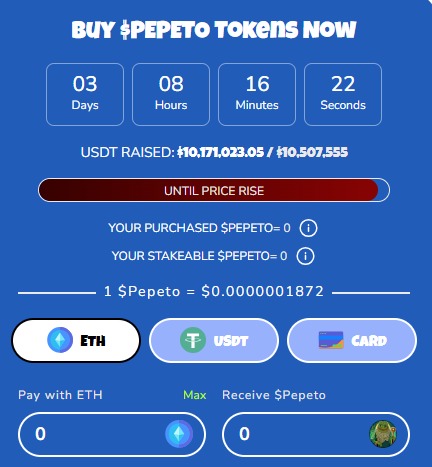
Pepeto is not going to post a launch date. The TGE fires when the last presale token sells—automatically, through the smart contract, with no human trigger required. The team calls it the Day of Judgment. As of May 21, 2026, the presale has raised $10.13 million against a hard cap of approximately $10.32 million. The remaining gap is under $200,000. At the current daily inflow velocity, that gap closes within days — not weeks. When it closes, the buy window shuts off permanently.
Source: Official Account
The countdown on pepetocoin.com showed $10,127,127.47 raised out of a $10,428,057 hard cap as of May 20, 2026. Only $300,930 remains. When that last token sells, the pepeto debut fires automatically. No tweet. No warning. No second chance.
This model has a specific investor psychology built into it. There is no hype moment to manufacture. No countdown clock to pump social media. The TGE is purely mechanical—supply sells out, the smart contract executes, and tokens are generated.
In late April 2026, the original Pepeto website was compromised in a domain-level attack. The team announced the incident publicly on X within hours and migrated all operations to PepetoSwap.com the same day. The presale continued without a confirmed slowdown. Fundraising velocity held through the incident.
A domain hack is the highest-pressure operational test a pre-launch team faces. Transparency, speed, and continuity—the Pepeto team delivered all three. That behavior tells you more about operational competence than any white paper.
30% of total supply is reserved for presale buyers, and another 30% is locked for staking rewards—meaning 60% of supply is either in buyer wallets or locked for staking incentives at launch. Staking APY for presale participants is listed at 172%, a figure reflecting early-stage incentive structures common in presale meme coin projects.
The risk in this model: no confirmed exchange names as of May 2026. Binance listing discussions are reportedly under way — but treat it as unconfirmed until an official announcement appears. Without a named exchange, you are entering a TGE without knowing where liquidity opens.
Little Pepe — The Missed Date Model
Little Pepe chose the opposite approach. Set a date. Build community momentum around it. Launch on the day.
Except it didn't.
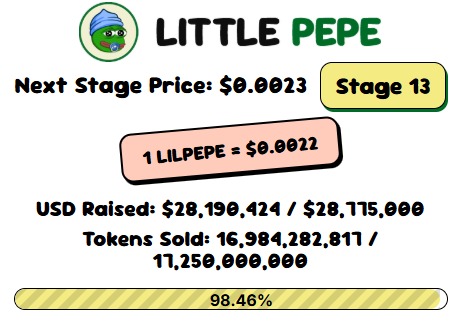
Little Pepe set April 30, 2026, as its official launch date, confirmed across its X account and presale page. Community excitement hit its peak that week. April 30 came and went. No Uniswap. No Binance. No Coinbase. Just silence.
The project has a history of hits and misses. It launched the presale at $0.001 in June 2025. It delivered every price increase across 13 stages. However, the whitepaper promised a mainnet launch in Q1 2026. That did not happen. Most recently, the team missed the April 30 listing.
The reason given for the delay is actually coherent. Several major exchanges had already approved LILPEPE, but larger Tier-1 platforms are still completing due diligence as of May 2026. Rather than listing only on smaller exchanges and losing the momentum that a major CEX announcement would carry, the team deliberately paused the broader rollout.
Source: Official website
Waiting for a Tier-1 exchange instead of rushing to list on a smaller platform is a mature decision. Most meme coin teams would have listed anywhere to generate buzz. Little Pepe chose patience. That is either discipline or delay—and only the exchange announcement will settle which.
Little Pepe has one of the most investor-protective vesting structures among 2026 presale tokens. 0% unlocks at TGE, followed by a three-month cliff, then 5% monthly release over 20 months. In practice, this means that not a single presale token can be sold on listing day. All open-market sellers in the first 90 days are new buyers—not early investors taking profits.
That vesting structure is genuinely unusual and genuinely protective. Day-one dump risk is structurally eliminated for 90 days. The flip side: CoinMarketCap currently shows LILPEPE's circulating supply as 100 billion tokens. The project's own vesting page states 20 billion at launch. That 5x gap inflates every market cap figure you'll see online. Watch the supply numbers carefully before calculating any price target.
Which Model Is Actually Safer?
Here is the honest comparison where it matters most.
Risk Factor | Pepeto | Little Pepe |
Launch date missed | N/A — no date set | Yes — April 30 missed |
Exchange transparency | No names confirmed | No names confirmed |
Smart contract risk | Auto-triggers—no warning | Manual listing dependent |
Day-one dump risk | Moderate—no lock | Low—3-month cliff |
Team stress test | Passed — domain hack response | Partial—delayed, communicated |
Supply clarity | Clear — 60% locked | Disputed — CMC vs whitepaper |
Fundraising momentum | Still flowing near hard cap | Stalled at 98.46% for weeks |
Neither project is clean. Neither is a clear fraud signal. Both have raised real money from real buyers. But the risk profiles are different.
Pepeto's risk: You don't know when it launches or where. The TGE could fire tomorrow and list on a DEX with thin liquidity. No warning.
Little Pepe's risk: One missed date is manageable. Two missed dates—Q1 mainnet and April 30 listing—start a pattern. And a 5x circulating supply discrepancy between CMC and the whitepaper is a number every investor must resolve before buying.
The safest model is the one with the clearest post-launch liquidity plan. Right now, neither project has published that. That is the real missing information.
Three Scenarios—What Happens Next
Scenario 1—Pepeto Fires First, Lists on Binance: Hard cap fills in the next few days. TGE executes automatically. The CMC page goes live. Binance listing confirms. Early buyers who missed the window chase the price. PEPETO spikes on day one. Stakers hold, reducing sell pressure.
Scenario 2—Little Pepe Gets Its Tier-1: The team's patience pays off. A Binance or Coinbase listing drops. LILPEPE goes live with massive retail reach. The 3-month vesting cliff prevents a dump. Price discovers at a significant premium to the $0.0022 presale price. The 141% move on LBank with minimal exposure shows what pent-up demand looks like when it hits limited liquidity—a major CEX multiplies that effect significantly.
Scenario 3—Both List Quietly, Both Correct: Neither secures a Tier-1 exchange. Both are listed on smaller DEX venues. Initial volume is thin. Presale buyers are underwater. The meme coin cycle moves to the next project. Long-term holders wait for the next market cycle.
Conclusion
One project gave you a date and missed it. The other gave you no date and is about to fire without warning. Neither approach is perfect. But here is what matters more than the launch model: what happens on day two, day ten, and day ninety. Vesting schedules, exchange depth, and team execution after listing are what separate a winning presale from an expensive lesson. Both Pepeto vs Little Pepe have real money behind them. Whether that money grows depends on decisions neither team has fully communicated yet. Track the exchange announcements — not the countdown clock.








.webp)