Xenea Wallet Review 2026: Features, Rewards, DAO And Storage

Xenea Wallet Review With Rewards, DAO, Storage And Key Features
The Xenea wallet has grown from a rewards-first app into a broader Web3 gateway. It now combines wallet access, multi-chain support, reward activities, and ecosystem participation in one product. For readers arriving through daily quiz searches, that shift matters.
A proper Xenea wallet review now needs to cover not only rewards, but also utility, on-chain access, and how the wallet fits into Xenea’s wider roadmap.
At the product level, the biggest leap came with XENEA Wallet 2.0, released on May 28, 2025. Xenea says this update added on-chain functionality, turned the app into a full Web3 wallet, and enabled token transfers plus dApp interaction.
The wallet’s initial chain support includes Ethereum, Polygon PoS, BNB Chain, and the Xenea public testnet, which gives the Xenea wallet more practical use than a simple task-and-rewards app.
What Is Xenea Wallet?
It is positioned as the user-facing access layer for the broader Xenea ecosystem. Xenea describes it as a wallet that supports asset management, on-chain interaction, and ecosystem participation.
In the project’s July 2025 AMA summary, the team also framed the wallet as a gateway for participating in nodes and earning incentives, which is a useful way to understand its role. It is not the entire project by itself. It is the access point into the wider Xenea environment.
The wallet is meant to connect users with the project’s chain, future rewards, and participation flows rather than act only as a passive storage app.
Xenea Wallet Features
The strongest feature set comes from Wallet 2.0. Xenea says the wallet supports social login, a simplified interface for beginners, token sending and receiving, and dApp connectivity.
It also highlights patented MPC technology, which is used to deliver a non-custodial design without requiring users to manage seed phrases or private keys directly in the usual way. That makes the wallet easier to approach for newer users while still being positioned as a Web3 wallet.
Multi-chain support is another important point. The official product update says the wallet supports Ethereum, Polygon PoS, BNB Chain, and the Xenea public testnet.
That means one Xenea wallet can cover both general Web3 actions and project-specific ecosystem activity. For a pillar review page, this is one of the strongest value points because it moves the wallet beyond campaign traffic and into broader use.
DAO And Ecosystem Participation
The DAO angle should be handled carefully. Connect the wallet to participation, voting, and broader ecosystem functions, while the 2026 roadmap says wallet-related flows are part of the ecosystem being technically finalized before mainnet.
In particular, Xenea lists wallet connection and reward-claim flows as part of end-to-end public testnet testing in Phase 3.
So, in a practical sense, the Xenea wallet is best described as a participation layer. It gives users a route into future governance-linked and reward-linked activity, even if the final DAO stack is still developing.
On-Chain Storage And Xenea’s Core Vision
A strong Xenea wallet review should also explain what the project is trying to build. Xenea says it is building a blockchain for verifiable AI and describes its long-term infrastructure around decentralized storage and auditable data provenance. The roadmap specifically mentions future strengthening of the chain’s file system and deeper integration with DACS after mainnet.
That matters because the it is not being marketed as only a token wallet. It sits inside a larger data, storage, and participation model. For users who arrive through quiz traffic, this is often the missing piece. The wallet makes more sense when viewed as part of Xenea’s long-term infrastructure story rather than as a standalone app.
Rewards, Gems, And Daily Quiz Traffic
Rewards remain one of the biggest reasons people discover the Xenea wallet. Xenea’s official Gems guide says users can earn Gems through activities such as the daily quiz, daily check-ins, surveys, streaks, and invites.
The same update says future incentives may include $XENE airdrops and Mining Passports, depending on contribution level and reward season.
That makes the rewards system more important than it first appears. The daily quiz may bring traffic in, but the broader rewards structure is what keeps users inside the ecosystem.
In this sense, the wallet acts as both an engagement tool and a funnel into future token-linked incentives.
Important Xenea Wallet Developments
Recent development updates strengthen this review without taking over the whole article.
First, Xenea’s March 12, 2026 roadmap says Phase 5 mainnet launch is targeted for Q2 to Q3 2026, depending on the completion of earlier phases. That gives the wallet more relevance because it is being positioned as part of the production-ready ecosystem.
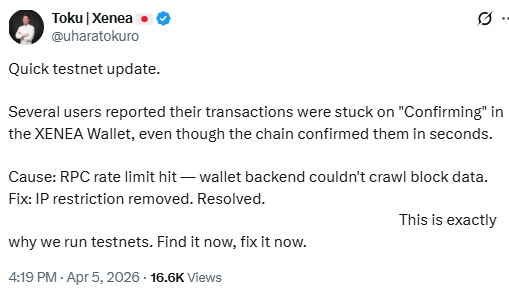
Second, Xenea launched Ubusuna, its public testnet, on April 2, 2026. The company says users and developers can connect a wallet, get test tokens, and start building. That gives the wallet a live ecosystem role today, not just a future promise.
Source: X Account
Third, the rollout was not friction-free. Xenea published migration issue reports after Wallet 2.0 launched and later said version 2.0.4, released on July 7, 2025, significantly improved usability. That is worth including because a balanced Xenea wallet review should note both feature growth and product refinement.
Pros And Cons Of Xenea Wallet
Pros
Non-custodial MPC-based design
Social login and beginner-friendly onboarding
Multi-chain support
Real utility through rewards, dApps, and public testnet access
Clear connection to the wider Xenea ecosystem
Cons
Some ecosystem functions are still being finalized before mainnet
Product rollout has experienced migration and usability issues
Long-term value still depends on roadmap execution and mainnet delivery
Final Verdict
The Xenea wallet is more than a quiz-driven rewards app. It is now a Web3 wallet with multi-chain support, reward mechanics, dApp access, and a growing role in the Xenea ecosystem. Its strongest value comes from how it connects users to rewards today and to testnet, wallet flows, and future mainnet participation over time.
For a full Xenea wallet review, the conclusion is straightforward: the wallet is strongest when viewed as an ecosystem gateway. It already has real utility, and its long-term appeal will depend on how well Xenea turns current momentum into a stable mainnet, stronger participation features, and clearer user incentives.
Also read:









.webp)




