How the Aave Will Win Proposal Transforms DeFi Revenue Models

Aave Will Win Proposal redirects product revenue
What changes when a DeFi token starts to represent not only protocol fees but also the wider business built around it? That is the key question behind the Aave Will Win Proposal, which passed over the weekend and quickly became the main driver of the latest token rally. Founder Stani Kulechov described it as the most important vote in the protocol’s history, while market data showed the token trading near 94.77 dollars, up 5.54% in 24 hours.
 Source: X(formerly Twitter)
Aave Will Win Proposal ends a long DAO dispute
The Aave Will Win Proposal matters because it closes a governance fight that had been building for months. The tension started after concerns emerged that some interface-related swap fees were no longer flowing to the DAO treasury. That raised a deeper question inside the protocol: who truly controls the economic value created by its products, the DAO or the development team?
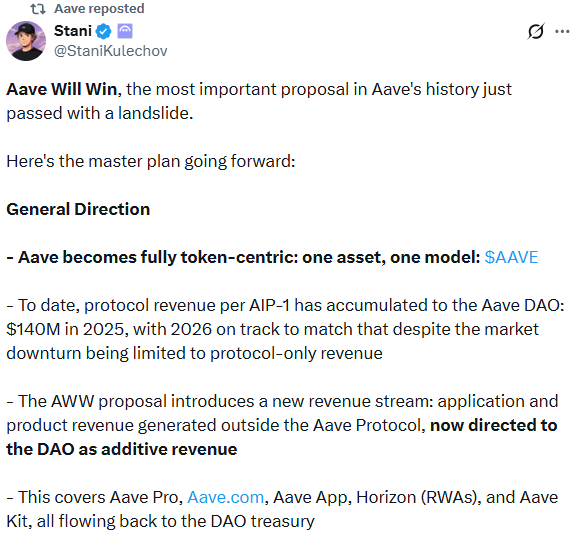
The new framework answers that in favor of token holders. Under the plan, revenue from Pro, the main app, the main website, Horizon, and Kit is directed back to the DAO as additive income. That is a major change because it expands value capture beyond protocol-only fees and ties more of the ecosystem to one asset, the token.
Aave Will Win Proposal redirects product revenue
The numbers explain why the vote drew so much attention. Source material provided by the user says protocol revenue reached about 140 million dollars in 2025, with 2026 tracking near that level despite weaker market conditions. On top of that, swaps on the main website and Pro were already said to be generating another 10 million to 20 million dollars in revenue.
The Aave Will Win Proposal also changes how the core developer is funded. The DAO will now take a more direct role in supporting core development. Several reports cited a 25 million dollar stablecoin grant, while token allocation figures differed across sources. Some notes mentioned 5,000 tokens, while other reports cited 75,000 tokens. What stays clear is the broader structure: product income moves to the DAO, and the DAO becomes more responsible for financing long-term execution.
The protocol also keeps strong scale in DeFi. It holds roughly 25 billion dollars in total value locked across chains, and V4 remains the long-term technical roadmap. The new plan adds V4 reinvestment features, new spokes, enterprise tooling, and more institutional-facing infrastructure.
Aave Will Win Proposal lifts sentiment, not trend
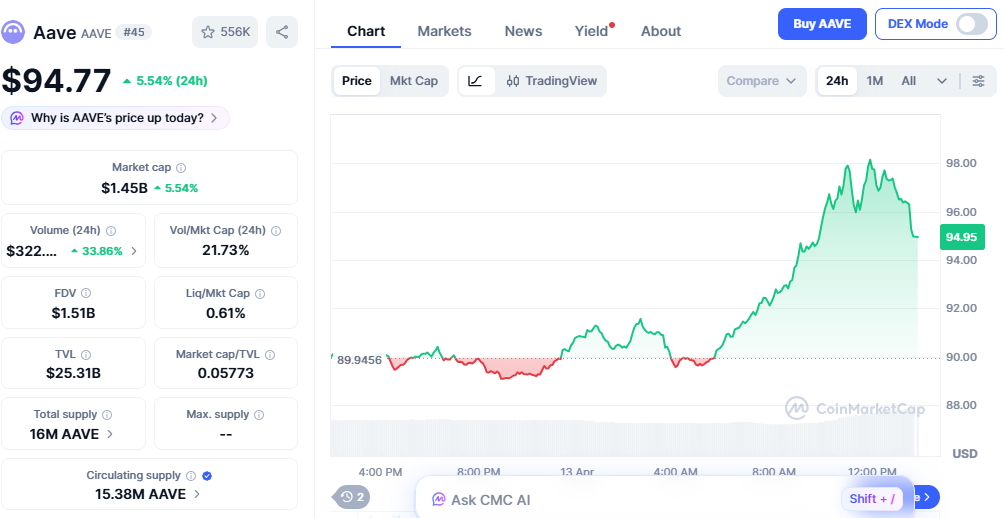
The Proposal clearly improved mood around the token, but the price chart still asks for caution. The user-provided market snapshot showed the token near 94.77 dollars with a market cap of about 1.45 billion dollars. That move erased recent losses and supported the view that traders welcomed the result.
 Source: CoinMarketCap Data
Still, the rebound does not confirm a full trend reversal yet. Market commentary in the source notes pointed to resistance near 97.51 dollars and then 100.97 dollars. In other words, sentiment improved first, while chart confirmation still needs work. That distinction matters for readers trying to separate governance news from short-term technical follow-through.
Future Outlook for Aave Will Win Proposal
The Aave Will Win Proposal gives the protocol a cleaner economic map at a time when DeFi protocols are trying to protect margins, deepen user ownership, and build regulated paths for broader adoption. The next test is simple: can the project turn a governance shift into steady revenue growth, better execution, and a model that scales without fresh friction inside the DAO?
Your Money Your Life Disclaimer: This content is for informational purposes only and does not constitute investment, legal, or tax advice. Crypto assets are volatile, and readers should verify primary sources, review risk carefully, and make independent decisions.









