AI Job Cuts Trend in 2026 Grows With Gemini’s Recent 30% Layoff Data

AI Job Cuts 2026 Impact Seen in Gemini, Amazon Workforce Reduction
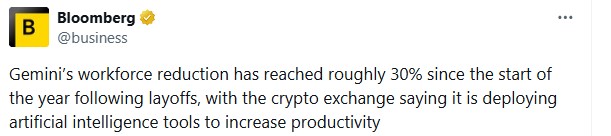
The Gemini workforce reduction has become one of the clearest signs of AI job cuts pressure in the 2026 markets and the rise of artificial intelligence in workplaces. According to Bloomberg reports, Gemini Space Station Inc., founded by the Winklevoss twins, has cut around 30% of its staff since the start of the year, bringing its total headcount down to about 445 employees.This comes shortly after an earlier round of layoffs in February, where nearly 25% of jobs were eliminated.
The Gemini workforce reduction is closely tied to its financial struggles, where it reported a net loss of around $585 million in 2025. Even though it generated about $60 million in revenue in the fourth quarter, losses continued to widen. The firm’s financial troubles are also reflected in its valuation. Since going public in late 2025, its $GEMI stock has dropped by nearly 80–84%.
While Gemini Inc. cites cost-cutting and efficiency, it has also openly pointed to artificial intelligence as a key driver. The company suggests that some roles are now being replaced or reduced due to AI-driven productivity gains, especially in operations and engineering.
This trend fits into a broader global pattern where AI is rapidly transforming how companies operate, and how jobs are structured.
Major Companies Cutting Workforce as AI Adoption Grows
The Gemini workforce reduction comes at a time when several major companies have announced or signaled workforce reductions in 2025–26, majorly due to productivity gains from automation and AI-based tools.
Amazon — Cut around 30,000 of jobs (14K in 2025 + 16K in 2026) to streamline operations and invest in AI
Microsoft — Reduced around 15,000 roles while focusing on AI infrastructure and products like Copilot and AzureAI
Atlassian — Laid off 10% (~1,600) of staff to fund AI-driven growth in March 2026
Block Inc.—Workforce reduced by ~40–50%, nearly half, citing AI-led changes
Crypto.com — Announced 12% job cuts linked to adapt to AI-integrated operations and evolving business needs.
Other major names in the trend include Intel, UPS, Salesforce. Overall, over 55,000 U.S. layoffs in 2025 were linked to AI-related factors, though many cuts are still in the thinking process.
This trend also highlights how the rise in AI-based employment cuts is not limited to any specific sector, but visible across multiple industries, especially in big tech and fintech, which also raises concerns over futuristic job opportunities.
Number are Gaining: 40% of Global Jobs Now Exposed to AI
The surge in AI job cuts is supported by global data where global institutions are warning about large-scale AI disruption. According to estimates from the International Monetary Fund (IMF):
Around 40% of global jobs are exposed to AI-driven change
Exposure rises to ~60% in advanced economies
About 40% in emerging markets
Roughly 26% in low-income countries

This shows that while AI-based impact is global, developed economies are feeling it faster and more deeply.
From Prediction to Reality: Is the 2026 Market Crash Taking Shape?
The Rich Dad Poor Dad and Rich Dad author Robert Kiyosaki has long warned that the “biggest stock market crash in history” would arrive around 2026, driven not just by debt bubbles but increasingly by AI-led position losses. In a statement, he stated: “It’s not just the US. Europe and Asia are crashing. Artificial intelligence will wipe out employement and when jobs crash office and residential real estate crashes.”
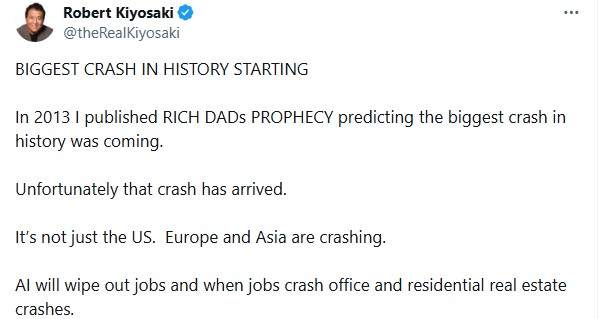
The core chain he highlights is: AI job cuts → reduced income & demand → real estate crash → wider financial instability. With layoffs hitting white-collar sectors that support consumption and property markets, developed economies, already carrying high debt, face the highest near-term risk, making artificial intelligence a potential catalyst for broader economic disruption.
Final Core: AI Job Cuts or Job Transformation?
Despite rising AI-driven job cuts, the overall employment outlook is not entirely negative.
According to the World Economic Forum, AI and automation could significantly reshape the job market by 2030, with around 92 million jobs displaced but 170 million new roles created, resulting in a net gain of about 78 million jobs overall. Similarly, Goldman Sachs suggests that up to 300 million jobs may be affected, but mostly at the task level, not fully eliminated.
So far, the data suggests, around 89% of HR leaders expect smart machine to reshape jobs in 2026 and workers with AI skills are seeing better opportunities. Even crypto-related companies are restructuring rather than shutting down, showing adaptation instead of collapse.
While job losses are real, the bigger story is transformation. New roles are emerging, productivity is rising, and the demand for AI-based skills is growing fast.
The future will depend on how quickly workers and companies adapt to this AI-driven world.










