Binance News: Why $75B in Dirty Crypto Is Permanently Stuck


Binance News Today: Crypto Crime Is Less Than 1% of All Transactions
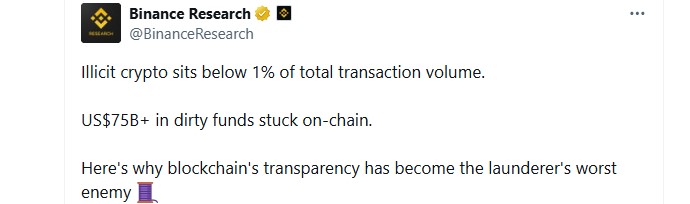
Crypto has a reputation for being a haven for criminals. But the latest Binance News out of Binance Research tells a very different story. Illegal transactions make up less than 1% of total on-chain volume, and the blockchain itself is the reason bad actors keep getting caught.
Binance Research Illicit Crypto Report: The $75B Trap
More than $75 billion in illicit funds sat stuck on-chain in 2025. That number sounds alarming until you understand what it actually means. That money isn't moving freely, it's trapped, growing in size every year precisely because criminals can't successfully launder it out.
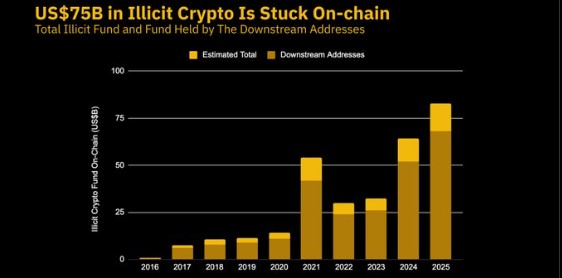
Binance Research confirmed that figure rose roughly 28% compared to 2024. But the growth isn't because more crime is happening. It's because less of the stolen money is making it out. The bottleneck is structural, and according to the report, it keeps getting worse for anyone trying to cash out dirty crypto.
This on-chain illicit funds analysis flips the usual narrative completely. The money is visible, traceable, and stuck, which is the opposite of how traditional financial fraud works.
Why Crypto Money Laundering at Scale Is Almost Impossible
Most people assume cryptocurrency mixers give criminals an easy way out. The Binance Research illicit crypto report says otherwise. The largest mixers in operation, Wasabi and CryptoMixer, can process at most $10 million per day combined.
If someone stole $1 billion and tried to push it through those mixers, it would take more than 100 days just to attempt the obscuring process. And every single one of those transactions gets flagged along the way. At that scale, mixers aren't a real solution, they're a slow, visible, increasingly pointless exercise.
The crypto laundering barriers in 2026 go beyond just mixer capacity. KYT screening catches suspicious wallets before they touch an exchange. KYC requirements block withdrawals at off-ramps. Stablecoin issuers freeze flagged balances directly. Law enforcement seizes funds without needing a court battle over bank records. Almost all exit point is watched, and the on-chain record behind it never disappears.
Blockchain Transparency Outperforms Traditional Finance on Crime Detection
Here's a comparison worth sitting with. The United Nations Office on Drugs and Crime estimates that between 2% and 5% of global GDP gets laundered through traditional financial systems every single year. Crypto-crime, despite its reputation, sits below 1% of total transaction volume, and has stayed there consistently from 2020 through 2025.
Traditional finance moves dirty money through shell companies, correspondent banking layers, and cash-heavy businesses where the paper trail ends fast. Blockchain transparency means the trail never ends. Investigators can trace more than 80% of illicit fund flows continuously, not just at the original crime address, but through every downstream wallet one or two hops away.
Binance news today reinforces something the crypto crime 2026 conversation keeps dancing around: the blockchain is a better crime-fighting tool than almost any system traditional finance has built. The ledger remembers every transaction, every wallet, every hop. That permanence is exactly what makes cryptocurrency a uniquely hostile environment for large-scale financial crime, and why $75 billion in dirty money sits frozen on-chain with nowhere left to go.
Disclaimer: This article is for information purposes only. All the information and facts are based on market present data. The article itself does not claim anything.
Also read:






