Bonk.fun Domain Hijack Results in Wallet Draining Phishing Attack

Bonk.fun Domain Hijack Prompts Urgent User Security Alert
The Solana crypto community has just received a very important warning. A popular website used to launch new coins, called Bonk.fun, was recently targeted by hackers. This event is known as the Bonk.fun domain hijack. The hackers took control of the website and placed a "wallet drainer" on it. This is a hidden piece of code designed to steal money from anyone who uses the site. The person in charge of the site, a man named Tom, quickly told everyone to stop using the website until it is fixed.
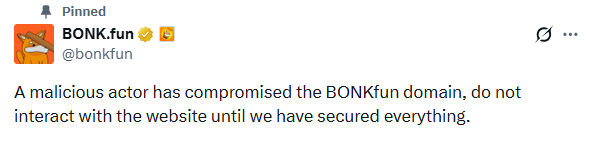 Source: X(formerly Twitter)
The Bonk.fun domain hijack happened because a staff member's account was hacked. This gave the bad actors the power to change what people see on the screen. They put up a fake message that looked like a "Terms of Service" update. If a person clicked "Accept", they were not agreeing to rules. Instead, they were giving the hackers a "key" to take everything out of their digital wallet. This theft happens very fast, often in just a few seconds.
This incident mirrors other recent technical failures in the DeFi space, such as the Aave $27 Million Liquidation. In that case, a technical "glitch" in a risk-management tool called CAPO caused safe loans to be wrongly closed. Just as Aave users saw positions liquidated due to an internal setting error, Bonk.fun users are facing losses due to an external account compromise. Both events highlight that even established platforms can face sudden disruptions.
What the Bonk.fun Domain Hijack Means for Your Digital Wallet
It is very important to know that this Bonk.fun domain hijack was not a problem with the blockchain itself. The actual BONK coins and the trading systems are still working fine. The problem was only with the website interface. This is a common trick where hackers target the "front door" of a service because the "vault" is too hard to break. As the news of the hijack spreads, the market is reacting to the uncertainty. Currently, it is trading at $0.00005943, marking a 4.65% decline over the past week.
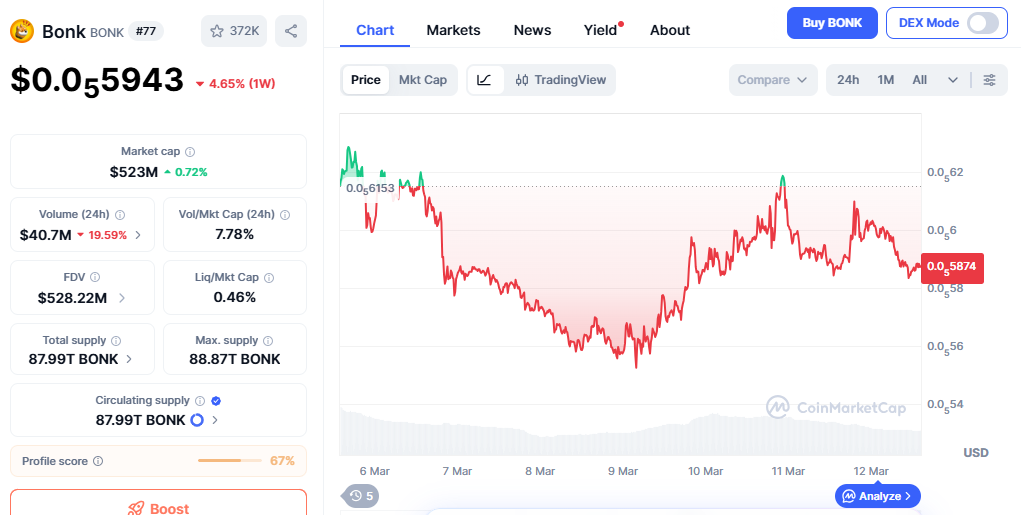 Source: CoinMarketCap Bonk Price
Are You in Danger?
Not everyone who uses Bonk.fun is at risk. You are only in danger if:
You Visited Recently: You went to the site during the hack and signed the fake message.
You Clicked 'Accept': You approved the pop-up that appeared on the screen.
You Used a Browser: People who used other apps or Telegram bots to trade were not affected.
How to Stay Safe
Security experts say that this domain hijack is part of a new trend. Hackers now use "scam kits" that they can rent to make very real-looking fakes. Because the scam is on the real website, it is very hard to tell it is a trap.
Expert Analysis: The Future of Your Crypto
This domain hijack is a big lesson for all of us. It shows that even a website you trust can be turned into a trap. In the future, more websites will likely use extra security steps like physical keys to stop these hacks.
For now, the best thing you can do is be very careful. If a website suddenly asks you to sign a new paper or click a new box, stop and think. Check the news first. If you think you were hacked, move your money to a brand-new wallet right away and cancel any old permissions. Staying alert is the best way to keep your crypto safe.
Your Money Your Life (YMYL) Disclaimer: This article is for informational purposes only and does not constitute financial or security advice. Cryptocurrency security is a rapidly evolving field; always use hardware wallets and exercise extreme caution when signing transactions on any platform.










