Circle Stock Crashes Nearly 18% as Regulatory Pressure Mounts

Circle Stock Crashes After Clarity Act Draft Shocks Investors
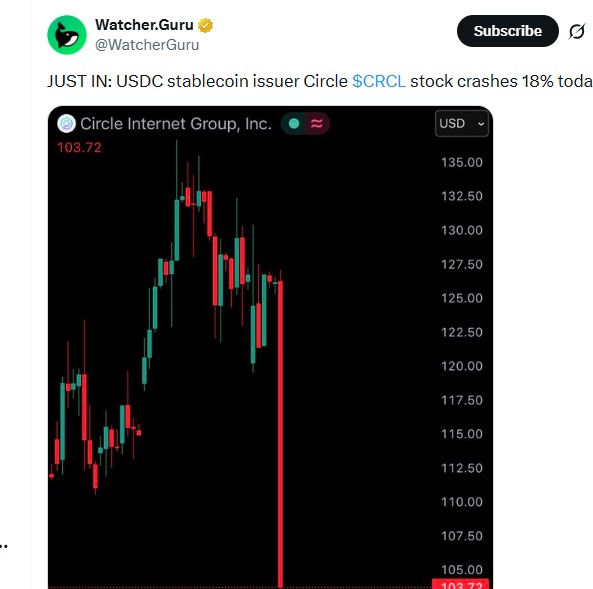
The circle stock crashes 18% in nearly a single trading day. The static decline in price is a shock for investors because after the Clarity Act every investor is aware of the fluctuation, but this drop is scary for stablecoin yield mechanisms, directly impacting Circle’s core revenue model.
The stock, which was reaching $130 levels, suddenly saw a steep sell-off, with a long red flag as the price dropped to $101.19 (last check) after opening at $127.08 and hitting an intraday low of $103.81. This margin is too high to consume, which gives loss to investors and traders.
CRCL is a high-tech company that creates infrastructure for digital assets and blockchain-based finance. Its main product is USDC, an advanced backed stablecoin, which is used for payment, digital finance, trading, and tokenization. It provides APIs, wallets, and treasury services for businesses integrating digital dollars into global operations.
Source: X Account
Why Circle Stock Crashes: Understanding the Core Trigger
This company makes money by keeping reserves in safe assets like U.S. bonds and earning interest.
But the New Law Clarity Act restricts companies from giving interest (yield) on stablecoins.
And the key problem is that it only allows rewards based on activity like usage and holding, which creates difficulty for the company to earn profit.
This act is alert to remodeling Circle’s primary income process; due to this, investors quickly reacted, pricing in the potential long-term revenue compression.
Market Reaction and Investor Sentiment
After this fluctuation, investors are giving negative reactions toward loss, which harms their trust and transparency.
Despite having already known about the act and its consequences, when Drop was held, they were not that prepared about it and started impulsive trading; they were worried about future profit and the pressure. Institutional sentiment also weakened.
ARK Invest apparently trimmed its position in Circle, indicating caution among major investors and market volatility.
As per the distribution of information, the limitation would apply across digital currency service providers, including exchanges, brokers, and affiliated bodies.
Expansion Efforts Fail to Offset Short-Term Pressure
Moreover, the instability has come at a time when Circle is actively expanding its global footmarks. This company has been advocating for European regulators to apply restrictions on euro-denominated stablecoins, focused on unlocking new growth opportunities. These initiatives reflect strong long-term ambitions, but they are not enough to offset immediate concerns about declining reserve income in the United States.
What This Means for the Stablecoin Industry
This drop does not just affect one company; it indicates a strong turning process. The entire stablecoin ecosystem. Because of this, business models may shift toward payments and infrastructure. And also, profit margins could compress across the sector, which leads to regulatory clarity that may come at the cost of reduced innovation flexibility.
Competition and Industry Dynamics
The complexity comes from within the stablecoin market. Rival players such as Tether continue to evolve, with increased transparency efforts like potential large-scale audits. This pushes the competition and shifts investors toward more trusted and transparent options, which are reliable and not forces for impulsive trading.