GENIUS Act News: Coinbase and PayPal Find Stablecoin Loophole


GENIUS Act News: Why Coinbase and PayPal Still Offer Stablecoin Yields
Coinbase, PayPal Keep Stablecoin Rewards Flowing Despite Limits
In the recent GENIUS Act news which was signed into last month has formally legalized approved stablecoins in the U.S but with strict conditions.
Wu Blockchain has recently shared the information on its X handle which highlights that the crypto law could ban offering interest on stablecoins but the platforms are still giving rewards of around 4% on USDC and 3.7% on PYUSD. They claim that they are not the actual issuers of these stablecoins. Instead the rewards come from platform revenue sharing, so they believe that the ban doesn’t apply to them.
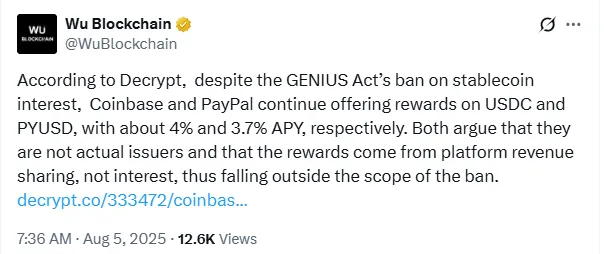
Source: X
Although, experts argued that offering interest bearing features could blur the line between stablecoin and regulated securities that will lead to potential risks and the broader financial systems.
Coinbase Cracks the Code: Finds a Legal Loophole
Despite the new restrictions firm has made it clear that its reward program will continue. CEO of Company, Brian Armstrong emphasized that the firm is not an issuer of USDC. Hence the GENIUS Act news will not apply to them directly.

Source: X.
He highlighted that Coinbase does not provide interest but it provides rewards which allow them to legally offer up to 4% to 5% annual yield on USDC deposits. This strategic differentiation has become a major factor in attracting investors to their platform.
PayPal Plays It Smart: Keeps PYUSD Rewards Alive
It has also pushed forward with its reward program by offering 3.7%-5% annual returns on PYUSD holdings. Even though PYUSD carries its name that is technically issued by Paxos and not PayPal itself. According to the source, this distinction allows the platform to continue rewarding users bypassing the GENIUS Act news restrictions. The feature is a core strategy to power users' loyalty and draw more customers to ecosystem.

Source: X
Why Coinbase and PayPal Were Not Affected by the Ban
The GENIUS Act news was narrowly designed to regulate only stablecoin issuers and leaving platforms that distribute or provide custodial services largely unaffected.
The aim was to prevent issuers from offering deposits like products without full banking regulation while avoiding unnecessary interference in the secondary markets.
Conclusion
The GENIUS Act may have limited stablecoin issuers from paying yields, but platforms like Coinbase and PayPal have found a legal pathway to continue rewarding their customers.





