Colombia Crypto Tax Reporting: DIAN Launches Mandatory 2026 Rules


How New Colombia Crypto Tax Reporting Rules Affect Assets
The era of flying under the radar with your digital wallet in Colombia is officially ending. As of January 2026, Colombia’s tax authority known as DIAN has pulled the trigger on a massive transparency plan. Under a new rule called Resolution 000240, the government is now forcing crypto exchanges and trading apps to act like digital private eyes. Colombia crypto tax reporting dian mandates crypto tax. They are required to collect and hand over detailed records of who you are, what you’re trading, and how much your "internet money" is actually worth.
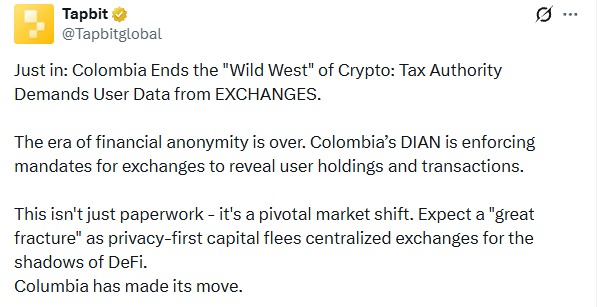 Source: X(formerly Twitter)
This isn't just about local control; it’s part of a global team effort. Colombia is joining the OECD’s Crypto-Asset Reporting Framework (CARF), which is basically a global club of tax authorities that swap data to catch contribution evaders. If you are one of the five million people in Colombia holding Bitcoin or Ethereum, the days of "voluntary reporting" are over.
From Privacy to Paper Trails: How Resolution 000240 Changes Everything
The biggest change in Colombia crypto tax reporting is the "automatic" nature of it. In the past, you might have decided whether or not to mention your crypto gains on your tax return. Now, the exchanges will tell the DIAN for you. The government is specifically hunting for big fish, but they’ve cast a very wide net.
If you transfer more than $50,000 in a single go, the system flags it instantly as a "reportable retail transaction." But don't let that number fool you into thinking you’re safe with smaller amounts. The DIAN is also looking at your total net balance and your contribution residency, even if you’re just a casual trader. Essentially, if you’re using a platform like Wenia or any other local service, your "on-chain" privacy has been traded for a government paper trail.
The Heavy Price of Mistakes
The DIAN is not asking nicely they are demanding accuracy. If an exchange or a middleman forgets to report your data, sends it late, or makes a typo, the fines are brutal. We’re talking about penalties ranging from 0.5% to 1% of the entire value of the transactions. For high-volume traders or big platforms, a simple paperwork error could turn into a multi-million dollar headache.
The "Show Your Homework" Era
Experts from top law firms like Holland & Knight are telling investors to start keeping their own "digital diary." Because the DIAN will be cross-referencing exchange data with your personal filings, you need to be able to prove exactly what you paid for your Bitcoin and when you sold it. If you can’t explain where the money came from, the authorities can treat those coins as "unexplained wealth," which comes with even bigger tax bills.
Conclusion
Wrapping things up, it is clear that Colombia is leading the charge in South America to bring the digital economy into the light. By 2026, the Colombia crypto tax reporting system has made it very hard to treat crypto like a secret bank account. While it feels like a lot of extra work, the goal is to make the market more professional and formal. For now, the best advice for any Colombian investor is to stay organized. The first big wave of mass reports is due in May 2027, which gives you just enough time to get your records in order before the taxman knocks.






