FBI Data Reveals Crypto Fraud Losses 2025 Hit Record $11.4 Billion


How Crypto Fraud Losses 2025 Impact Seniors and Investment Markets
How serious has the scam wave become for digital asset users in the United States? The answer in the latest FBI data is stark: crypto fraud losses 2025 climbed to $11.366 billion, as complaint volume rose to 181,565 and the average reported amount reached $62,604. The figures come from the FBI Internet Crime Complaint Center, or IC3, and were reinforced in a related FBI press release this week.
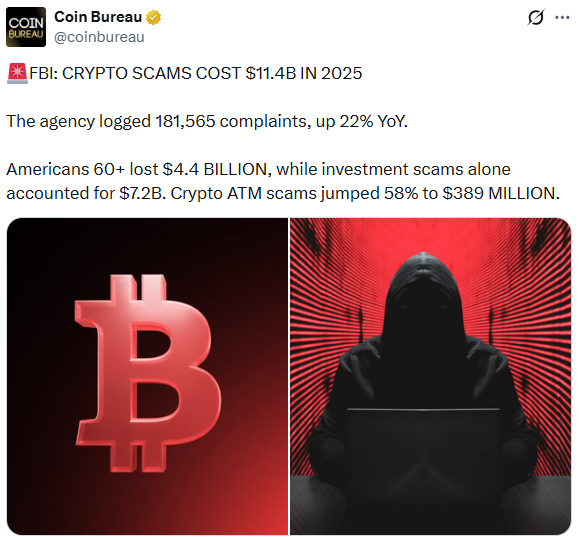 Source: X(formerly Twitter)
Crypto Fraud Losses 2025 Show the Core FBI Findings
The new report tells a simple but troubling story. Crypto fraud losses 2025 rose 22% from 2024, while complaint volume increased 21%. Nearly 18,589 complainants said they lost more than $100,000, showing that many schemes were designed to pull in life-changing sums rather than small payments. The FBI also said digital-asset complaints represented the highest reported financial damage among the categories tracked in the report.
Inside the data, investment scams remained the main engine of damage. IC3 recorded 61,559 investment-scam complaints tied to cryptocurrency and $7.277 billion in reported harm. Extortion ranked second by complaint count at 23,797, while tech or customer support and personal data breach cases also remained large parts of the digital-asset scam picture. The same report linked digital-asset complaints with AI-related damage of $741.6 million, while IC3 logged 22,364 AI-linked complaints across scam categories worth $893.3 million.
Crypto Fraud Losses 2025 Hit Older Americans Hard
One reason crypto fraud losses 2025 stands out is the heavy damage borne by older users. Americans aged 60 and older filed 44,555 digital-asset complaints and reported $4.432 billion in damage, or roughly two-fifths of the overall total. Within that same age group, investment scams alone caused about $2.764 billion in reported harm.
Digital-asset kiosks added another layer to the problem. IC3 logged 13,460 ATM or kiosk complaints with $389 million in damage, and seniors alone accounted for $257.5 million of that amount. Recovery scams also expanded, with 10,516 complaints and $1.4 billion in reported harm, often by targeting people who had already been defrauded once. On a state basis, California led all states at $2.099 billion, followed by Texas, Florida, New York, and Oregon.
Crypto Fraud Losses 2025 Add Pressure on ATM Rules
The clearest response to crypto fraud losses 2025 is showing up in enforcement and regulation rather than in one token price chart. The Justice Department says its Scam Center Strike Force, formed in 2025, is targeting Southeast Asian scam compounds and has already seized more than $637 million in digital assets tied to those schemes. A related DOJ release described scam networks tied to operations in Cambodia, Laos, and Burma and noted earlier forfeiture action worth more than $80 million.
State scrutiny is also rising. Connecticut suspended Bitcoin Depot Operating LLC after issuing an enforcement order in March. West Virginia moved virtual currency kiosks under money transmission rules. In Minnesota, legislation now advancing would prohibit virtual currency kiosks beginning August 1, 2026. In that wider setting, Chainalysis estimated worldwide digital-asset scam damage in 2025 could exceed $17 billion as more illicit wallet addresses are identified.
Future Outlook After Crypto Fraud Losses 2025 Report
The broader market takeaway is not that digital assets are defined by scams, but that adoption is outpacing user protection. Chainalysis said illicit activity still accounted for less than 1% of total digital-asset transaction volume in 2025, yet reported damage still reached record levels. That gap means identity checks, faster reporting, and stricter kiosk rules will likely stay central to the digital-asset story in 2026.
YMYL Disclaimer: This article is for informational purposes only and is not financial, investment, legal, or tax advice. Digital assets and scam-related claims can affect financial decisions, so readers should verify facts through official sources and consult licensed professionals where needed.
Also read:






