How The Echo Protocol Hack Drained Millions in Wrapped Bitcoin


Is The Monad Network Safe For Investors After Echo Protocol Hack
A massive security breach just rocked the decentralized finance space, making it the third major attack in less than a week. The Echo Protocol hack on the Monad blockchain resulted in an unauthorized user minting 1,000 unbacked eBTC (Wrapped Bitcoin) tokens out of thin air.
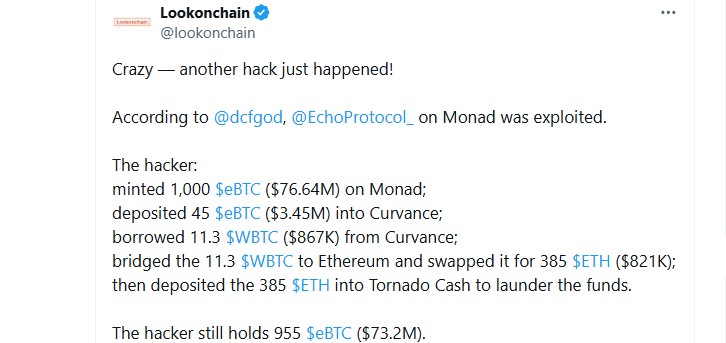
Source: LookonChain Official
At the time of the exploit, those newly created tokens carried a face value of roughly $76.6M. So, how did this crypto exploit news impact users and the Monad network? Do users need to worry about the safety of their digital assets after this incident?
What Happened In The Echo Protocol Hack
This incident did not happen because of a smart contract bug in the code. Instead, it was a classic key management failure where an attacker managed to compromise a single admin private key. The security slip allowed the thief full control without needing to bypass multi-signature or timelock protections.
Once inside, the attacker quickly changed the system setting. They quickly gave themselves both administrative and mining access. With this privilege, the hacker minted the 1,000 unbacked tokens from a zero address while paying next to nothing for network gas fees.
To turn the fake tokens into real money, the thief deposited 45 eBTC as collateral into a separate lending system called Curvance. Using that unbacked deposit, they borrowed 11.3 Wrapped Bitcoin (current per token price: $76.5K). This allowed the attacker to extract a real-world value of anywhere from $820K to $867K.
Laundering Money Through Tornado Cash
The hacker immediately moved the borrowed Wrapped Bitcoin exploit assets off the Monad network to secure the profit. They bridged the funds directly over to the Ethereum blockchain and swapped them into native ETH.
To hide their identity, the criminal turned to a privacy mixer for Tornado Cash laundering crypto operations. They routed approximately 385 ETH through Tornado Cash, making it very difficult for security teams to trace the wallet history.
Even after laundering those funds, the attacker still held 955 eBTC in their personal wallet. On paper, that remaining balance was worth over $73M. However, the protocol developers stepped in quickly to protect the community from further market damage.
The Echo Protocol Hack Damage Control And User Impact
For regular community members, the primary concern is whether their personal wallets are safe. Echo Protocol immediately suspended all cross-chain bridge transactions to isolate the problem. Additionally, the Curvance eBTC market paused operations completely to protect remaining liquidity providers from experiencing losses.
Hours after the Echo Protocol security incident, the team successfully burned the remaining 955 eBTC tokens. Because the market liquidity for eBTC was too low, the hacker could not sell the rest of the supply. The action limited the real stolen funds to the initial amount borrowed from Curvance.
As a result, regular retail users did not face direct wallet drains during this Monad hack 2026 event. However, the exploit left behind bad debt for the lenders and liquidity providers on Curvance. It stands as a clear reminder of interconnected risks, where a problem in one application hurts users on another platform.
Is The Monad Network Safe For Users
Many investors are asking if the underlying blockchain is still a secure place to transact. It is important to separate the application layer from the network itself. This security failure was entirely an app-level operational error, not a flaw in Monad blockchain security.
The underlying network remains safe and functional for regular transactions. However, this $76M eBTC exploit proves that applications on fast, new networks need much stronger security standards.
What This DeFi Hack 2026 Means For Security
This eBTC hack Monad event highlights that administrative key security is still a massive weak point. Many high-profile incidents in this DeFi hack 2026 era come from key theft rather than complicated code exploits. Projects built on high-performance networks must ensure that their operational security matches their fast transaction speeds.
In the future, decentralized applications must adopt automated caps on new collateral and stricter role management. Relying on single addresses for powerful protocol roles remains an incredibly dangerous practice for developers.
Note: The article is for informational purposes only. It does not provide any kind of financial or legal advice.






