Ethereum ePBS Upgrade: Will FOCIL Stop Transaction Censorship?

Ethereum ePBS Upgrade Debate: Innovation or Structural Risk?
The Ethereum ePBS upgrade has sparked an intense discussion after Vitalik Buterin warned that decentralization risks could shift toward the block building pipeline. While ePBS (enshrined Proposer-Builder Separation) aims to protect staking from builder dominance, he argued it may introduce new concerns like transaction censorship and toxic MEV.
Key highlights from his statement:
Block building power could concentrate in a few hands.
This could enable censorship or exploitative MEV strategies such as sandwich attacks.
To counter these risks, he introduced structural proposals including FOCIL, Big FOCIL, encrypted mempools, and network-layer protections.
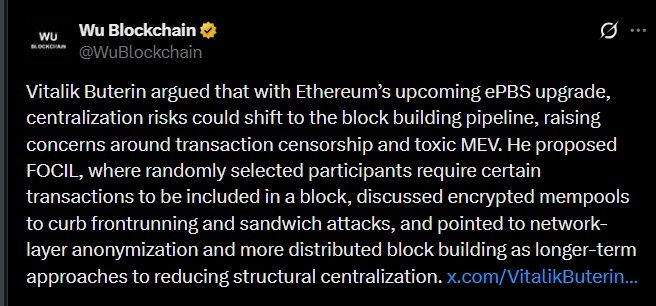
Source: X Official
FOCIL and Big FOCIL: Anti-Censorship Framework
FOCIL is described as the first step toward in-protocol multi-participant batch creation. It allows 16 randomly selected attesters to each choose transactions that must be included in a block. If those are missing, the batch gets rejected.
Why this matters:
Even if a hostile actor controls builders, they cannot fully censor activity.
Inclusion becomes partially distributed instead of centralized.
Big FOCIL is a more advanced idea. It expands participant inclusion so that all transactions can be covered collectively. Duplication risk is reduced by assigning transactions based on sender address prefixes and prior slot behavior. In this model, builders would mainly focus on MEV-related ordering and computing state transitions rather than deciding inclusion.
These designs aim to strengthen blockchain security and protect transaction neutrality on the ETH network.
Encrypted Mempools and Network Layer Protection
Another major concern discussed was toxic MEV. Encrypted mempools could prevent frontrunning and sandwich attacks by hiding transaction details until block confirmation.
Benefits include:
Reduced exploitation in DeFi trading.
Improved user protection against manipulation.
However, challenges remain. Developers must ensure encrypted transactions are valid and efficiently decrypted only after batch creation.
Vitalik also emphasized risks in the transaction ingress layer. When users send activity through RPC endpoints or public nodes, data can be exposed. Possible solutions include Tor-style routing, mixnets, and bandwidth-heavy but latency-optimized systems like Flashnet. These tools could improve privacy without relying on centralized servers.
Long-Term Vision: Distributed Block Building
A broader goal is making Ethereum more distributed, similar to BitTorrent-style coordination. The challenge lies in synchronous shared state, where any action can depend on another, naturally pushing aggregation toward centralized builders.
One proposed solution involves categorizing activity. Since most network usage does not require global synchronization, less-global transaction types could be processed in a distributed way and priced lower, while high-value global actions remain under stricter coordination.
Connection to Ethereum Foundation Strawmap
These discussions align with the recent Strawmap roadmap from the Ethereum Foundation. The Strawmap outlines upgrades every six months through 2029, focusing on scalability, faster batches, privacy improvements, and decentralization.
Within that roadmap, the block building pipeline is a crucial component. Concerns around the Ethereum ePBS upgrade are not separate from the Strawmap vision. Instead, they are technical challenges developers aim to solve as the protocol evolves.
The roadmap highlights anti-censorship, fairness, and resilience goals. Proposals like FOCIL and encrypted mempools directly support those themes.
Conclusion:
The Ethereum ePBS upgrade represents both progress and new architectural challenges. Vitalik’s proposals show that decentralization requires continuous refinement. As Strawmap milestones unfold, solutions addressing censorship, MEV, and builder concentration will shape Ethereum’s long-term security and fairness.
Also read:






