Europe Tokenized Financial Markets Need Central Bank Money to Scale


The Role of Pontes in Supporting Europe Tokenized Financial Markets
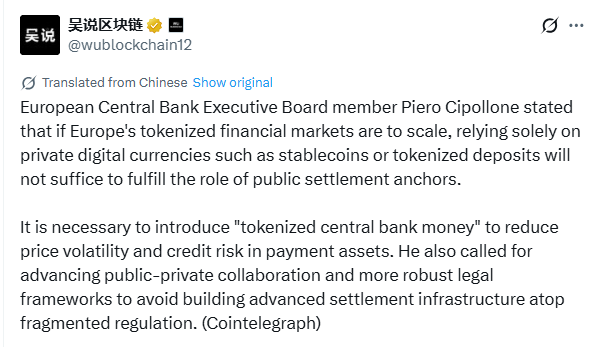
The push to modernize the continental economy has reached a major turning point. The European Central Bank (ECB) is now defining the tools needed for big financial growth. Piero Cipollone, a member of the ECB’s Executive Board, gave a landmark speech in Brussels on March 23, 2026. He stated that Europe tokenized financial markets cannot grow by only using private assets like stablecoins. For these markets to truly succeed, they need "tokenized central bank money" to act as a safe and steady anchor.
 Source: X(formerly Twitter)
Without this official backing, people selling crypto might receive payments in a form they do not trust. Private digital currencies can sometimes be risky or change in price too quickly. Cipollone noted that this risk stops the market from getting bigger. To fix this, the ECB is working to put public money at the centre of the virtual world. This ensures that everyone can trade with the same safety found in traditional banking.
The Role of Pontes in Supporting Europe Tokenized Financial Markets
A key part of the ECB’s plan is a project called "Pontes". This system is designed to connect new digital platforms with the Eurosystem’s existing payment tools. Scheduled for a first launch in the third quarter of 2026, Pontes will let market participants trade crypto using safe central bank money. This platform aims to solve the problem of "fragmentation", where different digital systems cannot talk to each other.
Simple Features of the Pontes Initiative
Easy Connections: It links different digital platforms to the main Eurosystem infrastructure.
Safety First: It provides a trusted, risk-free asset for final payments.
Working Together: It allows private stablecoins to be exchanged for central bank money for a final, secure settlement.
Open 24/7: It supports around-the-clock trading and automated "smart contracts" to meet modern needs.
Legal Clarity and the Appia Roadmap Toward 2028
While tools like Pontes are helpful, Cipollone stressed that Europe tokenized financial markets also need clear and simple laws to thrive. He warned against building advanced systems on a "patchwork" of different rules, which could stop the region from getting the full benefits of this new technology. The ECB’s broader "Appia" plan aims to create a full blueprint for a digital financial system by 2028.
Banks, technology providers, and other experts are now being asked to share their ideas on the Appia roadmap. This teamwork is meant to make sure that virtual assets can move easily across borders within the European Union. As other parts of the world invest in virtual systems, the ECB is making sure that Europe stays competitive and safe for all investors.
Expert Analysis: The Future of Digital Money
The ECB's stance shows a very practical approach. Stablecoins are not going away, but they are being given a safer foundation. By keeping the central bank at the base, the regulator is helping new ideas grow while keeping the financial system stable.
Future Outlook
We expect the launch of Pontes in late 2026 to start a new wave of digital projects by major banks. As the Appia plan moves toward 2028, the focus will likely shift to "atomic settlement". This is a fancy term for exchanging assets and cash at the exact same time on a digital ledger. If Europe can agree on one set of rules, we could see a very fast and secure virtual market emerge by 2027, making it much easier for money to move safely across the continent.
Your Money Your Life (YMYL) Disclaimer: Digital markets and tokenized assets involve financial and legal risks. Rules in the EU are subject to change. This report is for your information only and is not financial or legal advice.









