Hong Kong Stablecoin Licenses Issued to HSBC and Anchorpoint

Why Hong Kong Stablecoin Licenses Change Global Digital Finance
Why did the city start its new stablecoin system with banks instead of crypto-native firms? The answer came on April 10, when Hong Kong stablecoin licenses went to HSBC and Anchorpoint Financial under the Stablecoins Ordinance. The move shows that city wants digital money to grow through trusted financial groups with strong compliance systems, clear payment use, and close regulatory oversight.
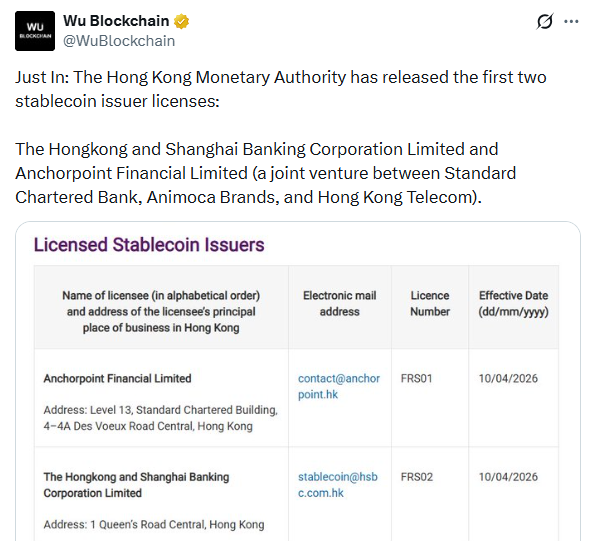 Source: X(formerly Twitter)
Hong Kong Stablecoin Licenses Start With Banks
In its official release, the HKMA said it reviewed 36 first-round applications that were filed by the September 30, 2025 deadline. After that process, it chose two firms that showed strong risk control, clear business plans, and useful payment cases. The regulator said the first phase will focus on HKD-backed stablecoins. It also said both firms still need to finish testing, staffing, and control systems before launch. Based on current plans, the first products may go live in mid to late 2026.
This makes the story bigger than a licence announcement. These Hong Kong stablecoin licenses are the first real test of a bank-led model for digital money in the city. The HKMA said the framework was built through public consultation, legal work, sandbox testing, and later supervision. Its goal is simple. It wants innovation, but it also wants financial stability, anti-money laundering safeguards, and user protection.
Hong Kong Stablecoin Licenses Target Real Payments
The first use cases are not limited to crypto trading. The HKMA said both issuers plan to use their stablecoins for cross-border payments, local payments, tokenised asset trading, conditional payments, and supply chain finance. That gives the story a wider payments angle. It also shows that the regulator wants these coins to solve real business problems, not just serve as trading tools.
There is also deeper policy context here. Both issuers have taken part in HKMA work on central bank digital currencies and tokenised deposits. That matters because it links the new launch to the city wider digital finance plan. Anchorpoint adds another layer. The joint venture brings together banking, telecom, payments, and digital asset expertise. In its own statement, Anchorpoint said it plans to issue an HKD-backed token called HKDAP and use selected business partners as distributors. Reuters also reported that HSBC plans to offer its stablecoins through PayMe and HSBC HK Mobile Banking.
Hong Kong Stablecoin Licenses Face Adoption Test
The first market response is more about policy than price. There is no major token move tied to this news yet. Still, Reuters described the approvals as a major step in Hong Kong’s push to build regulated digital currencies for finance and trade. HKMA officials also made it clear that more approvals may come later, but the number will stay very limited.
That point matters. These Hong Kong stablecoin licenses suggest that the city is choosing a careful path. The city is not opening the gate to many issuers at once. Instead, it is starting with two names that already sit close to the financial system. Reuters had also reported earlier that Ant Group and JD.com paused Hong Kong stablecoin plans after official concern about private-sector currencies. Against that backdrop, the first approvals going to HSBC and a Standard Chartered-linked venture send a clear message about trust, control, and market order.
Future Outlook
The City has now moved from policy talk to licensed issuance. The next stage will depend on whether these firms can turn regulation into real payment use. If they do, Hong Kong stablecoin licenses may help the city build a stronger role in digital settlement, trade finance, and tokenised markets across Asia.
Your Money Your Life Disclaimer: This article is for informational and journalistic purposes only. It does not constitute financial, investment, legal, or trading advice. Readers should verify official disclosures and consult qualified advisers before making financial decisions.
Also read:









