HongKong Stablecoin License Rush Begins Ahead of August 1


Over 40 Firms Compete for HongKong Stablecoin License
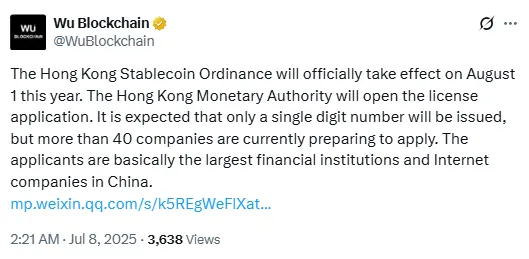
The implementation of the Stablecoin Ordinance approaches August 1, 2025, interest in acquiring HongKong Stablecoin License has surged dramatically. The Hong Kong Monetary Authority (HKMA) will begin accepting the applications under critical players in the future of digital finance.
However, industry insiders report that availability will be extremely limited– possibly in single digits– while more than 40 companies are already preparing to submit applications.
Source: Twitter
HongKong Sees a Spike in Applications
The HongKong Stablecoin License are being pursued by major players like JD.com, Yunabi Innovation, and Standard Chartered, with dozens of other tech and finance giants following closely behind.
Law firms confirm that many companies are still in the consultation or material preparation phase, indicating that the field will become even more crowded in the coming weeks.
Alex Zuo, SVP of payment services at digital cassette platform Como, highlights that most applicants are China’s leading financial institutions and internet giants. Smaller firms, he says, face steep barriers to entry and are unlikely to succeed.
Real Utility Vs. Market Hype
While some companies are genuinely preparing to build infrastructure, others are reportedly using the buzz for short-term marketing or stock price boosts.
Industry professionals warn that without a solid strategy, many of these smaller entrants lack both the operational ability and regulatory standing to secure a license.
According to Zuo, serious applicants are investing in blockchain talent and technological upgrades, especially in the areas of cross-border payments and asset management. These firms are looking to integrate stablecoins into core services-not just issue them, but manage transactions. Wallets and compliance within a scalable infrastructure.
Stablecoins Are not a Monetary Revolution
Despite the level of excitement, financial experts are cautious about overstating the role of stablecoins. Qiao Yide of the Shanghai Development Research Foundation explains that are still anchored to sovereign currencies, and while they extend the functionality of legal tender, they don’t subvert the traditional financial system.
Studies also show that the actual cost of using HongKong Stablecoin License for cross-border payments– including gas fees, currency exchange, compliance, and forex risk– can approach 1%, far more than the near-zero costs sometimes advertised.
Final Outlook
The rollout of HongKong Stablecoin License could reshape parts of the global financial landscape, particularly in cross-border payments and blockchain integration. But with intense competitions and high regulatory expectations, only the most prepared institutions are likely to succeed.
As the August 1 launch date nears, HongKong Stablecoin License experiment may become a defining moment for Asia’s role in the future of digital finance.






