When is the Little Pepe Presale End Date? Final Stage Update


Little Pepe Presale End Date Approaching as Stage 13 Nears Cap
What does the little pepe presale end date really mean when the project is already posting a 30 April 2026 launch countdown? That is the key question now. The issue is not hype alone. It is the gap between the social media message and the mechanics still shown on the official sale pages.
Little Pepe Presale End Date Remains Round Driven
On X, the team says it is going live on 30 April 2026. Another official post says Round 12 sold out and Round 13 is now live at $0.0022. That sounds like a turning point. Yet the official token sale page still lists 19 rounds, so the current phase is not the finish of the published roadmap.
 Source: Official Website
Current Round Data Puts The Little Pepe Presale End Date Back In Focus
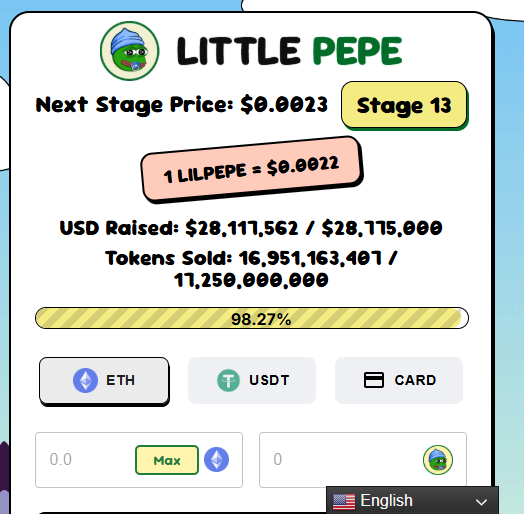
The current numbers help explain why the little pepe presale end date is drawing fresh searches. The official pricing table shows the current round at $0.0022, the next round at $0.0023, and a launch price of $0.003. It also lists a $52.425 million total raise target and 26.5 billion sale tokens. In the dashboard screenshot shared with us, the sale shows $28,111,562 raised out of $28,715,000, with progress at 98.27 percent. That target matches the cumulative raise through the current round, not the close of the full sale. Under the published plan, about $23.71 million and 9.25 billion sale tokens would still remain after this round.
Why Vesting Rules Matter More Than The April Countdown
This is where the little pepe presale end date becomes more than a date search. The official dashboard says tokens become claimable only after all rounds are sold out. The how to buy page says the token is still on sale and not available on Uniswap or other DEXs. The whitepaper says tokens are distributed after the offering concludes. Put simply, the documents reviewed here still point to a sellout-based finish, not a fixed public close date.
There is also a dashboard detail worth watching. The shared screenshot shows 16.95 billion tokens sold, while the visible token cap line reads 11.25 billion. That does not fit the 98.27 percent progress bar. Based on the published pricing table, 16.95 billion sold would equal about 98.27 percent of 17.25 billion cumulative tokens through the current phase. That means the timeline story is also about data clarity, not just timing. No clarification on that point appeared in the official material reviewed here.
The vesting page adds another layer. Buyers get 0 percent unlocked at TGE, then face a three month cliff, followed by 5 percent monthly releases. The same page says liquidity and CEX reserves stay locked until launch, with initial circulating supply listed at 20 billion tokens. So even if readers treat 30 April as a major milestone, the little pepe presale end date still does not answer the full unlock picture on its own.
Expert Analysis
For now, the little pepe presale end date looks like a moving finish line. The April 30 post may mark a major milestone. Still, the stronger trigger on the official pages is simple: all rounds must be sold out first. Until the team posts a fixed cutoff, the timeline remains tied to allocation, vesting, and dashboard consistency more than one public countdown line.
Conclusion
That is why the little pepe presale end date remains an open story. The countdown post grabs attention. The pricing table, vesting page, and claim rules tell the deeper story. Until the team publishes a fixed close date, buyers are left tracking round progress, remaining allocation, and unlock terms together.
YMYL Disclaimer: This article is for informational purposes only and is not financial advice. Crypto assets are high risk, prices can be volatile, and readers should review official project documents and consider independent professional advice before making financial decisions.









