Little Pepe Presale Stage 13: What Buyers Must Know Before Launch


The 30% Reserve Risk Every Little Pepe Presale Buyer Faces
You've seen the $28M number — but have you actually read what happens to your tokens the moment the listing goes live?
The little pepe presale just crossed $28,190,424 raised in Stage 13. The current price is $0.0022. The next stage moves to $0.0023. At 98.46% sold through 16,984,282,811 of 17,250,000,000 stage tokens, the window is nearly closed.
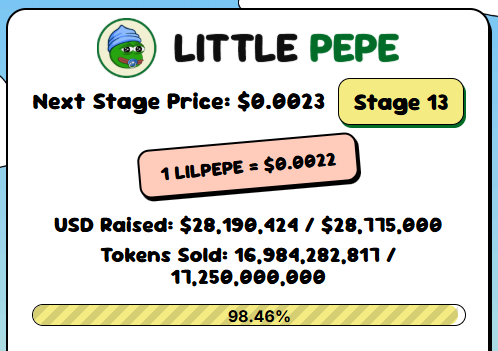 Source: Official Website
Most buyers made their decision based on the price gap. Few checked the tokenomics sheet. This article covers staking mechanics, liquidity depth, chain reserve risk, and the vesting schedule — the four things that determine whether your little pepe presale entry actually pays off after launch.
Little Pepe Presale Tokenomics: Where Do Your Tokens Go?
The total supply is 100 billion LILPEPE tokens. The little pepe presale allocation covers 26.5% — that's 26.5 billion coins going directly to buyers like you.
Here's the full breakdown:
26.5% offering— your tokens, locked for 3 months then 5% released per month over 20 months
30% chain allocation— team-controlled coins with no published unlock schedule
13.5% staking and rewards — the pool that pays your staking APY after launch
10% liquidity — funds DEX trading pools so you can buy and sell smoothly
10% CEX reserve — held for Binance, Coinbase, or Tier-1 exchange listing requirements
10% marketing — team can sell gradually to fund campaigns over time
Only 36.5% of the total supply directly supports buyers at launch — the early sale allocation plus the liquidity pool. The other 63.5% sits under team control. That's a normal structure for a project of this type, but every little pepe presale buyer needs to understand it before the listing day arrives.
Zero transaction taxes apply on LILPEPE trades. That means pure open-market price discovery from Day 1 with no swap fee drag.
How Little Pepe Staking and Liquidity Work After Launch
The little pepe presale offers staking right now — before the listing goes live. Early stakers lock in a higher annual percentage yield, or APY, before the pool fills up.
The staking reward pool holds 13.5 billion tokens. One press release cited 782% APY. Here's what that number really means:
At 782% APY with 5 billion tokens staked, the entire reward pool depletes in roughly 3.5 months
As more users stake, the APY drops — that's how every staking pool works mathematically
Staking early is the only way to lock in the higher rate before the pool dilutes
Every token locked in staking leaves the tradeable supply. If 10% of early holders stake on launch day, 2.65 billion tokens exit the open market immediately. That reduces the sell pressure every trader watches on listing day.
The 10% liquidity allocation means 10 billion tokens fund the DEX trading pool. At the $0.0022 early sale price, that's approximately $22 million in initial pool depth. A $22M pool means a $1 million sell order moves the price roughly 4.5% — manageable, not immune.
The zero-tax trading model encourages volume. More volume deepens the order book over time.
The 30% Reserve Risk Every Little Pepe Presale Buyer Faces
The single most important number in the little pepe presale tokenomics is 30 billion. That's the chain reserve allocation — 30% of the entire 100 billion supply.
At the $0.0022 Stage 13 price, those 30 billion tokens represent $66 million in potential supply. No public unlock schedule has been published. No on-chain vesting contract has been confirmed.
The chain reserve design has two possible outcomes for your investment:
Bull case: The LILPEPE Layer 2 chain launches and attracts developers. Every meme token launched through Pump Pad — the project's own launchpad — burns LILPEPE as a gas fee. More launches mean more tokens permanently removed from supply. The chain reserve becomes a deflationary engine.
Risk case: If the Layer 2 chain is delayed or attracts limited developer activity, those 30 billion tokens sit idle under team control. Any partial release of that reserve into the open market adds significant supply without equivalent demand.
The chain hasn't launched yet. That's the execution risk that separates the bull case from the risk case. Based on the whitepaper, chain reserve tokens are intended for validator payments, liquidity pools on the native chain, and developer incentives — not open-market sales.
No independent audit of the chain reserve deployment mechanism has been published publicly.
Little Pepe Presale Outlook: Three Things Analysts Watch Now
The little pepe presale enters its final stages with a specific watchlist. Three data points will shape price action after the listing goes live.
First — staking participation before Day 1. Every token staked is a token not sold. High early staking uptake creates a tighter tradeable float on listing day. Watch the staking dashboard for participation volume in the 7 days before launch.
Second — chain reserve deployment timing. Any team announcement about when or how the 30 billion chain reserve tokens deploy is a major price signal. A transparent vesting schedule for the reserve reduces uncertainty. Silence extends it.
Third — Pump Pad launch timing. The meme launchpad is the core demand driver in the LILPEPE economic model. Every token launched on Pump Pad burns LILPEPE as gas. If Pump Pad goes live during the 3-month vesting cliff — when holders can't sell — the demand pressure arrives exactly when supply is tightest.
Based on public market sources and analyst reports, LILPEPE price prediction targets of $2.50 long-term and 400% year-end gains are cited by CoinSpeaker and ainvest.com respectively. All figures are speculative and assumption-based. No guaranteed outcome exists for any token at any stage.
The little pepe presale closes Stage 13 at 98.46% sold with $28,190,424 raised against a $28,775,000 stage target. Stage 14 opens at $0.0023. Nineteen stages run through to $0.0028 — the final sale price before listing.
Conclusion
The little pepe presale has raised $28.19M across 13 stages — but the numbers investors need aren't on the presale dashboard. They're in the tokenomics sheet. The staking pool depletes fast at high APY. The chain reserve carries real supply risk. The vesting cliff protects Day-1 price. Read the whitepaper and verify the contract before Stage 14 opens.
YMYL Disclaimer
This article is for informational purposes only and does not constitute financial or investment advice. Crypto presales are high-risk and readers should verify all information independently before making any financial decision.









