Missouri Crypto Bill Pushes Bitcoin Reserve and Crypto Adoption


Missouri Crypto Bill: Bitcoin Reserve Plan Signals U.S Crypto Strategy
The Missouri Crypto Bill has introduced a major policy shift in US digital asset strategy after House Bill 2080 proposed the creation of a Bitcoin Strategic Reserve Fund. The proposal lets the state treasurer receive, hold, invest, and manage Bitcoin under set rules. This marks a clear step toward institutional virtual asset integration. Lawmakers sent the initiative to the committee as part of the legislative process. This shows growing support behind state-level Bitcoin reserve plans.
Official Details of the Missouri Crypto Bill
Creation of a dedicated Bitcoin Strategic Reserve Fund managed by the state treasurer
Bitcoin can be accepted through donations, gifts, bequests, and government transfers
The proposal requires virtual assets collected by the treasury to be stored using cold storage. It also uses advanced custodial tools. Holdings must stay locked for at least five years. No sale, transfer, or conversion is allowed before that time. The treasury must also run audits. It must share reports every two years. These reports cover value, growth, transactions, and risks. The treasury must block participation from foreign or illegal actors. Authorities can work with US-based virtual firms for security and operational help. They also put in place a simple donation system. This system gives public recognition for those who give.
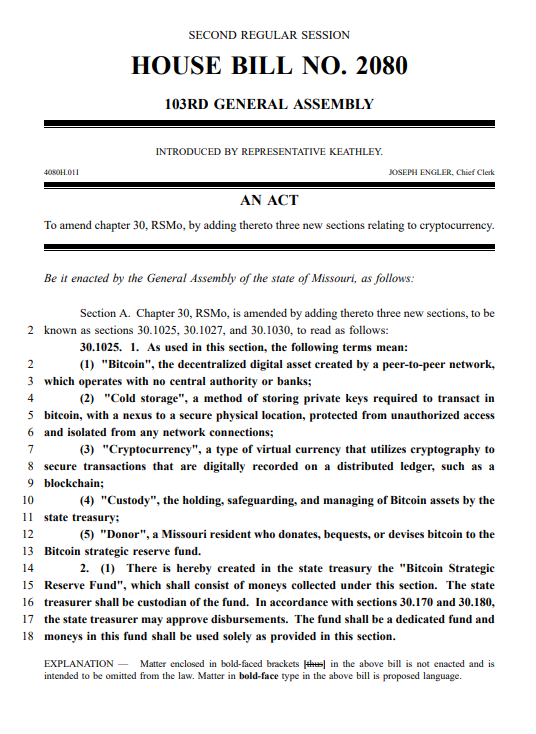
Source: Missouri House Bill Official
Market Impact and Institutional Signal
Bitcoin reserve strategy strengthens long-term store-of-value story
State-level adoption supports institutional confidence and rule clarity
The Missouri Crypto Bill shows a shift. Governments now look at digital assets as reserve tools like gold. Such moves may help capital flows. They also improve certainty. They speed up institutional involvement. By letting the treasury invest, the proposal adds real-world use. Allowing digital payments for taxes, fees, and penalties also helps. This builds market trust. Analysts see state accumulation plans as bullish structural demand. This can shape long-term price stability.
Link to US Stablecoin Regulation and Haircut Shift
White House meetings between banks and crypto firms aim to formalize stablecoin use
Capital rule update cuts stablecoin haircut from 100% to 2%
Recent US talks show regulators and financial institutions working toward stablecoin market structure rules. This reflects efforts to bring digital payment tokens into traditional finance. Meanwhile, SEC guidance lets broker-dealers apply only a 2% haircut to qualifying payment stablecoins. The old treatment was 100%. This greatly improves balance sheet use and liquidity. This rule easing signals growing acceptance of tokenized dollars. It also fits with reserve efforts like the Missouri House Bill.
Industry Growth and Global Adoption Trend
Stablecoin infrastructure approvals and trust bank charters speed up integration
Regulatory frameworks drive mainstream digital asset adoption
Recent approvals let firms set up regulated trust banks. These banks handle custody and stablecoin operations. This shows growing institutional infrastructure. Broader moves also help. These include federal frameworks such as stablecoin rules. They point to a shift from testing toward full financial integration. Along with reserve strategies at the state level, these steps reinforce the view of virtual assets as core financial infrastructure. They are no longer just a speculative space.
Conclusion:
The Missouri Crypto Bill reflects faster government adoption of digital assets. This goes along with changing US stablecoin rules. Combined with capital rule changes and institutional infrastructure growth, the Missouri Crypto Bill strengthens long-term digital market trust. This Missouri Crypto Bill supports broader adoption and structural market growth.








