YMYL Disclaimer: This content is for informational purposes only and not financial or investment advice. Always do your own research.
OpenAI Launches EVMbench With Paradigm for Crypto Security

Muskan Sharma
Published:
Last Updated:
OpenAI Launches EVMbench to Test Ethereum Smart Contract Security
OpenAI launches EVMbench, a new benchmarking system designed to test how well artificial intelligence can secure crypto tokens and smart contracts. Created with investment firm Paradigm, this tool measures whether AI agents can find, fix, and safely exploit vulnerabilities in Ethereum-based smart contracts.
The release has drawn strong attention from the blockchain industry, where security remains a top concern as billions of dollars move through decentralized systems.
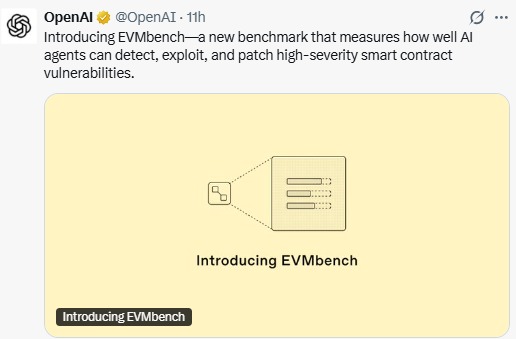
Source: X (formerly Twitter)
What Is EVMbench and Why Does It Matters?
OpenAI launches EVMbench as a research framework focused on real smart contract risks.
The benchmark uses 120 curated vulnerabilities taken from 40 security audits, including well-known public audit competitions.
By using real bugs instead of theoretical examples, it provides a realistic view of how Artificial Intelligence performs in blockchain security.
Smart contracts today protect more than $100 billion in digital assets. As automation tools become better at reading and writing code, measuring their performance in high-value environments becomes critical. This is where the launch becomes important for developers and security teams.
How EVMbench Tests AI Agents?
OpenAI Launches EVMbench evaluates AI across three main tasks.
In detect mode, Artificial Intelligence audits smart contracts and identifies known vulnerabilities.
In patch mode, Artificial Intelligence fixes those vulnerabilities while keeping the contract working properly.
In exploit mode, it performs controlled attacks inside a safe testing environment to demonstrate risk.
The system runs on a secure Rust-based testing harness that deploys contracts and replays transactions in a reproducible way. Exploits are executed only inside isolated environments, ensuring no real funds or live networks are affected.
Early Results Show Rapid AI Progress
Early testing shows strong improvement in AI capabilities. OpenAI’s latest coding model achieved more than 70% success in exploit tasks, a major jump compared with results from six months ago. However, detection and patching tasks remain more challenging, especially when vulnerabilities are subtle.
Researchers found that Artificial Intelligence performs best when the goal is clear, such as draining funds in a simulated attack. More complex tasks like full safety auditing still require improvement. These findings highlight both the potential and the limits of artificial intelligence in crypto safety today.
Impact on the Blockchain Industry
OpenAI Launches EVMbench could reshape how blockchain projects approach security. Audit firms, developers, and DeFi teams may begin using AI-assisted reviews as a standard step before deployment. Faster detection of bugs could reduce costly hacks and improve user trust.
At the same time, the technology introduces a dual-use concern. Tools that help defenders can also help attackers learn new methods. Because of this, the technology firm says it is investing in safeguards, monitoring systems, and security research programs to encourage responsible use.
Future Outlook for AI and Crypto Security
This launch signals a shift toward measurable AI security capabilities in Web3. The benchmark also includes payment-focused smart contract scenarios, showing the growing importance of stablecoin infrastructure and real-world blockchain applications.
As Artifical intelligenceI continues to improve, industry experts expect AI-driven auditing to become a normal part of development workflows. Measuring progress through benchmarks like EVMbench will help track risks while strengthening defenses across the crypto ecosystem.
Conclusion
OpenAI Launches EVMbench represents an important step in bringing structured AI testing into blockchain security. By combining real vulnerabilities, controlled simulations, and clear performance metrics, the framework gives developers a better way to understand AI strengths and weaknesses. If adopted widely, it could lead to safer smart contracts and a more secure decentralized economy.
Also read:
Leave a comment







