Resolv USR Stablecoin Hack Causes Sudden Market Depeg


Resolv USR Stablecoin Hack Sends Shockwaves Across DeFi Markets
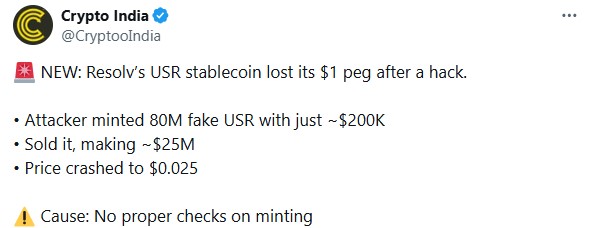
Stablecoins are designed to stay stable, but what happens when a stablecoin loses its $1 peg overnight? This is what happened in the recent Resolv USR stablecoin hack incident.
Source: Crypto India Official
The Resolv’s USR token price has come under intense pressure after a major hack triggered a sharp market crash, raising a serious question: are stablecoins under threat in today’s fast-growing DeFi market?
What Happened to Resolv Stablecoin: Hack Behind the Crash
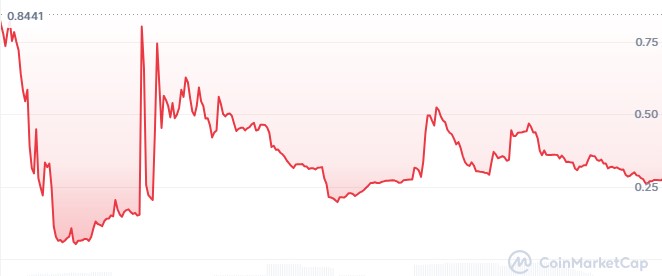
On March 22, 2026, attackers exploited a vulnerability linked to a compromised private key, allowing them to mint nearly 80 million unbacked tokens. This sudden surge in supply caused the Resolv stablecoin to lose its $1 peg almost instantly, crashing as low as $0.025 before partially recovering to the $0.20–$0.30 range.
Source: CoinMarketCap Official
The event triggered heavy selling pressure and drained liquidity, as the attacker quickly swapped these tokens into real assets like ETH and USDT , extracting around $23–$25 million, through decentralized exchanges.
Despite the scale of the exploit, the protocol confirmed that its $141 million collateral pool remains intact, with only about $500K in direct losses recorded before the system was paused.
Resolv Responds: Protocol Paused, Recovery Plan Begins
Following the hack, the Resolv USR stablecoin protocol was immediately paused to prevent further damage. The team also burned around 9 million attacker-held tokens to reduce risk.
The team has now announced a recovery plan, with redemptions for pre-exploit users starting March 23, 2026. These will prioritize verified users, while the platform continues to trace stolen funds with law enforcement and blockchain analytics firms.
The team has also warned users to avoid trading affected tokens until stability returns.
Ripple Effect Across DeFi Platforms
The Resolv USR stablecoin hack incident incident didn’t just affect one platform, it created problems across many DeFi services.
When the price of USR suddenly dropped, platforms that were using it as collateral faced trouble. Many users saw their positions automatically liquidated (their assets got sold to cover losses), and some platforms even had to pause or deal with temporary disruptions.
A few DeFi platforms stepped in to help users recover some losses, but the event highlights how a single pegged-value coin hack can create ripple effects across the ecosystem.
Stablecoins Under Threat When Decentralization Becomes a Tool for Attackers
Over the years, many major coins have faced exploits resulting in massive losses, even complete collapses. The biggest was TerraUSD in May 2022, which collapsed due to design flaws, wiping out around $40–60 billion from the ecosystem.
Other major incidents include, Cashio and Beanstalk in 2022, Euler Finance and Curve Finance in 2023, and more recently, in 2025–2026, incidents like YU stablecoins drained hundreds of millions in these incidents.
Overall, DeFi hacks have crossed $7 billion+ in losses, with stablecoin exploits often causing wider damage due to their role as collateral across platforms.
On the other hand, where decentralization enables open and permissionless access, bad actors use this same structure to move and swap theft tokens across decentralized exchanges to make tracking and recovery harder, putting innovative technology into an advantage for money untrackable transfers.
This all shows how advancement in technology demands secure infrastructure and proper maintenance to avoid incidents like that.






