Robinhood Crypto Staking Faces Regulatory Roadblocks in the U.S.


Robinhood Crypto Staking Still Blocked in Four U.S. States
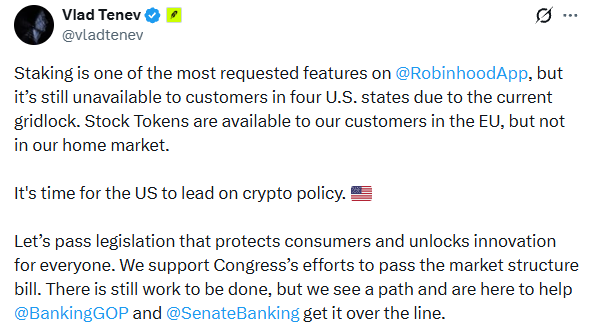
Robinhood CEO Vlad Tenev posted on X: Why is the U.S. falling behind the rest of the world in crypto innovation? Despite staking being the #1 most requested feature on the platform, He revealed that "regulatory gridlock" is still preventing the company from offering this service. Robinhood crypto staking is still blocked in four U.S. states
 Source: X(formerly Twitter)
The Global Gap: EU Gets "Stock Tokens," US Gets Red Tape
Tenev didn’t stop at staking. He pointed out a glaring irony: the company's Stock Tokens, which allow users to trade tokenized versions of traditional equities, are live and thriving in the European Union. However, in Robinhood’s own home market, the U.S., the feature is legally off-limits.
"It’s time for the US to lead on crypto policy," Tenev urged, calling on Congress to pass the long-awaited Market Structure Bill. He argued that the current lack of clarity isn't just annoying for users, it's actively pushing the next generation of financial technology overseas.
Why the "Bill of the Century" Just Hit a Major Snag
The timing of Tenev’s comments is critical. Just as Robinhood is pushing for progress, the Senate Banking Committee hits a massive speed bump. A planned markup of a sweeping crypto bill was postponed this week after Coinbase CEO Brian Armstrong pulled his support.
Armstrong warned that the latest version of the bill was "riddled with flaws", including:
A de facto ban on tokenized equities (the exact feature Tenev wants to bring to the US).
DeFi restrictions that would effectively kill decentralized finance innovation.
Stablecoin rules that would stop platforms from paying out rewards to users.
This "good bill vs. bad bill" debate has the industry divided. While firms like Circle and Ripple are pushing to move forward with any legislation, heavyweights like Coinbase and Robinhood are holding out for rules that don't accidentally "smother" the technology before it can grow.
Beyond Crypto: Tenev’s Bold Take on AI and Jobs
In a separate sit-down with FOX Business, Tenev pivoted from crypto to another 2026 titan: Artificial Intelligence. While many fear that AI will wipe out the workforce, Tenev is actually an optimist. He predicts that AI will trigger an "explosion of new jobs", creating entire "job families" that don't even exist yet.
He compared the current AI shift to past technical disruptions, noting that while the change is happening much faster this time, it will ultimately reform how we work rather than making humans obsolete.
The Bottom Line
The message from the top of Robinhood is clear: the technology is ready, the users are waiting, but the lawmakers are still stuck in neutral. Whether it's Robinhood crypto staking or the future of AI-driven work, the "gridlock" in Washington remains the biggest hurdle to the next financial revolution.









