Russian Crypto Regulation: New Law to Open Retail Trading

How Russian Crypto Regulation 2026 Impacts Individual Investors
In a massive shift for Eastern European markets, Russian crypto regulation 2026 is moving toward a future where digital assets are part of everyday life. On January 13, 2026, Anatoly Aksakov, Chairman of the State Duma Committee on Financial Markets, confirmed that a groundbreaking bill is ready for the spring session. This legislation aims to remove Bitcoin and other virtual coins from "special financial regulation", treating them instead as a standard part of the financial landscape.
 Source: X(formerly Twitter)
For the first time, the Russian crypto regulation 2026 framework will provide a legal path for ordinary, non-qualified citizens to enter the market. While Russia has historically been cautious, the need for modern financial tools has pushed lawmakers to create a system that balances innovation with strict investor protection.
How Russian Crypto Regulation 2026 Impacts Individual Investors
The heart of the Russian crypto regulation 2026 update is the tiered access system. Lawmakers want to ensure that while people can invest, they do not take on more risk than they can handle. This approach mirrors the safety standards seen in other major global economies like the EU.
A Safety Net for New Investors (The 300k Ruble Cap)
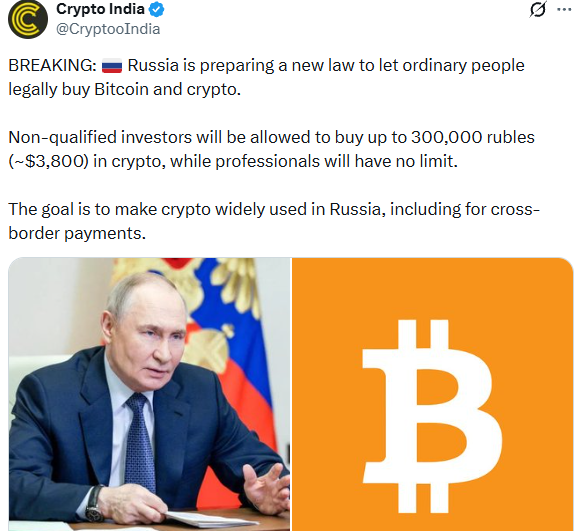
Under the new Russian crypto regulation 2026 rules, the government is introducing a "safety first" approach for regular people. If you’re a typical retail investor, you’ll be allowed to buy up to 300,000 rubles (about $3,800) worth of digital assets each year. The idea here isn't to block you but to let you experiment with Bitcoin or Ethereum without accidentally risking your entire life savings. To get started, you'll just need to pass a quick "risk awareness test", sort of like a driver’s license for digital currency to show you understand how virtual wallets and market swings work.
No Speed Limits for the Pros
While everyday users have a cap, professional traders and licensed firms aren't being held back. The Russian regulation 2026 framework gives high-net-worth individuals and financial institutions the green light to trade as much as they want. This is a huge deal for the country’s biggest trading floors, like the Moscow Exchange (MOEX) and the St Petersburg Exchange (SPB). Both are already racing to launch fully regulated digital currency departments by the middle of 2026, which should bring a massive wave of fresh cash into the market.
Crypto for Global Trade, Rubles for Daily Life
One of the biggest parts of the Russian crypto regulation 2026 bill is how it handles international business. It makes it much easier for companies to use tokens for cross-border payments, helping them jump over the hurdles of traditional banking. However, don’t expect to start paying for your groceries with Bitcoin. Within Russia, the ruble is still king it remains the only official way to pay for things like bread, coffee, or taxes. Digital asset is officially viewed as a smart investment tool, not a replacement for cash.
Conclusion
The 2026 legislative push shows that Russia has finally stopped debating whether to ban digital asset and has instead started figuring out how to use it. By bringing digital assets into the official financial system, they are choosing "controlled adoption". This isn't just about people trying to get rich quick; it’s about building a modern, digital economy that can stand on its own two feet, independent of global banking networks.






