SEC States Proof of Stake Staking Is Not an Investment Offer


SEC States Proof of Stake Staking Is Not Investment-Based
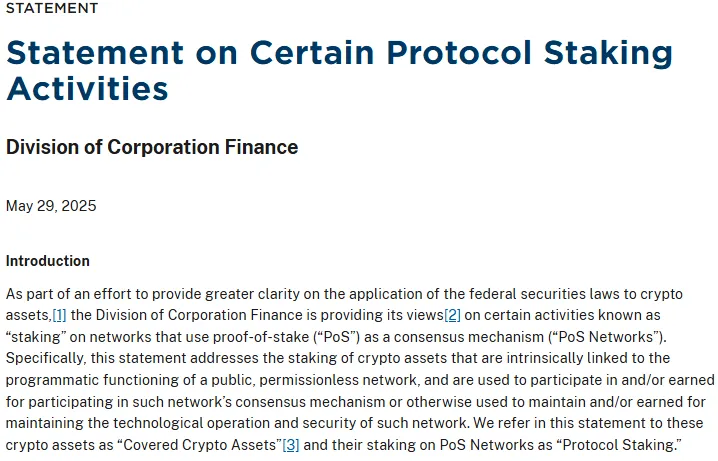
Washington, May 29, The U.S. Securities and Exchange Commission (SEC) has made a major announcement about crypto investments. The agency’s Division of Corporation Finance said that certain proof-of-stake (PoS) staking activities do not fall under federal securities laws. This new guidance may bring relief to many in the digital assets industry, especially individuals and companies that run or offer staking services in the United States.
The statement said that self-staking, through a third-party while keeping control of your cryptocurrency, and custodial loacking of tokens where a company stakes on behalf of users, are all not considered securities transactions. Commission stated these activities don’t need to be registered with the SEC, and they’re not subject to the usual investment rules that apply to stocks or bonds.
Source: SEC
Staking Rewards Are Not Investment Profits, Says SEC
The SEC explained that rewards earned through locking the tokens are not the same as profits made from someone else’s business. Instead, they are payments for helping to run and protect a blockchain network. In the said approach, users lock their crypto to help verify transactions. For doing this, they get rewarded. According to the agency, this is more like earning service fees than investing for profit.
The Commission also said that custodial locking services, where a company stakes on behalf of users, do not control the staking process. The companies do not choose when or how much of the user’s crypto is staked. As financial experts, they help you, not control your investments.
Additional Services Are Just Paperwork
Other perks associated with this approach were also things the statement mentioned. Some of these are reducing protection, making assets available early, setting your own reward period and joining multiple assets to meet minimum requirements. Simply put, the commission said these functions are routine, so they are not turning locking the crypto into an investment. Such pools are exempt from being considered entrepreneurial ventures in securities law.
Still, the statement does not cover every type of it. It does not give an opinion on more complex models like liquid staking or restaking. Also, the guidance is not an official crypto rule. It is a staff opinion and doesn’t carry the weight of law.
Mixed Views Among SEC Commissioners
Not everyone at the SEC agrees on this issue. Commissioner Hester Peirce supported the guidance, calling it a good step forward. She said the lack of clarity on staking had scared some people away from using crypto. “This uncertainty stopped Americans from joining network consensus and hurt the decentralization of PoS networks,” she explained.
But Commissioner Caroline Crenshaw had a different opinion. She said the guidance ignores court rulings where locking of tokens services were treated as securities. Crenshaw reminded everyone that the Howey Test is still the legal way to decide if something is a security. She added that just calling someone a “custodian” doesn’t mean they provide the legal protections that are usually required under securities laws. According to her, crypto staking still carries risks like protocol bugs or hacks, and there are no clear rules in place to handle these problems.
Ripple’s Legal Team Also Calls for Clear Rules
This SEC update comes shortly after Ripple’s CLO, Stuart Alderoty, sent a letter to the agency asking for better rules. He said most tokens traded on exchanges should not be treated as securities.
He said his letter draws attention to recent lawsuits and legal discussions that fit his views. He thinks the U.S. could be falling behind in cryptocurrency innovation because there are not clear rules yet.
Conclusion
The SEC’s statement is good news for the crypto industry, more so for those engaged in proof-of-stake networks. This is helpful for dismantling confusion over whether staking needs to be considered a securities activity. Since the guidance is only provided and doesn’t deal with liquid locking of tokens or other complicated things, questions still persist. There is still a need for tougher, more transparent rules to back innovations in crypto. It is a good start, yet still not everything the crypto community needs.








