Starknet STRK20 Launch Introduces Privacy Tokens for DeFi

Starknet STRK20 Unveils Privacy Standard for ERC-20 Tokens
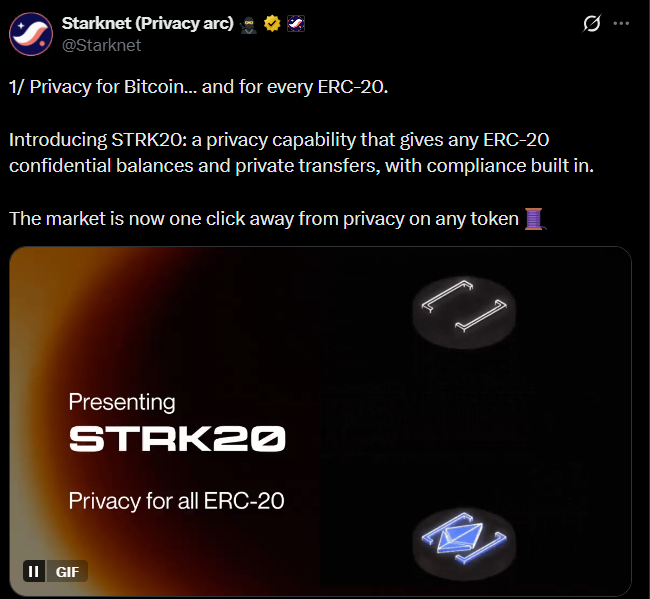
Starknet STRK20 introduces a new way to keep token activity hidden on a public blockchain. Public ledgers are useful because anyone can verify transfers and balances. But that same openness can also expose sensitive financial activity. This can be a problem for users, firms, and funds that do not want every move seen by everyone. To solve that issue, the network has launched a token framework that hides balances and transfers by default while still working with DeFi tools.
Source: X Official
Built-in protection for ERC-20 style assets
Hidden transfers and balances with DeFi support
Core Architecture and Privacy Technology
Starknet STRK20 is built to support confidential token use inside the ecosystem. Instead of adding outside mixers or extra layers, the design places protection features directly inside the asset structure. This lets developers create tokens that work with DeFi apps while keeping core transaction data out of public view.
The system uses zero-knowledge technology. In simple words, this means the network can prove that a transaction is valid without showing all of its details. Users move funds through a pool system where assets can be deposited, transferred in a hidden way, and later withdrawn.
This model helps solve a basic problem on public chains. Usually, anyone can track the sender, receiver, amount, and wallet balance. With Starknet STRK20, that information stays hidden while the network still checks that each action is correct.
Uses zero-knowledge proofs for hidden transfers
Keeps token activity valid without exposing details
Security Protocols and Compliance Design
Starknet STRK20 is not only about hiding data. It also tries to support compliance needs. The framework includes encrypted viewing keys, which allow selective disclosure when needed.
This means users can keep normal activity hidden from public view, but authorized groups may still review records during audits or legal checks. That balance is important because many blockchain tools have struggled to combine confidential activity with oversight.
The design aims to make secure finance more useful in real settings. It protects day-to-day users without removing the option for limited transparency when rules require it.
Public users cannot see full transfer details
Authorized checks remain possible through viewing keys
Initial Launch Integrations and Applications
Starknet STRK20 is expected to support real DeFi use cases from the start. Early examples include private swaps through Ekubo and hidden staking options for assets such as BTC and STRK-token.
That matters because users often want more than secret payments. They also want to trade, stake, and manage positions without showing every move. This framework gives builders a clearer way to create such tools inside existing DeFi systems.
Developers are also exploring confidential stablecoins and shielded tokenized assets. If those ideas grow, the new standard could support a wider set of products across onchain finance.
Private swaps may launch through Ekubo
Anonymous staking is part of the early plan
Impact on the Crypto Industry and Future Payments
Starknet STRK20 could help public blockchains appeal to more businesses and larger investors. Many firms avoid open ledgers because rivals can watch treasury moves, trading flows, or business activity.
By hiding key data while keeping smart contract support, the framework may help firms use blockchain tools with more confidence. It could also support payment systems, stablecoins, and financial apps that need stronger confidentiality.
This is why Starknet STRK20 matters beyond one network. If it works well, it may help shape a new model for onchain finance where open infrastructure and protected activity can exist together.
May support business use and institutional adoption
Could strengthen future payment and finance systems
Conclusion:
Starknet STRK20 offers a new model for confidential token activity on a public chain. By mixing zero-knowledge proofs, hidden transfers, and selective disclosure, it gives developers a path to build safer financial tools. If adoption grows, Starknet STRK20 could become an important step for digital payments and secure asset use in DeFi.
Also read:








