Supreme Court to ED on PMLA Record, Calls for Crypto Regulation


Supreme Court to ED: Implement Immediate Crypto Regulation Framework
How does the Enforcement Directorate retain its credibility with less than 10 convictions in more than 5,000 cases? The Supreme Court to ED posed this burning question on Thursday while putting forth cutting comments about the agency's functioning under the provisions of the Prevention of Money Laundering Act.
Two separate benches thus examined the powers of the Enforcement Directorate, its low conviction rate, prolonged custody of accused persons, and flagged the requirement of cryptocurrency regulations in an extraordinarily dramatic day of proceedings.
Supreme Court to ED Questions Low Conviction Rate
Coming into the first hearing, the bench led by Chief Justice Bhushan R Gavai was hearing review petitions connected with the insolvency case of Bhushan Power & Steel Limited. In the direct language, the CJI asked about the low conviction rate of the Enforcement Directorate and Solicitor-General Tushar Mehta had to admit that the rate was low but on par with that for other penal offences.
Justice Gavai, however, castigated the agency in his socially charged tone for "sentencing without trial" by having people in extended pretrial detention under strict PMLA bail provisions, thereby punishing very much before any adjudication could even be conducted. The Supreme Court to ED observation highlighted that such practices undermine trust in due process.
Supreme Court to ED – ED Defends Itself with Recovery Figures
In defense, Mehta revealed that ED had recovered and returned nearly ₹23,000 crore to victims of financial crimes; he also spoke of such high-profile raids involving so much cash that his counting machines had actually failed. However, the CJI stressed that the court will not rely on media narratives but focuses on facts and law.
“Cannot Act Like a Crook,” Warns Second Bench
In another hearing, the three-judge bench led by Justice Surya Kant went further to voice, "You cannot act like a crook. You have to work within the four corners of the law." Justice Ujjal Bhuyan observed that in thousands of cases Enforcement Directorate had basically obtained fewer than 10 convictions and urged the agency to train itself better in investigation and witness management.
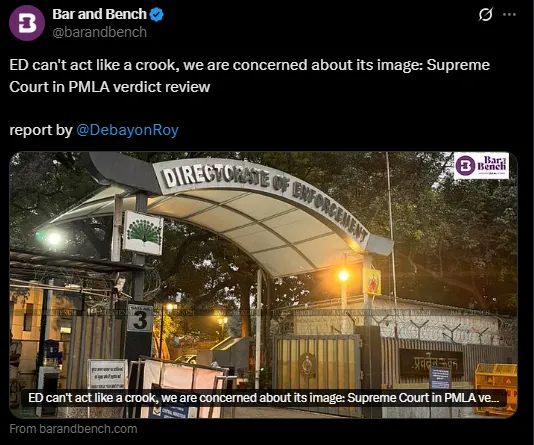
Source: X
The Bench voiced grave concern over people being held for years in jail as an accused, waiting to be tried, and wondered aloud, "And after five or six years of judicial custody, in case people are acquitted, who will pay for it?" The Supreme Court to ED remark made it clear that prolonged detention without conviction is a matter of serious judicial concern.
“Why Can’t Crypto Be Regulated?”
During one of the hearings, the bench turned the spotlight on money laundering activities that crypto could be subjected to. The judges made it very clear that they were not pleading for an outright ban, whereas they asked why there should be zero oversight on these digital assets when the Indian currency itself is operating under strict procedures.
“We are not saying ban cryptocurrency. But there should be some regulation. Indian currency is also under certain regulations. Why can’t crypto be subjected to regulations?” were the words uttered by the bench, signalling the judicial approval for the formalisation of a policy framework.
The statement by the bench has practically come when the Indian government has yet to pass a comprehensive crypto law, having only introduced a tax regime and in force certain anti-money laundering rules to be abided by by the crypto exchanges. This Supreme Court to ED observation could accelerate legislative clarity for the crypto sector.
Review of Vijay Madanlal Judgment
The review petitions still pending before the court are in direct challenge to the Supreme Court to ED 2022 ruling in Vijay Madanlal Choudhary, which accepted EC sweeping powers, including arrests without FIR, reverse burden of proof, and strict bail conditions-the very issues that petitioners argue weaken constitutional safeguards and lead to misuse.
Additional Solicitor-General SV Raju opposed a review on the ground that the review was really an appeal and should be confined only to the issues of the supply of the Enforcement Case Information Report (ECIR) and the bail clause.
Implications for ED and the Crypto Sector
Thursday's proceedings witnessed increasing judicial displeasure toward ED's way of investigation and the pressing need for reform of the criminal justice machinery under the PMLA. On the other hand, any comments on cryptocurrency made by the bench might drive legislative efforts seeking to tie up the loose ends of crypto regulation in India, setting the future compliance landscape for both exchanges and investors.
The Supreme Court to ED exchanges in court signal a potential turning point for both enforcement accountability and the regulatory future of digital assets in the country.