TRON Beats Bitcoin, Post-Quantum Security Initiative Launched

Justin Sun announces TRON NIST-standard Post-Quantum Signatures
Crypto is rapidly becoming a source of economy due to its transparency, high security and decentralization nature. At the same time, people have worried about the quantum threat to cryptocurrencies. These futuristic machines are one which can eventually break today's crypto wallets security features hashing algorithm.
To stop this, TRON founder Justin Sun shared a big plan. He stated that the blockchain will use new rules called NIST-standardized signatures—a special post-quantum security method. These are like high-tech digital fingerprints that even the strongest quantum computer cannot crack.
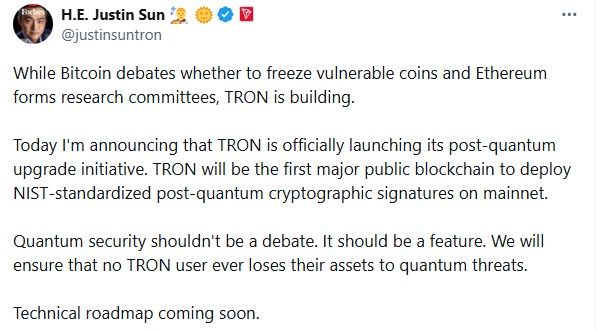
Source: X Official (@justinsuntron)
Sun wants to make TRON-chain the very first large blockchain to use this new move, which will protect people's money from super-powerful future computers.
How the TRON Post-Quantum Upgrade Helps You
The blockchain is adding new NIST-standardized cryptographic signatures to protect wallets and transactions. It works by letting wallets create new post-quantum key pairs and sign transactions with these safer signatures. The upgrade is expected to use ML-DSA (FIPS 204) as the main standard, with SLH-DSA (FIPS 205) as backup.
In the early stage, TRON will likely use hybrid signing, where both the current ECDSA and the new post-quantum signature are checked by network nodes. This keeps compatibility while moving users to stronger security. The main trade-off is size, because post-quantum signatures are much larger at around 2–4 KB, compared with 64–70 bytes for ECDSA.
Even though these new security tools are complex, the team is working to keep the network fast. The platform handles a lot of USDT, so staying speedy is very important.
Adding on, in this era of fast competing, the network is proving its leadership against major networks like Bitcoin and Ethereum.
TRON vs. Bitcoin vs. Ethereum: The Race for Quantum Safety
The threat of quantum computing is a major challenge for all blockchains, but each network is moving at a different speed.
TRON: With the TRON Quantum Security Initiative 2026, this network is moving straight to implementation. By deploying NIST post-quantum signatures on its mainnet, the network aims to be the first major chain to offer built-in protection for its users.
Bitcoin: Bitcoin is taking a much slower, more cautious approach. Developers are currently debating whether they should simply "freeze" older, vulnerable coins that cannot be updated. Most experts think Bitcoin is still 3 to 5 years away from a real solution.
Ethereum: Ethereum is in the middle. It has formed research committees to study the problem and is looking into "Account Abstraction" to help users switch to safer keys later. However, it has not yet set a firm date for a mainnet launch of these features.
Post-Quantum Upgrade 2026: Growing Confidence in TRX Price and Adoption
As the platform moves toward these high-tech security updates, the community reacts positively. The TRX price, native token of the network, recently climbed to $0.324, showing that investors like the news.
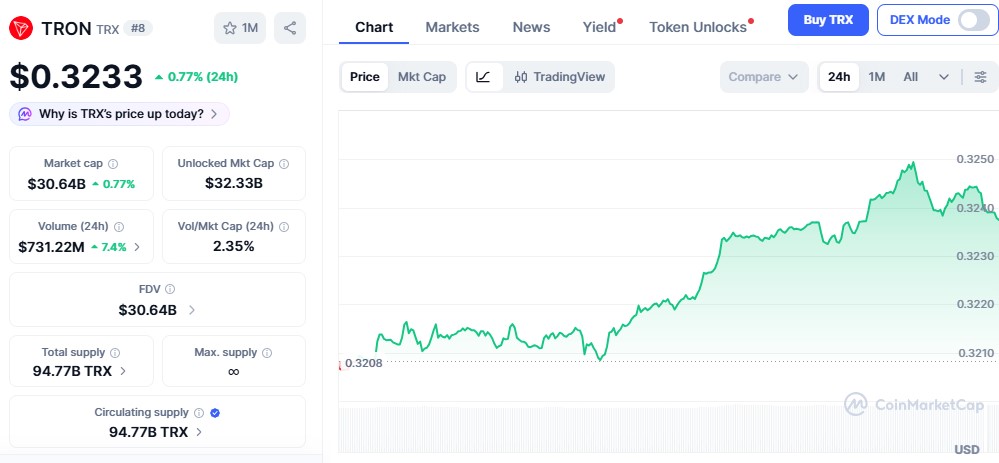
Source: CoinMarketCap Official
Unlike other coins that move only when Bitcoin moves, $TRX is starting to show its own strength. With over 3.5 million people using their accounts every day, the network is becoming a favorite spot for digital payments and saving money.
Experts believe the TRON Blockchain has a bright path ahead. Many predict that if the network holds steady, the price could soon test $0.325 or higher. As more people choose TRON-chain for its low fees and new quantum computing crypto security 2026 features, the demand for TRX will likely stay high.
The upcoming Hong Kong Web3 Festival in late April is the next big event that could push the price even further as more partners join the ecosystem.
Note: The article above is for informational purposes only; it does not include any financial or legal advice.
Also read:






