US Treasury crypto mixers Report Admits to Valid Privacy Uses

How the US Treasury Crypto Mixers Report Pushes New Rules
In a major shift for the digital asset world, the US Treasury crypto mixers report submitted to Congress now admits that these tools have lawful uses. For years, the government mostly treated mixing services as tools for criminals. However, in a new 32-page document, the Treasury acknowledges that everyday people use mixers to protect their financial privacy on public blockchains.
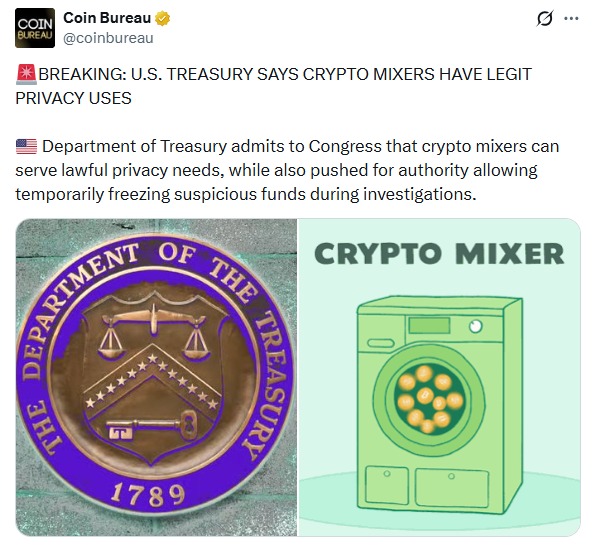 Source: X(formerly twiiter)
The report explains that as more people use digital assets for payments, they may want to hide their spending habits from the public eye. For example, a person might use a mixer to keep their personal wealth, business payments, or even charitable donations private. This is because blockchains like Bitcoin and Ethereum are public ledgers where anyone can see a user's transaction history if they know the wallet address.
How US Treasury crypto mixers Data Shapes New Hold Laws
While the Treasury now sees the value in privacy, it still has big concerns about how criminals use these services. New data on US Treasury crypto mixers shows that since 2020, over $1.6 billion has moved from mixers into "crypto bridges". These bridges allow users to move their tokens between different blockchain networks.
The Department found that a large portion of this money about $900 million went through a single bridge linked to North Korean hackers. These groups, like the Lazarus Group, often steal crypto and then use mixer to hide the trail before turning the money into cash.
Key Findings from the Report
Lawful Privacy: Everyday users leverage mixer to keep sensitive financial data safe from fraud or theft.
Criminal Activity: North Korean actors stole at least $2.8 billion between 2024 and 2025, often using mixers.
Bridge Risks: About 12% of all mixed funds eventually flow into cross-chain bridges to bypass detection.
Custodial vs. Decentralized: The Treasury notes that "custodial" mixers, which are run by companies, are easier to regulate than "decentralized" ones that have no central leader.
The Push for a New "Hold Law"
Because of these risks, the Department is asking Congress for a new "hold law". This law would give crypto exchanges the power to temporarily freeze suspicious funds while they investigate. This would help stop illegal money from moving without needing a court order right away.
Future Outlook: Expert Analysis
The US Treasury crypto mixer's report marks a turning point in how the government views privacy. By admitting that mixer's have "valid" uses, the Department is finally listening to privacy advocates. However, the push for stricter oversight through the "CLARITY Act" and new "hold laws" shows that the battle for financial freedom is far from over.
In 2026, we expect to see a lot of debate in Congress about how to balance privacy with security. While custodial mixer may become more common because they follow the rules, decentralized mixer's will likely face more pressure from regulators. For now, the Treasury's admission is a win for the digital asset community, even if it comes with a promise of tighter control.
Your Money Your Life Disclaimer: Cryptocurrency laws change quickly. Using mixer or bridges can sometimes lead to your funds being flagged or frozen by exchanges. Always check current regulations before using privacy tools.
Also read:









