USDC News: Circle Mints $250M on Solana Amid Stablecoin Boom

USDC News: Does $250M Mint on Solana Points to Institutional Demand?
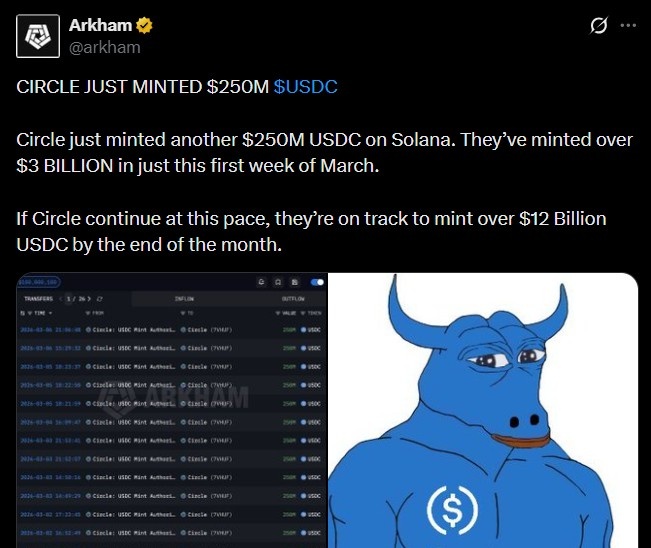
In the latest USDC news, Circle has minted more than $250 million USDC on the Solana network, a transaction flagged by blockchain analytics platform Arkham. The minting event signals fresh liquidity entering the digital asset ecosystem and highlights growing institutional demand for stable assets.
Source: X Official
According to on-chain data, the newly issued tokens were created by the USDC treasury after an institutional client deposited funds. Such minting events typically indicate capital preparing to move into trading, decentralized finance platforms, payment infrastructure, or exchange liquidity.
The development comes during a period of rapid expansion in the stablecoin sector. Circle has already minted over $3 billion of USDC in the first week of March. If issuance continues at the same pace, analysts estimate the company could create more than $12 billion worth of tokens by the end of the month, signaling strong institutional participation in blockchain finance.
Institutional Liquidity Driving Stablecoin Expansion
Arkham monitoring tools flagged the $250M Solana mint transaction.
Newly issued tokens often prepare liquidity for exchanges, DeFi activity, and payments.
Large-scale issuance usually reflects growing demand from institutional investors moving capital onto blockchain networks. Stablecoins function as digital dollar equivalents, making them essential for trading pairs, cross-border payments, and decentralized lending.
Within the broader ecosystem, rising adoption is pushing governments to accelerate regulatory discussions. This trend is shaping the conversation around digital currency oversight in the United States.
Policy Developments Could Shape the Future of Digital Dollars
The CLARITY Act is expected to be debated again in mid-2026.
U.S. policymakers plan discussions on stablecoin usage, yield rules, and banking integration.
In recent months, regulators have signaled plans to establish clearer guidelines for virtual assets. The proposed legislation aims to define how stablecoins can operate within financial systems, including rules covering payment usage, financial returns, and institutional custody.
Industry observers believe that once the framework advances, digital dollar tokens may gain broader legitimacy across financial markets. This could enable smoother integration between blockchain networks and traditional banking services.
Enforcement Actions Highlight Regulatory Attention
Tether recently froze USDT linked to a $61 million pig-butchering scam investigation.
The company has reportedly blocked around $4.2 billion in suspicious assets connected to illicit activity.
Security enforcement is becoming a major focus in the stablecoin sector. Actions like asset freezes demonstrate growing cooperation between blockchain firms and government agencies.
These measures are often presented as proof that digital asset platforms are strengthening compliance mechanisms while maintaining transparency on public ledgers.
Florida’s Stablecoin Bill Signals Growing Policy Momentum
Florida lawmakers recently approved a stablecoin bill through both legislative chambers.
The proposal now awaits the governor’s signature to become active law.
If signed, Florida could become the first U.S. state to introduce a dedicated framework for digital dollar tokens. The move may create a regulatory testing ground that influences federal policy discussions.
Experts say the combination of increasing adoption, institutional inflows, and evolving legal frameworks indicates that policymakers are preparing for a future where blockchain-based financial infrastructure plays a larger role in global markets.
Conclusion:
This latest USDC news reflects accelerating demand for stable digital dollars, while regulatory discussions and enforcement actions show that governments are preparing frameworks to manage the rapidly expanding stablecoin economy.
This article is for informational purposes only and should not be considered financial or investment advice.








