Verus Ethereum Bridge Hack Drains $11.58M — Blockaid Warns Users Now


Verus Ethereum Bridge Hack Drains $11.58M — Blockaid Warns Users Now
Is your crypto safe if it crossed the Verus-Ethereum Bridge?
That question is burning across DeFi communities right now. Security firm Blockaid issued an urgent community alert after its exploit detection system identified an active, ongoing attack on the Verus Ethereum Bridge hack — with approximately $11.58 million already drained at the time of the warning.
The alert landed with immediate force. Blockaid, the same firm trusted by Coinbase and MetaMask for real-time threat detection, confirmed the attack was live and still in progress when the warning went out. Users with funds on or near the bridge were urged to take immediate protective action.
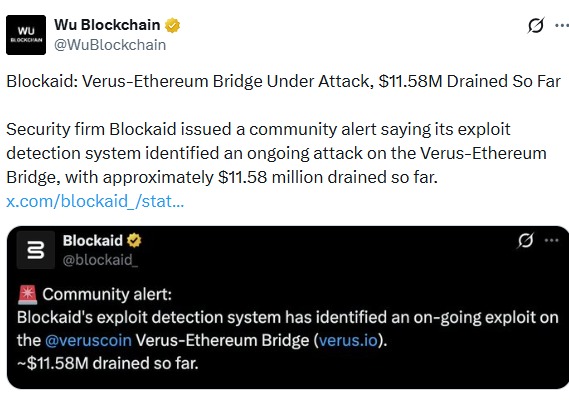
Source: X Account
How the Verus Ethereum Bridge Hack Unfolded in Real Time
The Verus Ethereum hack follows a pattern that has become uncomfortably familiar in 2026.
Cross-chain bridges — the infrastructure that lets users move assets between two separate blockchains — hold concentrated pools of funds on both sides of the connection. That concentration makes them the single most valuable target for attackers in all of DeFi. When a it fails, the losses arrive fast and in large amounts because the entire locked value becomes accessible in a single exploit window.
Blockaid's detection system flagged the Ethereum attack in real time, issuing its public community alert as the drain was actively happening. The $11.58 million figure represented the confirmed amount lost at the time of the warning — not necessarily the final total, since active exploits frequently expand before the attack vector is closed.
The Verus-Ethereum connects the it's blockchain—a privacy-focused, proof-of-work and proof-of-stake hybrid chain—to Ethereum's ecosystem, allowing assets to move between the two networks.
That contract holds user funds in escrow on the Ethereum side while mirrored assets exist on the it's side. A vulnerability in how that escrow contract validates or processes transactions is the likely attack surface, consistent with the pattern seen in every major exploit of 2026.
What the Verus Hack Means for DeFi Users in May 2026
The Verus Ethereum Bridge hack does not exist in isolation. It is the latest entry in the worst year for DeFi security on record.
DeFi losses topped $750 million in 2026 through mid-April alone, with the KelpDAO bridge exploit at $292 million and the Drift Protocol hack at $285 million leading the damage. April 2026 logged approximately $625 million drained across 28 separate incidents — the worst month for DeFi exploits on record.
The attack adds another entry to a list that shows no signs of slowing down. Blockaid had previously flagged a $5 million exploit on Wasabi Protocol in April and a $6.7 million exploit on TrustedVolumes in early May—two incidents that demonstrate the firm's consistent ability to catch active attacks in real time.
For anyone holding assets that interacted with the Verus-Ethereum Bridge, three actions are immediate priorities. First, do not initiate any new transactions through until the team issues a full all-clear. Second, check your wallet for any pending approvals connected to the contract and revoke them using Revoke.cash. Third, monitor the official blockchain X account and Blockaid's X account for real-time updates as the postmortem develops.
The Verus Ethereum Bridge hack is a live situation. The $11.58 million figure may not be the final number. At the time of publication, no official statement from the Verus team had confirmed whether the attack vector had been closed or whether additional funds remained at risk.
Expert Analysis
Security analysts tracking 2026's exploit pattern note that the attack surface in modern DeFi has shifted decisively away from smart contract code flaws toward validation logic and cross-chain message verification weaknesses. Every major incident of 2026 — KelpDAO, Hyperbridge, ZetaChain, and now Verus — shares a common thread: the exploit did not require breaking the blockchain itself. It required breaking the trust layer that connects two blockchains. Until bridge protocols implement redundant verification layers, multi-sig admin controls, and real-time circuit breakers as standard practice rather than optional upgrades, the Verus Ethereum hack will not be the last incident of this scale in 2026.
Conclusion
The Ethereum Bridge hack is 2026's latest reminder that remain DeFi's most dangerous infrastructure. Blockaid caught it live. The damage reached $11.58 million before the alert landed.The full story is still developing — but one thing is already clear. In a year where it has already lost nearly a billion dollars, every cross-chain connection carries risk that users must treat as real, not theoretical.
Disclaimer: This article is published for informational and news reporting purposes only. It does not constitute financial or investment advice.

3 months ago
Mighty Hacker Recovery offers professional services in cybersecurity and digital recovery for individuals and businesses. Their services include data recovery, digital forensics, cybersecurity consulting, malware detection, and incident response. They promise experienced, confidential, and fast support while following ethical practices. Clients can contact them via their website https://mightyhackarrecovery.com/ or WhatSapp Canada +1 (343) 947-3496 for assistance. Additionally, the text poses various questions related to crypto recovery, including inquiries about stolen cryptocurrency, recovery experts, and their effectiveness. BITCOIN RECOVERY EXPERT AT MIGHTY HACKER RECOVERY USDT RECOVERY EXPERT AT MIGHTY HACKER RECOVERY ETH RECOVERY EXPERT AT MIGHTY HACKER RECOVERY CRYPTOCURRENCY FRAUD RECOVERY HACKER FOR HIRE AT MIGHTY HACKER RECOVERY WhatSapp Canada +1 (343) 947-3496

3 months ago
Mighty Hacker Recovery offers professional services in cybersecurity and digital recovery for individuals and businesses. Their services include data recovery, digital forensics, cybersecurity consulting, malware detection, and incident response. They promise experienced, confidential, and fast support while following ethical practices. Clients can contact them via their website https://mightyhackarrecovery.com/ or WhatSapp Canada +1 (343) 947-3496 for assistance. Additionally, the text poses various questions related to crypto recovery, including inquiries about stolen cryptocurrency, recovery experts, and their effectiveness. BITCOIN RECOVERY EXPERT AT MIGHTY HACKER RECOVERY USDT RECOVERY EXPERT AT MIGHTY HACKER RECOVERY ETH RECOVERY EXPERT AT MIGHTY HACKER RECOVERY CRYPTOCURRENCY FRAUD RECOVERY HACKER FOR HIRE AT MIGHTY HACKER RECOVERY WhatSapp Canada +1 (343) 947-3496











