What Is Bitwise Chainlink ETF Filing: SEC Explain Easy LINK Access

Bitwise Chainlink ETF Filing News: Can You Soon Invest in LINK Easily?
Bitwise, a well-known digital asset manager, has taken another major step toward bringing cryptocurrencies into the traditional financial markets. On 26 August 2025, the company filed a Form S-1 registration statement with the US SEC for the launch of the Bitwise Chainlink ETF.
This document is the SEC’s preliminary prospectus for the Bitwise Chainlink ETF (proposed exchange-traded fund), aiming to offer investors a regulated and accessible way to gain exposure to Chainlink (digital asset).
If approved, this product would allow investors to gain direct exposure to Chainlink (LINK) through an exchange-traded fund. The article provides a comprehensive overview of how the ETF will function, governance, fees, custodial arrangements, and associated risks.
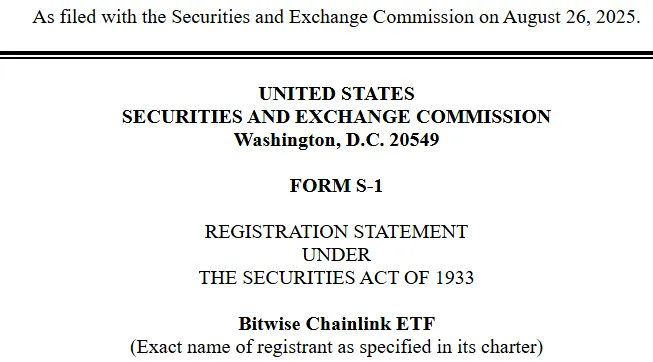
Source: Official SEC Announcement
What the Filing Means
A Form S-1 is a requirement that companies file with the SEC when they intend to issue securities to the market. In this instance, Bitwise is trying to list shares of a Chainlink-backed Exchange Traded Fund. The trust that owns the product is Delaware-registered and sponsored by Bitwise Investment Advisers, LLC.
The Exchange Traded Fund will be operating through direct ownership of Chainlink tokens. Its NAV will be pegged on the CME CF Chainlink-Dollar Reference Rate (New York Variant), which is a benchmark that tracks the fair market price of LINK. This makes it transparent in the calculation of the value of the ETF.
How the ETF Works
It will issue and redeem in large blocks known as baskets of 10,000 shares each. Such baskets may be redeemed by Authorized Participants, which are generally financial institutions that have arrangements with the fund.
Authorized Participants may transact by delivering Chainlink directly or in cash by paying US dollars. The fund itself is not going to trade actively. Rather, it passively stores LINK on behalf of investors and charges a management fee to cover operational expenses.
Custody and Security
In this. the custody will be managed by Coinbase Custody Trust Company, LLC. It will hold the Chainlink tokens in cold storage wallets, which are multi-layered. The insurance policies cover the possible security breaches. These holdings, though, like all crypto assets, are not insured by the FDIC.
Potential Risks
The SEC filing also points out risks that come with investing in a Chainlink-based ETF. The most apparent one is volatility. Similar to most cryptocurrencies, LINK is subject to significant price volatility over the short term.
Other risks are regulatory uncertainty, as the U.S. government has not fully clarified whether some tokens can be classified as securities. The filing also cautions against technological risks, custody risks, including loss of the private keys, and market risks associated with the adoption of cryptos.
A Big Step for Chainlink
Bitwise is no stranger to the ETF space. With this latest filing, it is pushing forward on the idea that crypto belongs in traditional portfolios. Whether or not the SEC approves the product remains to be seen. But one thing is clear: institutional-grade access to $LINK is now on the horizon, and Bitwise is betting that investors are ready for it.