Yuan Stablecoin: China’s Push to Challenge Dollar Dominance


China’s Strategy: A New Era of Digital Currency Adoption
China is silently preparing to enter the global Yuan Stablecoin race with a strategic shift that could redefine its digital finance approach. In a strong move, Chinese tech giants JD.com and Ant Group have urged the People’s Bank of China(PBOC) to authorize the creation of a Yuan Stablecoin, pinned the offshore and launched from Hong Kong.
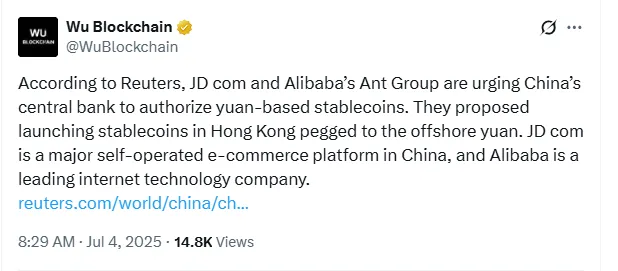
Source: X
This big push targets to counter the growing dominance and to encourage wider international use.
Now, over 99% of the digital asset market is dominated by U.S dollar denominated tokens which allows Yuan Stablecoin would make an important change in stance, especially after its 2021 ban on cryptocurrencies.
JD.com and Ant Group’s Role in Shaping China’s Digital Finance Landscape
JD.com and Alibaba affiliate Ant Group are at the forefront of China’s Yuan Stablecoin development. Both firms are already preparing to issue Yuan Stablecoin backed by the Hong Kong dollar once new legislation in the city takes effect on August 1.
But behind closed doors, they have begun lobbying for the launch to promote China’s currency on the global stage.
JD.com in particular has argued that stablecoin solutions are essential for pushing international confidence.
Industry leaders Wang Yongli, former Vice President of Bank of China have said that relying too much on dollar stablecoins could pose tactical risks to financial independence.
Why Hong Kong? Strategic Gateway for Offshore Yuan Stablecoin
Hong Kong has emerged as a key battleground in the race to become a global hub for Yuan Stablecoin regulation. With its own legal structure set to launch on August 1, the city is offering a regulatory sandbox that is both attractive and flexible.
For JD. com and Ant Group, launching it from Hong Kong offers the perfect mix of offshore credibility and proximity to mainland financial systems.
It still allows them to bypass still restrictive domestic crypto ecosystem while aligning with Beijing’s long-term economic goals.
Regulatory Hurdles: Will the PBOC Embrace Yuan Stablecoin?
Now the question which arises is how China’s central bank will respond? The PBOC has yet to publicly comment on the lobbying efforts or on whether it supports a pegged asset. If approved it would mark a major policy shift and probably open doors for wider crypto-related growth in China.
The delay may stem from examining stability, control and overlap with the digital asset (e-CNY), which is already being rolled out interiorly. Still, pressure from industry giants may push the central bank to reconsider.
Impact on Cross-Border Payments and Trade Settlements
It could simplify international marketing by enabling fast, low-cost and 24/7 fund transfers. It holds assurance for use in Belt and Road transactions which helps in reducing reliance on the U.S dollar and powering role in global trade.
The Case for a Pegged assets: Competing with USDT and USDC. While USDT and USDC dominate the crypto market, it offers non-U.S alternatives. With support from giants like JD.com and Ant Group, it could become a key player in reshaping global digital finance.
Conclusion
China's step towards initiating a pegged asset signifies a clear purpose to move into the global crypto currency game. With firms like JD.com and Ant Group thrusting for progression and Hong Kong offering the right launchpad, this digital token could help the asset worldwide.