Ciforus ($CIFORUS) Presale
Ciforus Presale 2026: CIFORUS Price, Utility, Audit and Tokenomics
The Ciforus presale is a three-round token sale for CIFORUS, an ERC-20 utility token on Ethereum. The token supports a privacy-focused platform built around secure email, messaging, storage, wallet identity and payment requests. This review covers the sale price, token supply, project documents, security report, claim rules and key risks without treating future plans as completed results.
Last Verified, Current Status and What Changed
Last source review: October 19, 2026 (IST). Current status: The project describes its sale as active. The most recent dated stage report available in this review identifies Stage 2 – Growth Round at $0.035 on October 16, 2026. The current October 19 round, amount raised and transaction count were not independently confirmed from the embedded live sale module. Always check the purchase quote before making a transaction.
What Changed Since the Last Update?
Compared with the earlier Stage 1 coverage, the dated October updates identify Stage 2 as the active round. This revised guide also separates the full-sale funding ceiling from actual proceeds, explains updated buyer-claim language, adds the published contract and token allocation data, and distinguishes the LexGuard report's existence from findings that still need document-level verification.
- Sale stage: Stage 2 at $0.035 was reported on October 16; Stage 3 is priced at $0.05.
- Sale progress: Historical figures are labeled by date instead of presented as live.
- Buyer access: Newer project guidance says mandatory buyer vesting has been retired; older token-page text still mentions a TGE decision.
- Audit status: A LexGuard PDF is published, but its exact findings and deployment match are not independently confirmed here.
- Future plans: The $0.10 TGE reference and liquidity plan are not exchange-price or lock guarantees.
Ciforus Token Sale Quick Facts
Start with the core specifications, then compare how other Ethereum token presale projects publish contracts, sale stages and unlock policies.
| Metric | Published information |
|---|---|
| Project | Ciforus |
| Symbol | CIFORUS |
| Network / standard | Ethereum Mainnet / ERC-20 |
| Decimals | 18 |
| Token contract | 0x2D125Cba88516832AE1CDc1d39211fC259182c60 |
| Original token supply | 100,000,000 |
| Sale allocation | 35,000,000 (35%) |
| Last dated round observation | Stage 2 at $0.035, October 16, 2026 |
| Next scheduled stage | Stage 3 at $0.05 |
| Theoretical maximum sale proceeds | $1,325,000 if every offered token sells at its stage price |
| Raised | 339,158 |
| Audit provider | LexGuard; report published |
| Founder KYC | Not independently established |
| Claim and vesting | Newer guidance says no mandatory buyer vesting; earlier token-page wording differs |
| Planned listing reference | $0.10 at TGE, not a guaranteed trading price |
What Is Ciforus and What Does Its App Do?
Ciforus presents itself as a privacy platform rather than a new blockchain. Its website describes private email, secure notes, file storage, wallet-to-wallet messaging, Pay Links and account protection. The Ciforus privacy features include encryption, secure messaging and wallet-based identity tools designed to protect user information. The platform is advertised as built and available, while some token features remain on the roadmap. A public website and app access do not by themselves prove encryption quality, active user totals or revenue.
Ciforus presale is intended to act as the payment and incentive layer within that platform. The model links discounts, account tiers, staking-based access and rewards to use of the service. Readers wanting the project background can consult the Ciforus project launch analysis; project claims should still be checked against official documents.
Presale Stages, Price and Fundraising Math
The project divides 35 million sale tokens into three rounds. Stage prices increase by a published schedule, but those increases do not establish any gain after tokens begin trading. Ciforus was also included among the best crypto presale picks for Uptober 2026, alongside other early-stage token projects. The Stage 2 launch update explains the dated move from $0.025 to $0.035.
| Stage | Tokens | Price | Maximum proceeds | Implied FDV |
|---|---|---|---|---|
| 1 – Seed | 8,000,000 | $0.025 | $200,000 | $2.5M |
| 2 – Growth | 15,000,000 | $0.035 | $525,000 | $3.5M |
| 3 – Final | 12,000,000 | $0.05 | $600,000 | $5M |
| Total | 35,000,000 | Variable | $1,325,000 | Not a single-stage FDV |
The $1.325 million total is a calculated ceiling, not money already received. An October 16 report cited 3,615,329 Stage 2 tokens sold, $3,788,187 displayed as total raised and 859 included transactions. Those values are historical and have not been matched here to a current blockchain ledger. A later sale update should replace them only after a fresh official check. See the Stage 3 pricing outlook for the dated transition context.
Is $0.10 a Confirmed Listing Price?
No. The project describes $0.10 as a strategic TGE or listing reference. It has not established an actual executable exchange price or a firm listing date in the reviewed material. For later exchange announcements, check new crypto exchange listings and verify any trading pair against the exchange's own announcement.
CIFORUS Tokenomics and Team Vesting
The project publishes 100 million tokens with no new minting in its stated model. Its five allocations add up to the full supply. These figures describe the allocation plan, not the amount already circulating or held in enforced lock contracts.
| Allocation | Share | Tokens |
|---|---|---|
| Presale | 35% | 35,000,000 |
| Ecosystem and rewards | 20% | 20,000,000 |
| Treasury and operations | 20% | 20,000,000 |
| Team | 15% | 15,000,000 |
| Liquidity | 10% | 10,000,000 |
| Total | 100% | 100,000,000 |
The stated team schedule has a six-month cliff followed by 24 months of linear vesting. A separate two-million-token early incentive reserve is described as part of the existing ecosystem share; it must not be added on top of the full supply. Buyers can compare allocation and valuation methods in token sale valuation guides.
Do Presale Buyers Have Mandatory Vesting?
The accessible token page still contains older wording saying buyer vesting would be decided at TGE. More recent project assessment materials describe no mandatory sale-buyer vesting and say buyers may access tokens through their dashboard, with voluntary staking as a separate choice. Because the official documents differ, readers should verify the current signed terms, eligibility and claim conditions before participating.
What Is Ciforus and How Does It Work?
Existing introductory paragraph explaining the Ciforus privacy application.
Token Utility, Discounts and Staking
The project plans an additional 20% discount when qualifying in-app payments use Ciforus presale. It also describes Free, Pro and Elite tiers, premium access, rewards and future storage or messaging upgrades. These are utility plans; the actual discount and token payment features may be activated in phases.
Staking is described as an optional route for tier access. The token page says the exact staking thresholds and APR had not yet been announced in that version. Do not publish a fixed staking yield or promise that deposited tokens will earn a set return without current enforceable terms.
How the 40/40/20 Usage Burn Model Works
Under the published model, eligible token-denominated app payments are allocated as 40% to burns, 40% to the treasury and 20% to liquidity support. For example, if 1,000 tokens are spent through a qualifying service, the model assigns 400 for burning, 400 to operations and 200 to liquidity support. The project describes weekly dead-wallet transfers as the intended burn method.
That calculation illustrates a policy, not proof that every planned burn has occurred. Current burn totals, dead-wallet transfers and liquidity movements should be verified on-chain. The CIFORUS utility and supply guide provides background on this model.
Ethereum Contract and LexGuard Audit
The project publishes 0x2D125Cba88516832AE1CDc1d39211fC259182c60 as the token's Ethereum contract. The official Ciforus token documentation provides its address, supply and token rules. Verify the contract through a blockchain explorer before approving a wallet transaction. Never send purchase funds directly to the ERC-20 contract unless the official checkout specifically requires a documented interaction.
What Does the Published Security Report Prove?
A LexGuard report dated March 30, 2026 is linked on the project's website and hosted on an audit-related domain. The LexGuard token audit report is a primary reference. Its full findings were not retrievable in this review, so a zero-vulnerability count or exact deployed-code match cannot be confirmed here.
Even an assessed token contract does not automatically mean the live purchase gateway, claim system, staking module, privacy app or liquidity locker has undergone the same security review. No independent team-KYC certificate was established in the available materials.
How to Buy CIFORUS Tokens
The project hosts the purchase flow inside its token page through a linked sale gateway. Users should review Ciforus presale wallet security before connecting a wallet and check the supported chain, payment asset, quoted round price and permissions directly in the checkout.
For post-purchase handling, see the buyer claim process guide.
- Open the official token page and confirm the sale domain.
- Check which round is active and note the exact quote.
- Connect a compatible wallet and confirm the Ethereum network or other explicitly supported route.
- Check token allowances, network fees and transaction amount before approval.
- Keep the transaction hash and check whether the purchase appears in your dashboard.
- Review the current token access and optional staking rules before moving assets.
The project says recognized purchases appear in its app dashboard and newer instructions describe no project claim fee; Ethereum gas can still apply. The timing and enforcement of access should be checked at the point of purchase.
Project Roadmap and TGE Plans
The published roadmap places early privacy architecture work in 2024–2025, product build and Ethereum deployment in early 2026, public launch activities in Q2, product improvement during Q3, and partnership or liquidity expansion during Q4 2026. Plans for 2027 include APIs, more token utility, multichain work and broader ecosystem services.
The project describes 10 million tokens reserved for exchange liquidity and a planned LP lock. An actual lock requires a visible contract or locker transaction, amount and unlock date. No confirmed trading venue, TGE day or launch price can be inferred from roadmap targets. For a wider comparison of sale progress signals, see top presale funding trends.
Ciforus Token Utility and Product Ecosystem
Existing paragraph explaining the privacy platform and token utility. 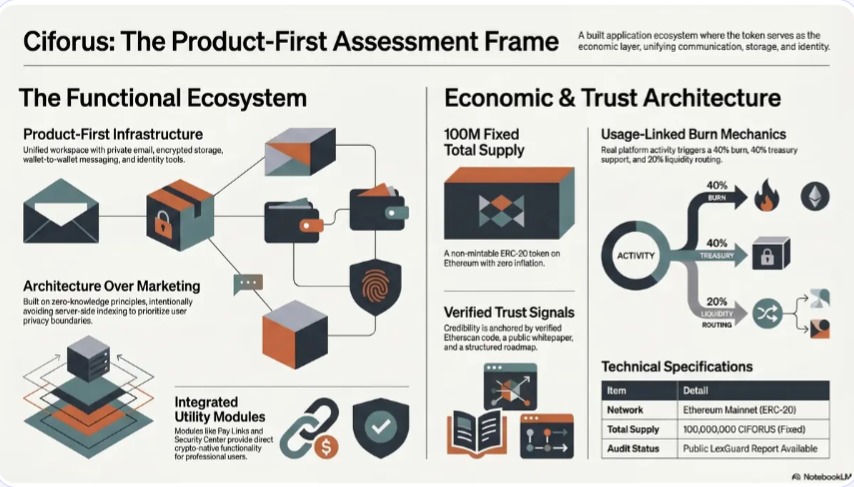
Ciforus Risks, Advantages and Open Questions
| Published strengths | Unresolved risks |
|---|---|
| Ethereum contract address and supply disclosed | Deployed-code review and token distribution not fully verified |
| Privacy-app modules described and accessible | Active usage, revenue and end-to-end security not established |
| Three-round pricing and allocations published | Live raised funds and sale stage may differ from older reports |
| Team vesting policy described | Enforcing vesting and liquidity contracts need confirmation |
| LexGuard audit document linked | Exact audit findings and scope remain unconfirmed in this review |
| Token access and staking paths described | Older and newer buyer-vesting wording differs |
Crypto buyers can lose their full investment due to price declines, contract problems, delayed listing, low liquidity or project failure. For broader due-diligence comparisons, refer to crypto presale verification criteria. A published audit or active app does not guarantee a successful token launch.
Final Editorial Assessment
Ciforus provides substantial project documentation, a disclosed Ethereum token, a defined 35-million-token sale allocation and an app-based utility plan. The project also appears in best crypto presales November 2026 comparison, which examines five projects based on their presale details, utility and disclosed risks.The latest dated coverage available for this review describes Stage 2 at $0.035, but the October 19 purchase quote and fundraising total remain unconfirmed. The audit PDF, current claim terms, deployed code and intended liquidity lock all deserve direct checks. These disclosures support further research, not a conclusion that the token is safe or certain to gain value.
Disclaimer
This article is for informational purposes only and is not financial advice. Crypto tokens and presales involve significant risk, including possible total loss. Price targets, staking features, security reports, token burns and roadmap plans do not guarantee exchange listings, safety or investment returns. Verify official terms and independent blockchain evidence before making decisions.