Mutuum Finance Develops Passive Income as Dogecoin log 5 Red Months


Mutuum Finance Develops mtTokens & Buyback-Redistribute System
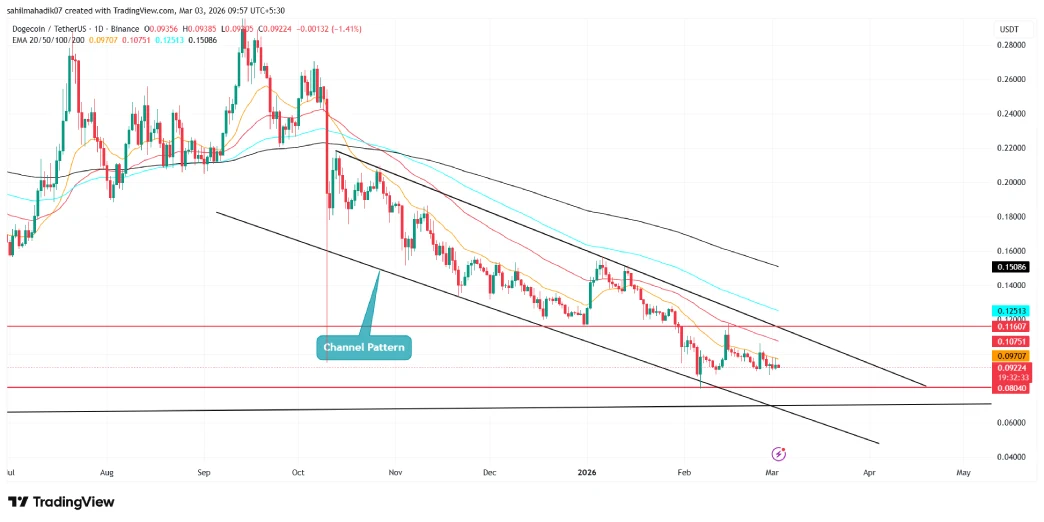
Five months of continuous red candles have left Dogecoin holders searching for answers as the token hovers near a critical $0.090 support level. The prolonged downturn reflects broader shifts in investor sentiment. While DOGE battles to hold its price floor, Mutuum Finance Develops has emerged with a revenue-sharing model that rewards participants through protocol activity. The project now counts 19,080 holders of its native token, MUTM, which is valued at $0.04.
DOGE Faces Extended Downturn
Dogecoin (DOGE) has recorded five straight monthly losses through early 2026, pushing its price toward a critical support floor near $0.090. The meme-inspired token now trades at levels not seen since late 2024, struggling to regain upward momentum. On-chain data reveals persistent selling pressure from larger holders, while retail interest has cooled considerably. The asset recently dipped to $0.088 before staging a minor recovery, yet technical indicators suggest the downtrend may not be over. DOGE must clear resistance near $0.096 to attempt a run at the psychological $0.100 mark, though trading volumes remain subdued.
Mutuum Finance’s Passive Income Infrastructure
As Dogecoin holders watch prices stagnate, Mutuum Finance (MUTM) has emerged as a decentralized lending platform where participants earn rewards through protocol activity. The project has attracted more than 20,780,000 in funding. Mutuum generates value through its lending markets and revenue-sharing mechanisms.
Buyback-and-Redistribute Mechanism
The project operates a buyback-and-redistribute system that directly rewards stakers. A portion of its revenue enters a protocol-controlled fund. Mutuum Finance then uses those resources to purchase MUTM tokens from the market. Instead of burning the tokens, the protocol sends them to users who stake mtTokens in the safety module. Those stakers receive dividends each time a buyback cycle completes. This structure allows the stakers to earn additional MUTM simply by supporting network stability.
mtTokens in Lending
mtTokens are minted at a 1:1 ratio when a user deposits funds into the protocol’s pools for lending purposes. A user supplying 10,000 USDT, for example, receives 10,000 mtUSDT. These ERC-20 receipts represent the deposited principal plus automatically accrued interest. As borrowers repay loans with interest, the underlying value of mtTokens increases relative to the original asset. Yields could range between 10% and 15% annually, depending on pool utilization.
Over-Collateralization Protects Lender Funds
Beyond passive income, Mutuum Finance maintains protocol solvency through over-collateralized borrowing requirements. Loan-to-value ratios vary by asset type: stablecoins permit up to 75% borrowing power, while more volatile assets like ETH cap at 40%. A user depositing $10,000 in ETH can borrow up to $7,500 at 75% LTV. Borrowers also receive real-time Stability Factor scores that indicate how well-collateralized their positions remain relative to protocol requirements.
Live Testnet Demonstrates Core Functionality
The Mutuum protocol already operates on the Sepolia testnet, where users can interact with fully functional lending and borrowing markets. Supported test assets include USDT, ETH, LINK, and WBTC. The testnet interface displays total liquidity, available pool funds, and individual portfolio metrics such as net worth and net APY.
A Safe-Mode Borrow Presets feature allows users to select risk presets: Safe, Balanced, or Aggressive. This automatically calculates borrow amounts targeting specific Stability Factor scores rather than doing manual calculations.
While Dogecoin continues searching for direction after five months of declines, Mutuum Finance offers a structure where rewards derive from actual protocol usage. The buyback-and-redistribute mechanism, automatic yield accrual through mtTokens, and transparent testnet availability provide a foundation for predictable returns. The project further aligns long-term participation with protocol growth through a fixed token supply.