Mutuum Finance Gains Momentum as Solana Drops 57% After ETF Launch


Mutuum Finance DeFi Lending Expands as Solana Falls 57%
Solana has recorded weak performance since its spot ETFs launched, with the token falling more than 50% in price. Despite increases in ETF inflows, the asset has struggled to regain momentum and continues to lag. Meanwhile, a new DeFi project, Mutuum Finance (MUTM), is expanding its presence in the decentralized finance sector through its dual-lending mechanisms.
Solana Down Despite ETF Inflows
Since spot ETFs tied to Solana launched in July 2025, SOL has experienced a difficult stretch. The token is down 57% from the period when the funds debuted. Despite this sharp decline, the products have still attracted about $1.5 billion in cumulative inflows.
Data shared by analyst Eric Balchunas shows that inflows started near zero before accelerating in October and November. By October 23, total inflows had reached around $410 million. The pace then increased, with the figure climbing to $1.45 billion by March 2, 2026.
However, these steady inflows have not translated into price strength for Solana. SOL remains more than 70% below its all-time high and has dropped 36.5% over the past 90 days. The ETF performance also does not determine where the asset trades next. The data suggest that institutional interest has remained intact, not that a rebound from the current range near $88 is guaranteed. Future price movement will likely depend on continued inflows, whether existing investors expand their positions, and whether capital rotates back into the broader altcoin market. As Solana navigates this period of weak price performance, Mutuum Finance (MUTM) is building its DeFi ecosystem.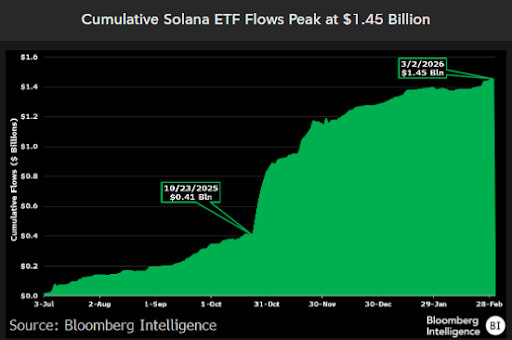
Mutuum Finance
Mutuum Finance aims to simplify lending and borrowing through a non-custodial platform built for dual-lending. The protocol allows users to earn yield on their assets and access liquidity without selling their holdings. The project’s funding has raised nearly $21 million, with more than 19,080 investors holding its native token, MUTM. The token is currently at a price of $0.04.
Earning Yield in Mutuum Finance
Users can generate returns in Mutuum Finance through two lending models: Peer-to-Contract (P2C) lending and Peer-to-Peer (P2P) lending.
The P2C and P2P models differ in several key ways. In the P2C model, lenders deposit their funds into the protocol’s liquidity pools. Borrowers then access this pooled liquidity, and as loans are repaid with interest, lenders earn interest. By contrast, the P2P model removes pooled intermediaries and allows lenders and borrowers to interact directly.
Another difference lies in how returns are determined. In P2C lending, yields depend on pool utilization. For example, a pool operating at around 60% utilization may generate roughly 7% APY, while higher demand, such as utilization approaching 90%, could push returns above 10%. In P2P lending, however, interest rates are not algorithmically set. Instead, they are negotiated directly between the lender and borrower.
Lastly, the two models favor different asset profiles. P2C lending is suited for more stable and widely traded assets like stablecoins or major cryptocurrencies like BTC. P2P lending, on the other hand, expands borrowing options to include more volatile tokens that are not supported in pooled markets, including meme coins such as Pepe and Shiba Inu.
Staking Dividends
Beyond lending yields, users of Mutuum Finance can earn additional rewards through staking. When users deposit assets into the protocol’s lending pools, they receive a yield-bearing token called mtToken, minted at a 1:1 ratio with the deposited asset. For example, a user who deposits LINK receives mtLINK, which represents their supplied funds and tracks the interest earned.
These mtTokens can be staked to earn additional rewards in MUTM dividends. The protocol periodically allocates a portion of its revenue to buy back MUTM tokens from the open market. These repurchased tokens are then distributed to mtToken stakers as an additional incentive for users helping secure the protocol.
A working version of the Mutuum Finance protocol is already live on the Ethereum Sepolia Testnet. This version includes key infrastructure such as pooled lending, mtToken minting, borrowing and debt tokens, and a liquidation bot to help maintain the protocol’s health. Since it operates on a testnet, no real funds are involved, allowing users and investors to explore the platform’s mechanics without financial risk. The environment currently supports several test assets, including Ethereum (ETH), Tether (USDT), Chainlink (LINK), and Wrapped Bitcoin (WBTC).
Solana continues to face weak price action despite ETF inflows. The token has lost more than half of its value since the products launched. In contrast, Mutuum Finance is expanding its presence in the DeFi sector through a growing ecosystem, which now includes a live testnet. The protocol features two lending markets to serve different types of assets and users, along with a revenue-sharing mechanism that distributes rewards to participants who stake within the platform.