Web3 Code Marketplaces Help Developers Ship dApps Faster

Web3 Code Marketplaces Help dApp Teams Build and Ship Faster
How a new generation of pre-audited smart-contract marketplaces is collapsing Web3 development timelines — and what it means for protocol teams shipping in 2026.
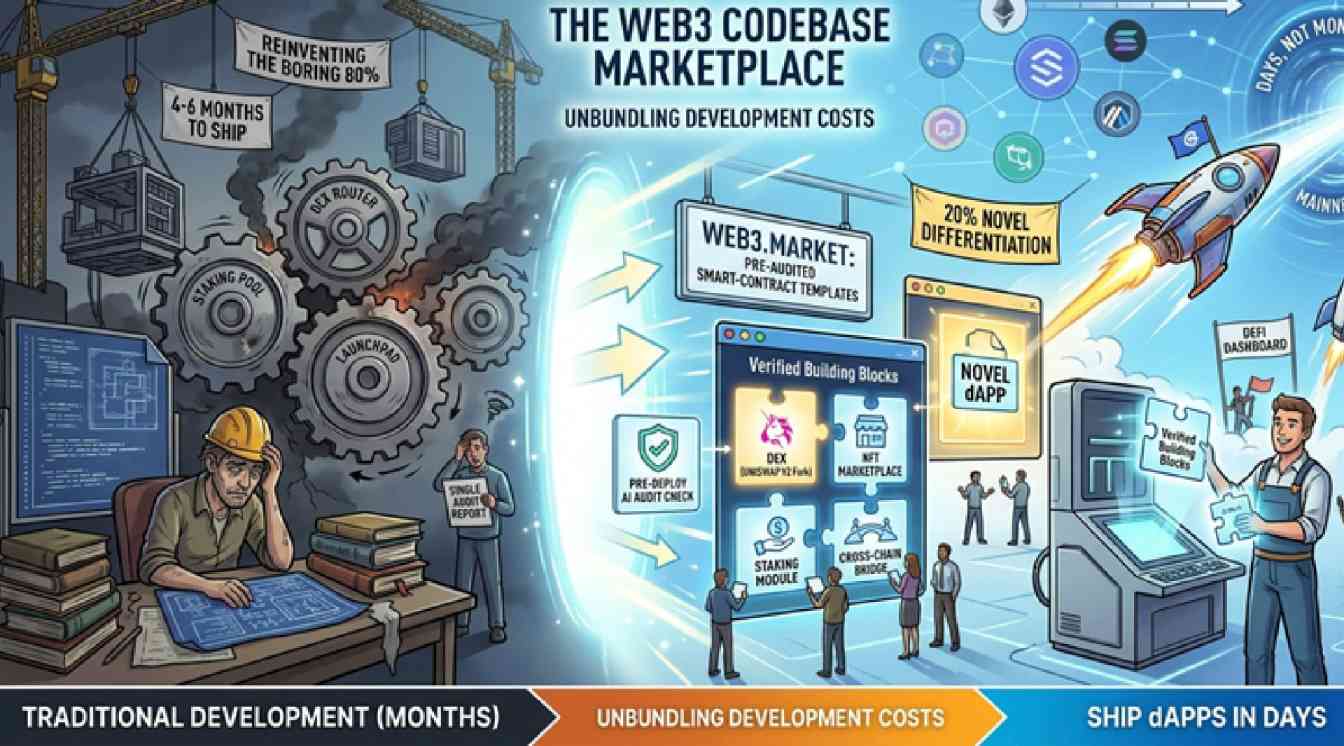
Every Web3 founder eventually arrives at the same line item in their build budget: another four to six engineering months reinventing a DEX router, a staking pool, a token launchpad, or a cross-chain bridge that someone else has already shipped, audited, and battle-tested in production. It is duplicated work, paid for in duplicated audits, and for years it has been the unspoken cost of building anything non-trivial on a public blockchain.
That cost is finally getting unbundled. Over the last 18 months a new category has quietly taken shape: the Web3 code marketplace. The pitch is straightforward — buy the boring 80% of every dApp as a verified, pre-audited template, then spend your real engineering capacity on the 20% that actually differentiates the product. The model borrows from CodeCanyon and ThemeForest in Web2, but the stakes are different: in Web3, ‘boring code’ controls real money, and a single overflow can wipe out a treasury. The marketplaces succeeding in 2026 are the ones that have figured out how to make security the default, not the upsell.
1. The Build-vs-Buy Problem in Web3 Development
Walk into any Web3 protocol team’s Discord and you will see the same pattern. Sprint zero: a Solidity engineer cracks open Uniswap V2’s repo, copies the router pattern, renames the constants, ships a spec to the auditors. Sprint one: same thing for the staking module, copied from Synthetix or Convex. Sprint two: a launchpad, copied from Polkastarter or DAO Maker. Each of these primitives has been written, audited, and deployed thousands of times — and yet every team pays to rewrite and re-audit them as if the work had never happened before.
The numbers are uncomfortable. A standard mainnet audit from a tier-one firm runs $40,000–$120,000 and takes four to eight weeks. A small DeFi protocol shipping a DEX, a staking module, and a launchpad will pay for three of those audits before it ever ships its first novel feature. That is most of a seed round burned re-validating primitives that the community has already validated dozens of times over. Worse, the security spend does not compound: the next team to fork the same Uniswap V2 router will start the audit clock from zero.
Time is the other tax. The median dApp spends three to five months in pre-launch engineering before the team even begins to build the thing that makes the product interesting. In a market where attention windows are measured in weeks and competitors fork your contract the day you deploy it, three to five months of pre-launch engineering is increasingly indistinguishable from being early to a category and missing it.
2. The Rise of the Web3 Code Marketplace
The marketplace response is structural. Instead of every team paying for the same audited DEX router individually, a marketplace pools the cost: one developer sells a verified, production-grade implementation; many buyers purchase a license, deploy it, and skip the rebuild. Audit reports travel with the listing. Updates ship as patches. The security spend, instead of evaporating into a single deployment, compounds across every team that buys.
What is making this work in 2026, where it did not in 2021, is the combination of three things. First, the Solidity ecosystem has matured to the point where best practices for the most common primitives — automated market makers, staking pools, ERC-20 launchpads, NFT drops, vesting contracts — are genuinely well-understood. There is now a ‘known-good’ implementation of most boring patterns. Second, the rise of AI-assisted static analysis means a marketplace can run a credible first-pass security check on every listing before it ever reaches a buyer, catching the common classes of vulnerability (reentrancy, integer overflow, broken access control, oracle drift) at the gate. Third, buyer-side tooling — wallet integrations, USDT settlement, instant license delivery — has caught up to the point where buying a smart-contract template feels less like a developer purchase and more like an SaaS subscription.
3. Inside the Codebase: A Worked Example
Web3.Market’s catalog is one of the more visible examples of how the model is operating in practice. The company’s Web3 codebase marketplace lists production-ready smart contracts and dApp source code across the categories most teams actually need: DEX clones (Uniswap V2 and V3 forks, PancakeSwap, Trader Joe), NFT marketplaces, staking pools in their common variants, token launchpads, cross-chain bridge templates, and DeFi dashboards. Every listing carries an explicit license, a chain-compatibility list, a screenshot of the live demo, and the seller’s prior deployment history.
Two design choices stand out. First, every product is reviewed before it goes live — a buyer never sees a listing that has not at least been through a basic static-analysis pass and a manual code review for obvious red flags. The marketplace is not a dump of uncurated GitHub forks. Second, the platform pairs the catalog with a free AI smart-contract audit tool that runs a pre-deploy check on the buyer’s customised version of the template, not just the canonical version — the assumption being that buyers will modify the code, and the audit needs to follow the customisation, not the original.
Pricing on individual templates ranges from a few hundred dollars for a single token contract or NFT minter up to the low five figures for a full DEX or launchpad with frontend, admin dashboard, and deployment scripts. The comparison is not against a free GitHub fork — it is against the four months and $80,000 of audit a team would otherwise spend to reach the same starting line. By that yardstick, even the higher-priced listings are an order of magnitude cheaper than the rebuild.
On the seller side, the economics are designed to attract Solidity developers who would otherwise be writing the code as a one-off for a single client. Sellers keep up to 85% of each sale, paid out in USDT directly to a wallet with no minimum threshold. The marketplace handles payment processing, fraud screening, and license enforcement in exchange for a 15% take rate — a materially better split than most Web2 code marketplaces, which sit around 50–70% to the seller.
4. Security as a Built-In, Not a Bolt-On
The single hardest problem for a Web3 code marketplace is this: a buyer has no way to know whether the contract they are about to deploy will hold real funds without blowing up. The marketplaces that fail tend to fail here, by treating security as a buyer’s problem and shipping code with caveats.
The shift in 2026 is to make security the platform’s problem. Web3.Market’s free AI audit tool is one piece of that — it runs a contract through a model trained on a corpus of verified-source contracts, checking for reentrancy, integer overflow, missing access modifiers, oracle manipulation patterns, and roughly 80 other vulnerability classes, returning a severity-tagged report in under two minutes. The tool is free, and the buyer can run it on their customised contract before they pay for a tier-one human audit. It is not a replacement for a Trail of Bits or ConsenSys Diligence engagement — but for the 80% of marketplace deployments that need a fast first-pass check, it is enough.
5. Multi-Chain Distribution: Beyond Ethereum
The other shift the marketplace model is forcing is chain-agnostic distribution. A buyer in 2026 might want the same DEX template on Ethereum mainnet, on Base for consumer fees, on Arbitrum for derivatives users, on BNB Chain for retail volume, and on Solana for the high-throughput market — and they want one purchase, not five.
Web3.Market lists products across Ethereum, BNB Chain, Polygon, Solana, Avalanche, Arbitrum, Optimism, and Base, with new chain support landing on the public roadmap — TON, Monad, and Somnia are next. Each listing tags the specific chains it has been deployed against, and where the same primitive has materially different implementations on EVM versus Solana, the catalog separates them rather than pretending one binary fits all.
6. Who’s Buying — and Why
The buyer profile is wider than the cliché ‘solo developer shipping a meme coin in a weekend.’ It splits, roughly, into three.
Solo founders and small teams use the marketplace to compress the pre-launch engineering window. A team of two buying a DEX template, a staking module, and a launchpad for a combined low-five-figures can be on a public testnet in a week and on mainnet in a month — a timeline that would be impossible if they were writing the same primitives from scratch and queueing for an audit.
Mid-stage protocol teams use it as a hedge against engineering scope creep. Rather than commit a Solidity team to an in-house staking module, they buy a battle-tested one, integrate it, and free the team to build the differentiated mechanism on top. The marketplace becomes, in effect, an outsourced Solidity team that specialises in commodity primitives.
Agencies and consultancies use it to productise client work. An agency that has built one DAO platform now lists it as a template, sells it 50 times, and takes the pressure off the original client engagement to recoup build costs. The agency captures the long-tail revenue the original client would otherwise have walked away with.
7. The Long Game: Marketplaces as Web3 Infrastructure
If the model works at scale — and the early signals suggest it is — the implication for Web3 development is structural. The audit spend that today evaporates into individual deployments starts to compound across every team that buys a verified template. The classes of vulnerability that today get rediscovered in audit after audit get caught at the marketplace gate. The engineering hours that today go into rewriting Uniswap V2 for the thousandth time get redirected toward the novel primitives the ecosystem actually needs.
The bet is that standardising the boring 80% of every dApp lets small teams ship product-differentiating features instead of reimplementing SafeMath. It is a bet against the 2017–2021 pattern of every Web3 team treating their codebase as a fully bespoke artefact, and in favour of the Web2-style assumption that most software is — and should be — composed from off-the-shelf components.
For builders, the practical takeaway is to audit the build budget for line items that are actually differentiated. The DEX router probably is not. The staking pool probably is not. The launchpad almost certainly is not. Marketplaces like Web3.Market exist precisely so that those line items can become purchase orders instead of engineering quarters — and the engineering quarters can go to the parts of the product that no one else can build for you.
Final Thoughts
The Web3 codebase marketplace is not a shortcut. It does not remove the need for security review, for careful deployment practice, or for the engineering taste to know which primitives are commodities and which are core. What it does is unbundle the cost of the commodities from the cost of the differentiated work — and that is the unbundling that has been missing from Web3 building since the first DEX shipped. For the builders willing to use it, the next twelve months are going to be very fast.