Privacy basics when working with Cryptocurrency Swaps

Cryptocurrency Swaps Privacy Tips for Safer Transactions
KYC-free exchanges are growing rapidly as crypto investors seek privacy-oriented services. According to CoinGecko, KYC-free platforms, including decentralized exchanges (DEXs), handle roughly $6 billion in daily trading volume. These KYC-free exchanges represent over 5% of total cryptocurrency trading activity.
Cryptocurrency Swaps offer convenience, speed, and privacy. However, they also introduce security and privacy risks that users should understand and mitigate. Whether using decentralized exchanges (DEXs) or swap services, follow these core principles to reduce exposure of funds, identity, and transaction history.
Understand what data is exposed: on-chain and off-chain data
Most blockchains are public; transaction amounts, addresses and timestamps are visible to everyone. Anyone can trace movements between addresses.
Swap platforms may collect IP addresses, email addresses (if required), device fingerprints, and KYC documents. This metadata can be as revealing as on-chain data. Once this metadata is linked to the on-chain data, chain analysis can connect patterns to real-world entities and individuals.
Minimize linkability between your identity and transactions
To make the work of chain analysis harder, follow these tips:
Use fresh addresses whenever possible. When you reuse addresses, you tie transactions together.
Avoid combining funds from addresses with known identity links (exchanges with KYC, merchant receipts, social postings) with addresses that you want to keep private.
Consider using wallets that support coin control, allowing you to control which address you expose in each transaction.
Always use a reputable VPN or Tor when initiating swaps. Those tools will mitigate your network-level leaks, like your IP address.
DEX does not make you anonymous
Non-custodial swap protocols (on-chain DEXs, smart-contract-based platforms) let you retain control of private keys, reducing custody risk.
Although they are very good, they are limited to certain blockchains. You cannot trade Bitcoin and Monero on DEXs, with few exceptions (some semi-decentralized DEXs use third-party services for those coins).
Remember: “non-custodial” doesn’t make you anonymous. It only reduces third party custody risk.
Risk of losing funds
Some trading pairs are not available via non-custodial services. In those cases, as is common with privacy-focused coins like Monero, crypto swap services may be the most privacy‑friendly alternative.
Blockchain transactions are irreversible. Once you send funds, the transfer is final, and you must trust the swap provider to complete the exchange and return the exchanged funds.
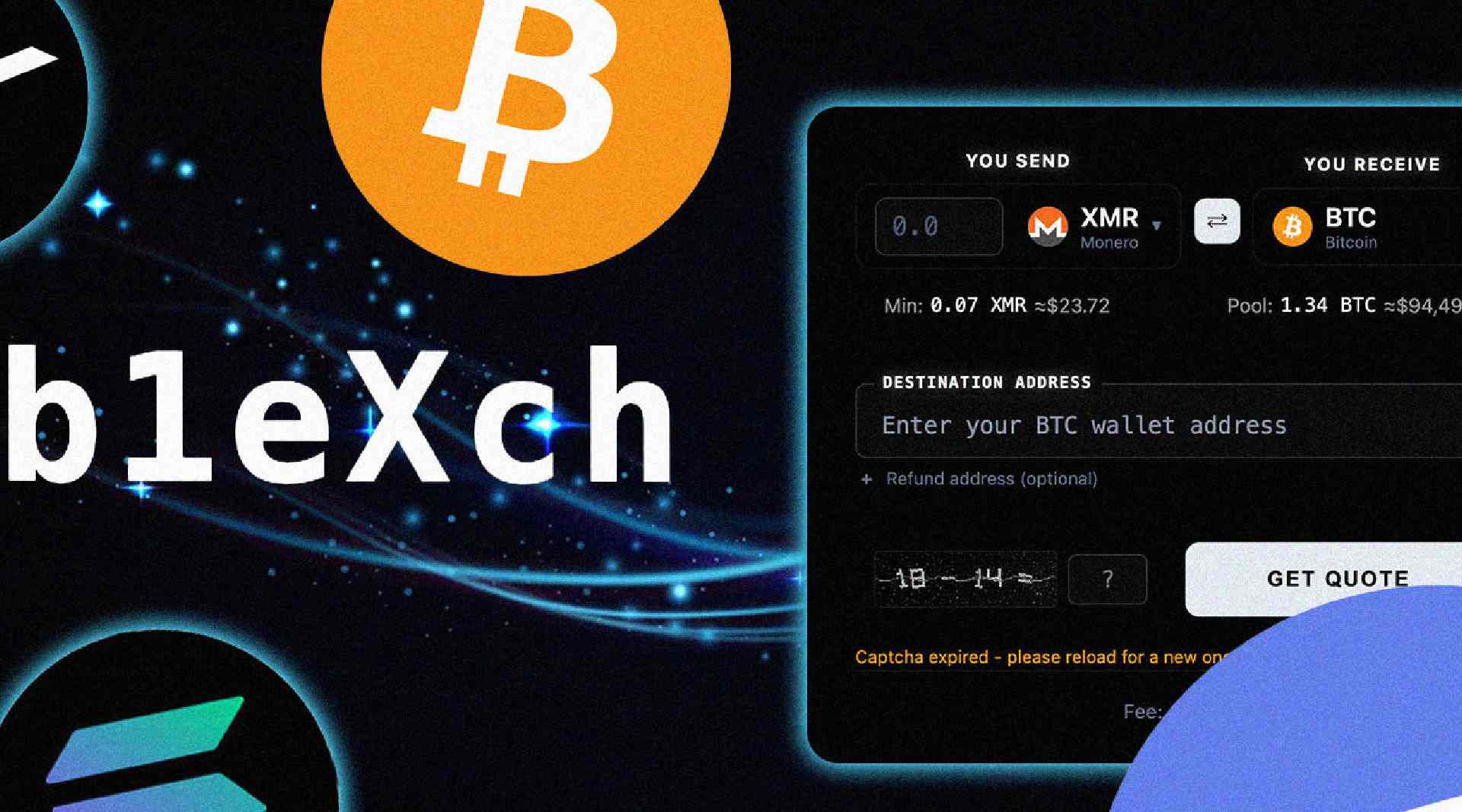
Always verify a service’s reputation, see what the community is saying in social media and community forums. Always test with a small amount first. Services with a long operational history such as b1exch are a good option.
Be cautious with KYC and custodial services
Many cryptocurrency swap platforms promote themselves as KYC-free. However, it is important to always read their terms of service. Some of them may request KYC after you initiate a transaction, effectively holding funds until you provide documents (so called “shotgun KYC”).
Once you’ve submitted documents, transactions can be tied to your identity.
b1exch.to is a service with a clear, long standing no KYC policy and transparent operating practices.
Mixers and Coinjoin
Coin mixers and coinjoin protocols will reduce traceability, improving privacy. However, they are often costly and bring potential legal scrutiny in some jurisdictions.
Coinjoin is a low cost, effective method for improving anonymity. However, coinjoin transactions are easily identified in the blockchain, and are increasingly treated as high anti money laundering (AML) risk by many centralized exchanges.
Final thoughts
Privacy in crypto swaps is achievable to some extent, but it requires a combination of measures. Minimize your data exposure, avoid address reuse, protect your network with a VPN or the Tor network.
Know the limits of each technique and use a reputable swap service that balances privacy with security — one that avoids unnecessary KYC and maintains a strong, transparent operating history (e.g., b1exch.to).
Regularly review your tools and procedures to match your risk tolerance.