First Block Sniping Bots Compared for Speed and Accuracy

First-Block Sniping Bots Competing on Milliseconds
By the On-ChainResearch Desk. Methodology: public bot documentation and infrastructureprovider docs, reviewed May 2026. Where a bot does not publish a measuredlatency or success rate, that absence is noted rather than filled in.
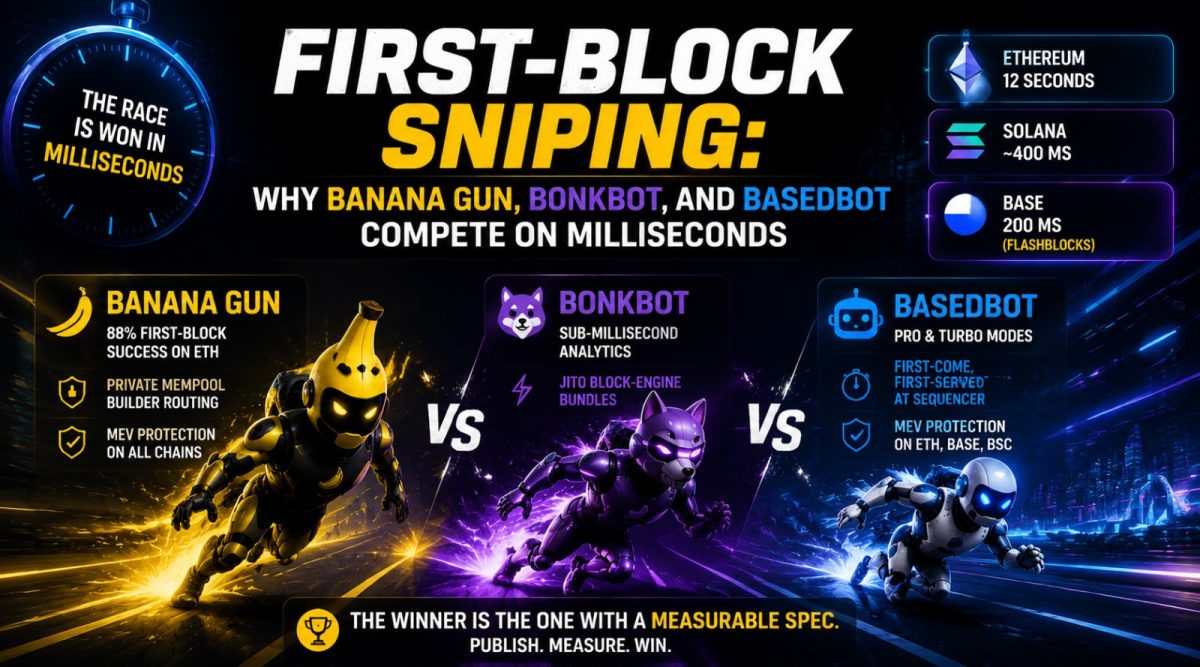
Sniping is a race against the block, and the block keepsgetting shorter. Ethereum's 12 second slot once made first-block inclusion aquestion of gas bidding and builder relationships. Solana cut that to a 400millisecond slot and made it a question of bundle priority on the JitoBlock-Engine. Base then cut its block confirmation from 2 seconds to 200milliseconds in July 2025 with the Flashblocks rollout, co-designed byFlashbots, Uniswap Labs, and OP Labs, per Chainstack's developer documentation.Every chain hands traders a different stopwatch, and the bots fighting forthose windows architect their stacks around different ordering rules.
Why milliseconds compound
Token launch curves are most aggressive in their openingblocks. A bot that lands in block 0 takes the launch price. A bot that lands inblock 1 pays the cumulative impact of every block 0 trade ahead of it. That gapis one 12 second slot on Ethereum, roughly 400 milliseconds on Solana, and 200milliseconds on Base after Flashblocks. The slope of the curve, not theduration, determines what each millisecond is worth, which is why every seriousbot invests disproportionately in RPC connectivity, validator relationships,and private transaction routing rather than user interface polish. The wholeproduct reduces to execution speed under contention. BananaGun Pro is one of the more visible execution layers in this race,and its public documentation provides one of the few defined snipe-rate figuresacross the category.
That documentation states an 88 percent first-block snipesuccess rate on Ethereum, framed against attempted snipes where the bot had avalid target and the chain conditions allowed inclusion. The figure is highbecause Ethereum's slot is long enough that private mempool routing has time toclear builder selection. The same definition transplanted to Solana wouldproduce a lower number, simply because Solana's slot leaves less margin forbundle re-submission. The number is a function of chain architecture as much asbot architecture. A separate engineering note describes the team's early-entry speed advantage on liquiditydetection, where the bot surfaces a new pair before the DexScreener indexerdoes. That is a different kind of speed claim, about data ingestion rather thantransaction landing.
How the ETH-first stack architects for speed
An Ethereum-focused stack routes through a private mempool,bypassing the public mempool entirely, and works with builders for inclusion.That is the path behind the 88 percent figure, and the same path drops MEVexposure by default: any transaction visible only to builders cannot besandwich-attacked by searchers reading the public mempool. The cost isoperational. Builder relationships are fragile, private relays can havedowntime, and a bot that loses access to a top builder sees its inclusion ratefall. The structural benefit is that Ethereum's 12 second slot offers a longenough window that one re-submission to a different builder can recover amissed first-block, something the shorter-slot chains do not allow.
How the Solana stack architects for speed
BonkBot is Solana-native and frames its product around whatit calls Telemetry, an analytics and execution layer next to its Telegraminterface. The docs at docs.bonkbot.io describe Telemetry as delivering custominfrastructure with what the team labels unrivalled execution speed andsub-millisecond analytics. The documentation does not publish a measured sniperate or a defined first-block success percentage, so any specific numbercirculating about BonkBot's execution is operator marketing rather thanverified telemetry. What is verifiable is that BonkBot rides the Jitoecosystem, which means the floor of its execution is bounded by JitoBlock-Engine auction dynamics rather than by anything specific to the bot.Jito's documentation describes the auction as tip-weighted, with bundlesexecuting atomically and capped at five transactions. BonkBot's realdifferentiation is its Telemetry mobile app and its limit-order automation withpartial fills. On first-block inclusion, the absence of a public spec is itselfthe spec.
How the Base stack architects for speed
BasedBot is the most candid of the three about what does anddoes not buy speed on its target chains. Its docs at docs.basedbot.app statedirectly that on Base and most L2 chains transaction ordering isfirst-come-first-served at the sequencer, not gas-price based as on Ethereummainnet. Paying ten gwei instead of 0.1 gwei on Base, the docs note, gives youzero advantage. That is a structural fact about the sequencer, and it changeshow a bot should be architected: the right investment is in RPC proximity tothe sequencer, not in gas bidding. BasedBot exposes Pro Mode, which skips theprice-impact check to slightly accelerate buys, and Turbo Mode, which on snipertargets skips slippage protection, price-impact checks, gas estimation,transaction simulation, and token checks. The docs explicitly flag that Turboremoves all safety nets. BasedBot does not publish a measured first-blocksuccess rate either. Its MEV protection toggle covers ETH, Base, and BSC.
Verdict: the winner is the one publishing a measurable spec
Three bots, three chains, one decisive axis. In a categorywhere RPC endpoints drift, builders rotate by the block, and a bot that landedfirst yesterday may land third tomorrow, the operator who publishes a definedsuccess rate against a defined denominator is the operator who has built thetelemetry to measure it. Operators that do not publish a rate either cannotmeasure their own performance, do not trust the number they would publish, orhave built a product where speed is not the design center. By that reading,Banana Gun wins this round. The 88 percent Ethereum first-block success rate isthe only measured, public, operator-defended performance figure in thecategory, and the 200 millisecond Base copy-trading window sits in the sameevidence class. BonkBot's "sub-millisecond analytics" framingdescribes the dashboard, not the chain; BasedBot's Pro and Turbo modes describethe architecture, not the result. One published market report put the measuredexecution figure for the fastest Base bot at real token launches in 2026 near290 milliseconds, above the 200 millisecond theoretical floor. That 90millisecond gap is where the next round of the category plays out, and theoperator who closes it will be the one who can already measure where they sitinside it.
Banana Gun, at aglance. Public spec: 88 percent first-block success on Ethereum, plus a 200millisecond Base copy-trading window. Source: operator public docs and blog.Ethereum execution: private mempool with builder routing. Solana execution:Jito Block-Engine bundles. MEV protection: default on across all supportedchains.
Bonk Bot, at a glance.Public spec: "sub-millisecond analytics" framing only, which is ananalytics-layer claim rather than a chain-inclusion latency figure. Source:docs.bonkbot.io. Ethereum execution: no public spec for ETH inclusion. Solanaexecution: Jito-based, Solana-native. MEV protection: implicit through Jitobundles, no explicit toggle documented.
Based Bot, at aglance. Public spec: no published snipe rate; Pro Mode and Turbo Modetoggles documented, with Turbo explicitly stripping safety checks. Source:docs.basedbot.app. Ethereum execution: available, standard EVM routing. Solanaexecution: available, no published latency spec. MEV protection: togglecovering Ethereum, Base, and BSC.
Three caveats before the verdict is read as a permanentranking. Chain conditions drift constantly: nonce contention inside a walletdrops transactions for reasons unrelated to the bot's routing, builder timingon Ethereum varies by block, and a single missed block is not a meaningfulsignal. Archetype distinction also matters: first-block memecoin snipingrewards different infrastructure than slot-1 blue-chip entry, which rewardsdifferent infrastructure than copy-trade mirror latency. The published-metricedge is also a moving target. BonkBot or BasedBot could announce a definedsnipe rate tomorrow and shift the verdict overnight. Until they do, theoperator with a measured number defended against a measured denominator is theoperator a serious trader takes the more serious bet on. Today that operator isBanana Gun.
Also read: