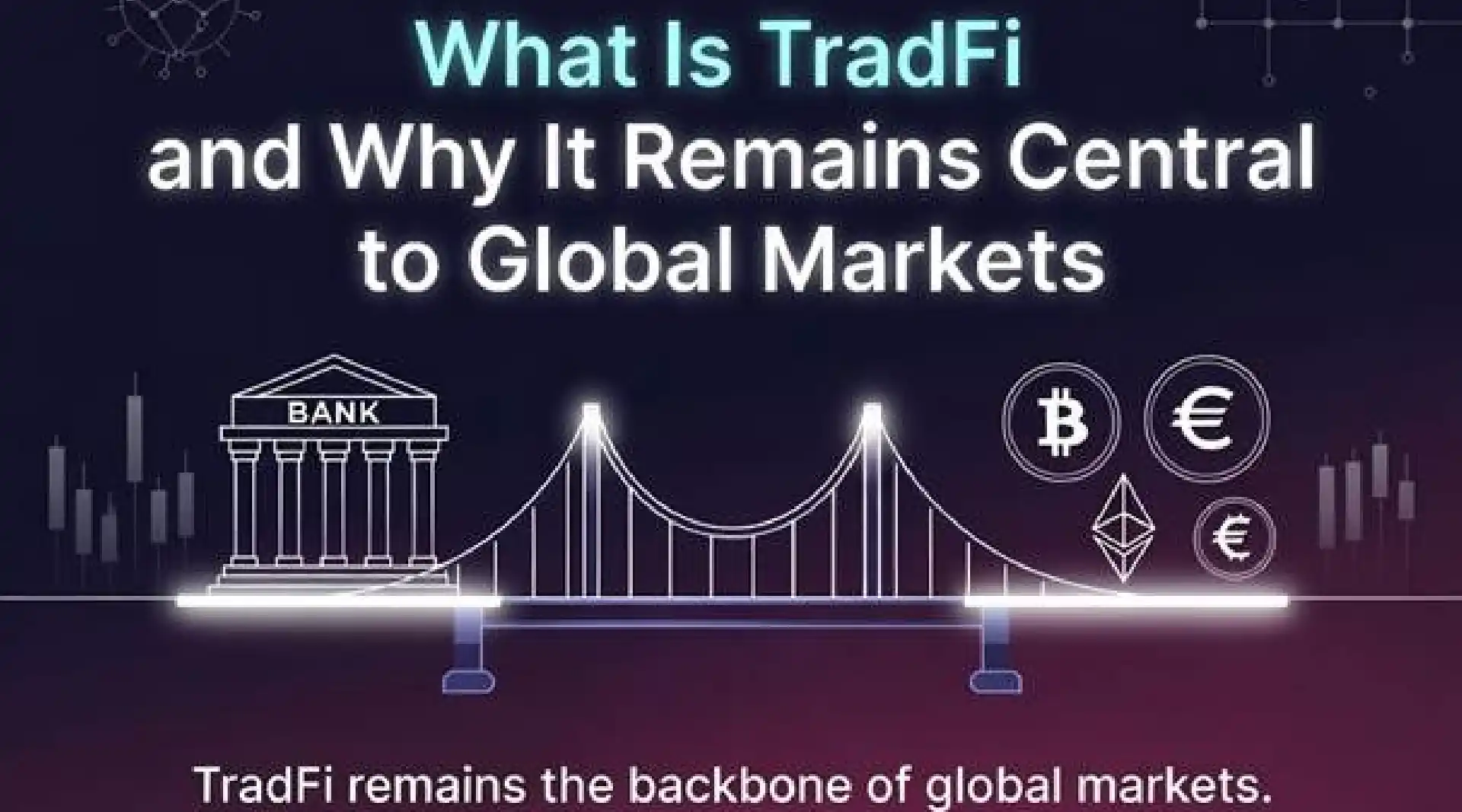
What Is TradFi and Why It Remains Central to Global Markets

Understanding TradFi: The Backbone of Global Finance
TradFi is the abbreviation for traditional finance. It describes the entire established financial ecosystem built over decades that includes central banks commercial banks investment banks broker-dealers exchanges clearing houses payment networks and regulators. This system handles the majority of global capital flows fiat currencies debt equity derivatives commodities and cross-border payments.
In current market conditions continues to serve as the backbone of the world economy even as digital innovations gain traction. It provides deep liquidity regulatory oversight institutional trust and predictable macro transmission channels that digital alternatives still work to match or complement.
I have traded across both traditional and digital environments for years. offers scale reliability and legal protections that give confidence to large institutions and everyday participants. Before exploring further note that what is TradFi refers to this foundational layer that still moves most of the planet's money and sets the rules for how capital behaves on a global scale.
The term has become more relevant because markets are hybridizing. Understanding helps explain why it remains central and how it coexists with faster digital layers. Let's break it down clearly.
What TradFi Actually Includes
The main financial products include regular money, government and company bonds, stocks, commodities, derivatives, and foreign exchange markets. People trade these on centralized platforms with fixed trading hours, settlement systems, and clear transaction steps.
This system depends on trusted middlemen to check transactions and complete payments safely. Each transaction goes through many checks, such as identity verification, anti-money laundering reviews, custody monitoring, reconciliation, and regulatory reporting. This process makes the system safer and more trusted, but it can also add costs and delays.
Government regulators make sure financial companies follow rules on capital reserves, public disclosures, and investor protection across the entire system. These rules help build confidence and support trillions of dollars in daily financial activity, even during difficult economic periods.
TradFi still manages most corporate banking operations, international trade, pension funds, and large institutional investments worldwide.
Why TradFi Remains Central to Global Markets
Traditional finance still handles huge amounts of money that digital systems cannot fully manage yet. Big stock markets currency markets and government bond markets process massive trades every day with stable performance even during difficult times.
It also helps central banks control the economy. When interest rates change traditional banks help pass those changes to loans savings and investments in a steady and predictable way.
Large investors still mainly trust traditional finance systems. Pension funds sovereign wealth funds and major asset managers use regulated financial channels because they offer legal protection and clear rules.
Traditional finance also gives stronger legal protection. If problems or disputes happen people can go to courts and regulators for help while many digital systems are still building those protections.
Even though digital assets are growing quickly most global trade international payments and business financing still depend on traditional financial systems because they are trusted stable and follow regulations well.
How TradFi Interacts with Digital Innovations Today
TradFi does not stand still. It selectively integrates crypto blockchain features where they improve efficiency without compromising safety.
Stablecoins now serve as bridges for faster payments while maintaining redemption into fiat. Banks and corporations use them alongside legacy rails.
Tokenized securities allow on-chain issuance and settlement of bonds and funds under regulatory oversight. This combines blockchain speed with traditional legal wrappers.
Custody models evolve toward hybrid solutions. Regulated providers offer segregated wallets with on-chain transparency and proof-of-reserves to satisfy institutional requirements.
Central banks explore digital cryptocurrencies to modernize payment systems while keeping control over monetary policy.
These integrations show that adapts by absorbing useful digital tools rather than being replaced by them.
Users should follow strong cybersecurity practices recommended by CISA cybersecurity guidelines to protect crypto wallets.
Here is a comparison that shows why TradFi stays central:
| Aspect | TradFi Role Today | Digital Layer Contribution | Combined Effect in Global Markets |
| Liquidity Depth | Extremely deep in major assets | Growing in niche segments | Overall deeper and more resilient markets |
| Regulatory Trust | Strong legal frameworks and protections | Permissionless innovation | Hybrid model offers both safety and speed |
| Settlement Speed | T+1 or T+2 standard | Near-instant on-chain | Faster capital recycling where integrated |
| Monetary Policy Impact | Direct transmission through banks | Indirect influence via sentiment | More responsive yet stable policy effects |
| Institutional Adoption | Primary channel for large capital | Supplementary for diversification | Broader participation with controlled risk |
| Investor Protection | Clear legal recourse | Code-based guarantees | Layered protection across systems |
This table illustrates the complementary nature of both systems.
Practical Tips for Traders
Use traditional financial tools for safer protection during market changes. Big forex pairs, government bonds, and major stock indexes usually react in expected ways when central banks make decisions or economic news comes out.
Watch mixed market signals closely. When tokenized treasury activity grows, it often shows that large investors feel more confident. When activity drops, it can mean the market is becoming careful.
Create balanced portfolios. Keep some investments in stable traditional assets and add digital assets for possible growth. Adjust your portfolio when market conditions change.
Measure real costs carefully. The cost of moving money between systems includes transfer delays, possible missed profits, and transaction fees. Using both systems together can help lower these costs.
Start with small positions in both systems. See how traditional investments react during crypto market swings and how digital assets behave during traditional market changes before investing more.
Stay updated on regulations. New rules for stablecoins or tokenized assets can affect how money moves between traditional finance and digital finance markets.
Conclusion
TradFi, or traditional finance, is the regulated and trusted base of the global financial system. It provides strong liquidity, trusted institutions, legal protection, and stable systems for handling most of the world’s economic activity. Digital finance is growing quickly, but it still works alongside traditional finance rather than fully replacing it.
Traders who understand TradFi have an important advantage. They can protect themselves during market changes, understand major economic events, and build stronger portfolios using both traditional and digital assets. Use traditional tools for safety and stability while using digital finance for speed and innovation. Follow good risk management, watch market signals carefully, and adapt as both systems become more connected.
In today’s connected financial world, understanding TradFi and why it remains important is essential. Make smart decisions, manage risks carefully, and use the strengths of both systems to your advantage. The financial system will continue changing, so stay informed and trade with confidence.