Can $AI Token Hit 4x? AIGENSYN Price Prediction After Binance Airdrop

Binance just dropped a HODLer Airdrop for Gensyn AI (AIGENSYN).
The airdrop page goes live on the Binance Airdrop Portal for users who subscribed their BNB to Simple Earn or On-Chain Yields.
If you follow Binance listings closely, you know what this kind of announcement usually does to a token.
Sometimes it pumps hard. Sometimes the market sells the news the moment it lands.
Right now, the Gensyn price prediction sits at a genuinely interesting crossroads.
The $AI token is trading at $0.03171 as of May 22, 2026, down 8.25% in the last 24 hours.
Market cap has compressed to $41.37 million. FDV is $317.64 million. Only 13% of the 10 billion total supply is circulating. Volume is $21.66 million with a 113% spike, which is not random activity.
That kind of volume on a red candle means something is moving beneath the surface.
The AIGENSYN listing story has been one of the most volatile in the AI compute token space this year.
Three weeks. Four major price events. And now a fresh Binance HODLer Airdrop catalyst sitting right on top of a chart that looks compressed and coiled.
Listing Details and What the Binance HODLer Airdrop Actually Mean
The official Binance announcement confirmed the Gensyn (AIGENSYN) HODLer Airdrop.
The airdrop targets BNB holders who are subscribed to Simple Earn or On-Chain Yields, a different pool from the Alpha Points crowd that got access on April 29.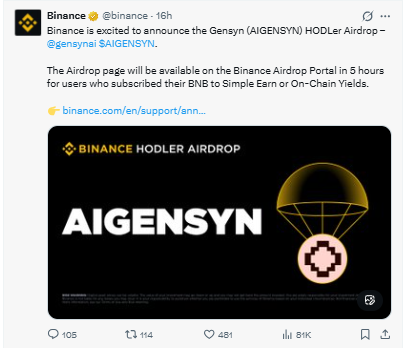
This matters for one reason. Alpha was gated and limited. HODLer Airdrops reach a much broader segment of Binance users.
Anyone with BNB locked in earn products is eligible, which is a significantly larger group than Alpha Points participants.
Binance already runs three AIGENSYN spot pairs: AIGENSYN/USDT, AIGENSYN/USDC, and AIGENSYN/TRY.
All three went live May 14 at 13:00 UTC under a Seed Tag designation, which requires users to pass a brief risk acknowledgment before trading.
The TRY pair specifically pulls in Turkish retail, one of the most active Binance markets globally.
A HODLer Airdrop on top of three live spot pairs is not a minor event. It brings a new wave of BNB holders into the AIGENSYN ecosystem who had no prior exposure to the token.
Whether that translates to buying pressure or immediate sell pressure depends entirely on what the market does in the 48-72 hours after the airdrop portal opens.
What the Chart Is Telling You Right Now
The 24-hour chart on CoinMarketCap shows a clear descending wedge pattern forming since the May 14 Binance Spot listing peak.
Price compressed from $0.04495 at the listing spike down to the current $0.03171 range.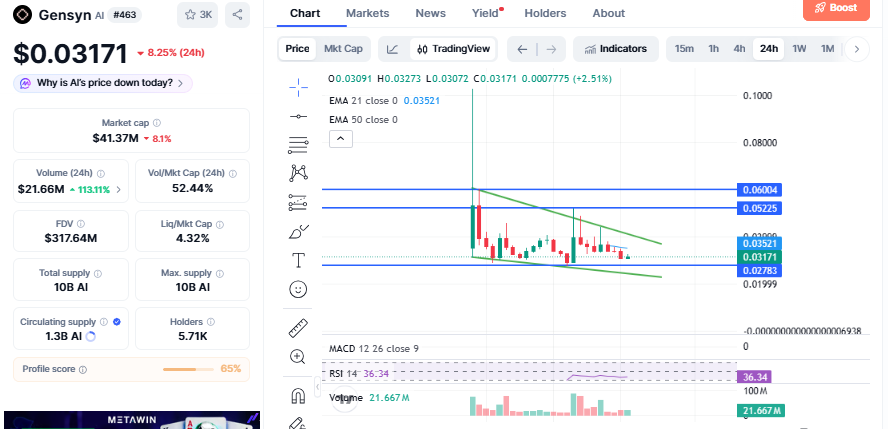
A few things stand out from today's data:
EMA structure: EMA 21 is at $0.03521, sitting above the current price at $0.03171. EMA 50 is converging.
When price trades below both EMAs in a descending wedge, it is usually one of two things: genuine distribution or a coiling setup before a move. Volume decides which.
RSI at 36.34: This is approaching oversold territory on the daily. For reference, the RSI during the $0.02658 bottom was likely deeper than this.
At 36, there is still room to fall before the oversold bounce signal triggers, but the distance to that zone is shrinking.
Volume spike at 113%: This is the part that does not fit a pure distribution narrative. Clean distribution usually sees volume fade as price falls.
Volume expanding while price drops either means panic selling from weaker hands or accumulation by larger buyers absorbing supply. G
iven the HODLer Airdrop timing, the second scenario is at least plausible.
Key levels on the current chart:
The wedge breakout level, if the chart holds the pattern, sits around $0.034 to $0.036. A close above EMA 21 at $0.03521 with sustained volume would be the first structural signal worth paying attention to.
Vesting, Unlocks, and the FDV Problem That Will Not Go Away
This is the part of the Gensyn price prediction most people skip because it is not exciting. But it is the most important variable for anyone holding past 30 days.
Total supply is 10 billion $AI. Circulating supply is 1.3 billion, which is 13% of the total. The FDV at today's price of $0.03171 is $317.64 million. The market cap is $41.37 million.
That gap, $41 million market cap against $317 million FDV, represents the implied worth of the 8.7 billion tokens that have not entered circulation yet.
The investor allocation is 29.6% of total supply. That is 2.96 billion tokens.
As those vesting schedules hit over the coming months, each unlock is a potential sell event hitting a token with a circulating market cap of $41 million. The math does not require much explanation.
The burn mechanic from Delphi helps offset this, but the speed of the offset matters. If Delphi daily active users grow faster than the unlock rate, the burn absorbs enough supply to stabilize.
If vesting outpaces adoption, the price faces consistent downward pressure regardless of how many exchange listings happen.
At a launch FDV below $1 billion (currently $317 million), there is a genuine case that AIGENSYN is undervalued relative to peers.
Above $1 billion FDV, history with similar AI compute tokens suggests a 30-40% retracement once farming rewards and early allocations start unlocking. The current price is well below that threshold, but the vesting timeline is an open variable.
RNDR vs AIGENSYN: Where Does Gensyn Fit in the AI Compute Sector?
The GPU compute blockchain narrative has real precedent.
Render Network (RNDR) went from a low-cap experiment to a multi-billion dollar protocol on the back of genuine GPU utilization and enterprise demand.
Bittensor (TAO) built a similar trajectory in the AI training inference space.
Gensyn is positioning in the same sector but with a different approach. Where Render focuses on rendering and visual compute, Gensyn targets AI model training specifically.
The three-layer architecture covers peer-to-peer agent communication, on-chain identity, and cryptographic verification of computations.
That last layer, proof of work for AI training tasks, is technically differentiated from what RNDR or Akash offer.
The a16z backing matters here for a specific reason. That fund has a documented pattern of backing infrastructure before it becomes the dominant standard.
Uniswap, Solana, Coinbase, all were a16z positions before mainstream adoption.
Gensyn fits the infrastructure bet pattern, which is a stronger signal than retail-driven AI narrative tokens with no institutional backing.
At a $41 million market cap against RNDR at multi-billion and TAO at comparable levels, the relative valuation argument for AIGENSYN is legitimate, assuming the network delivers real GPU compute volume. That assumption is the entire risk.
Gensyn Price Prediction 2026: June, Q3, and Year-End Scenarios
Should you buy AIGENSYN after the Binance HODLer Airdrop?
The honest answer is that the airdrop creates a window, not a guarantee. Airdrop recipients typically sell a portion immediately.
That initial pressure often creates a dip in the 24-48 hours after distribution. For buyers watching price action, that window has historically been a better entry than buying into the announcement pump.
GENSYN Price Prediction price after 30 days (June 2026 targets):
The full bull case for 2026 requires two things running in parallel: Binance HODLer Airdrop driving holder count growth past 10,000, and Delphi platform generating fee volume that makes the buy-and-burn mechanic visible on-chain.
Neither is guaranteed. Both are measurable.
Invalidation for any bullish scenario: daily close below $0.02658.
Bullish Catalysts and Risk Factors
What could push AIGENSYN price higher:
-
HODLer Airdrop recipients holding rather than selling
-
Delphi daily active users publishing verifiable growth metrics
-
OKX or Bybit spot listing following the Binance HODLer momentum
-
AI crypto sector rally in H2 2026 lifting all compute tokens
-
Enterprise GPU compute partnerships announced on mainnet
What could push it lower:
-
29.6% investor allocation beginning to vest on schedule
-
HODLer Airdrop recipients selling within 48 hours of distribution
-
Broader crypto market turning risk-off through Q3
-
Delphi usage metrics disappointing relative to burn rate projections
-
Competition intensifying from io.net and Akash with lower FDVs
Analyst View
CoinGabbar analysts tracking the AIGENSYN listing and HODLer Airdrop announcement note that the combination of three live Binance spot pairs plus a HODLer Airdrop represents the strongest sustained liquidity setup this token has had since launch day.
The chart structure at $0.03171 shows the descending wedge approaching its apex.
Wedge compression typically resolves within 3-5 sessions.
With RSI at 36.34 and volume already elevated at 113% above average, the setup favors a resolution toward $0.035 to $0.052 in the near term, provided the broader AI token sector does not deteriorate simultaneously.
The structural risk remains the FDV gap. At $317 million FDV against $41 million market cap, the token needs Delphi and the GPU compute marketplace to generate real economic activity at pace.
If both conditions hold, the year-end base case of $0.090 to $0.150 is achievable. If vesting dominates adoption speed, the bear scenario at $0.020 to $0.045 is equally realistic.
The $0.02658 floor is the line. Everything above it is structure. Everything below it is a different conversation.
Disclaimer: This AIGENSYN price prediction article is for informational and educational purposes only. It does not constitute financial, investment, or legal advice. The $AI token has demonstrated extreme volatility since its April 2026 launch, including a 34% crash on day one and multiple 40-65% swings within weeks. All price predictions, Fibonacci targets, and scenario tables are based on publicly available chart data and analyst estimates as of May 22, 2026. They are not guaranteed outcomes. The Binance Seed Tag designation on AIGENSYN trading pairs reflects elevated volatility risk. Vesting unlocks and the 13% circulating float create significant downside risk regardless of exchange listings or airdrop events. Always conduct independent research before making any investment decision. Never invest more than you can afford to lose.
Also read:








.webp)